
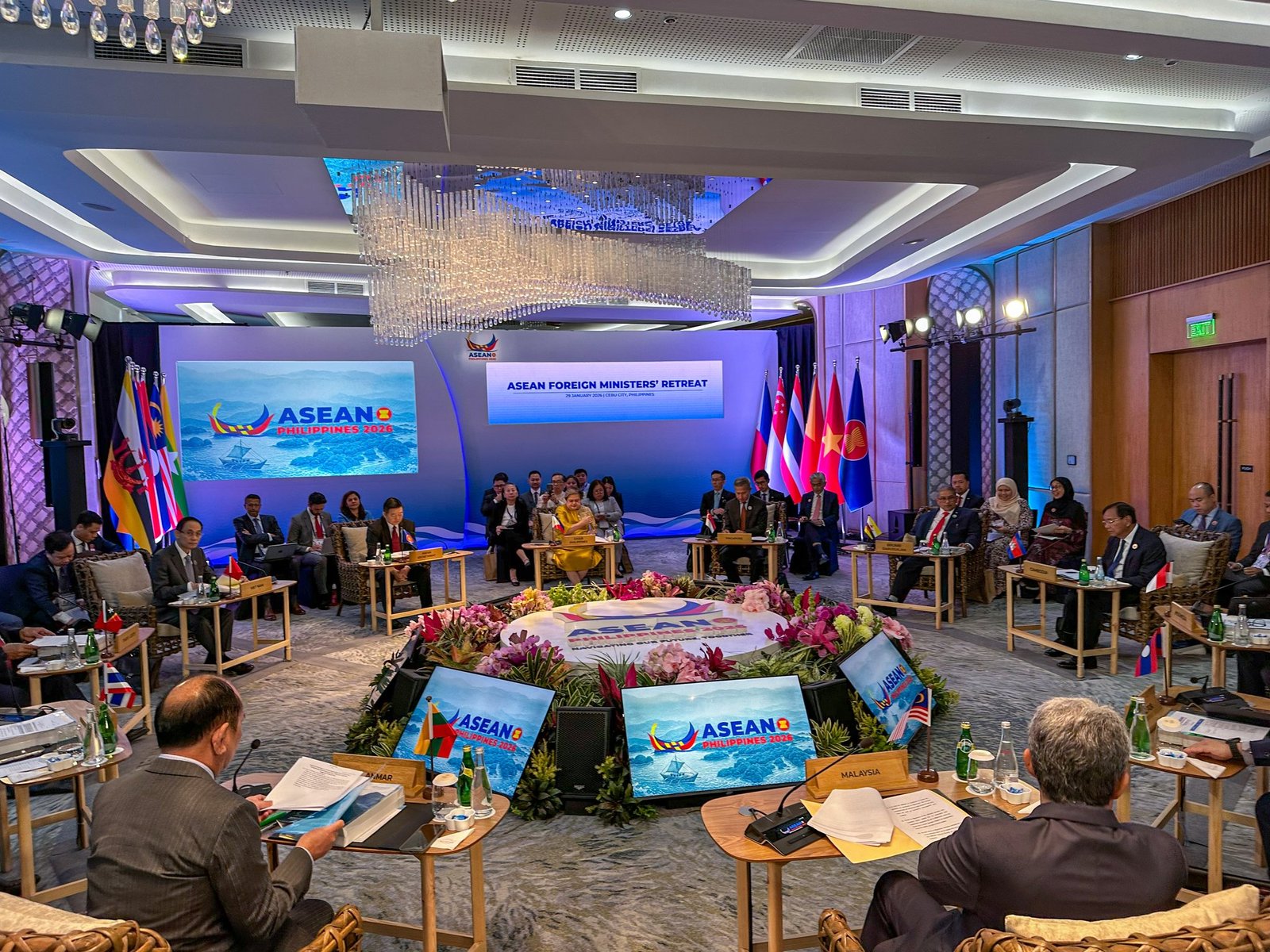
At the ASEAN Foreign Ministers’ Retreat in Cebu on Jan. 29, 2026, Ministers discussed priorities, regional tensions, Myanmar’s elections, the South China Sea Code of Conduct, and Gaza. (Wisma Putra)
The Philippines, as the current chair of the ASEAN will hold an informal consultation dialogue between the bloc and Myanmar’s foreign minister, Tin Maung Swe, on July 12. This marks the first of its kind since the junta seized power back in 2021.
Led by Philippine Foreign Secretary Theresa Lazaro, the meeting will address Myanmar’s domestic volatility, including the civil war, peace efforts and the implementation of the Five-Point Consensus (5-PC) peace plan. The Department of Foreign Affairs (DFA) noted, “Myanmar remains an integral part of the ASEAN family, the Foreign Ministers will listen to a briefing from U Tin Maung Swe on developments in Myanmar,” highlighting that the efforts aim to “exchange views” regarding ASEAN’s move in the country.
The consultation forms part of the 59th ASEAN Foreign Ministers’ Meeting (AMM), which is scheduled to convene from July 18 to 24 and the commemoration of the Treaty of Amity and Cooperation in Southeast Asia (TAC) anniversary.
During the AMM, ASEAN foreign ministers will hold dialogue with like-minded partners like Russia and India, alongside the ASEAN Regional Forum (ARF) comprising 27 member states, to discuss the pressing regional and global issues.
The strategic issues will weigh significantly at the upcoming meeting. To further realise the ASEAN-China Code of Conduct (COC) in the South China Sea, the Philippines will intensify negotiations using the ruling issued on July 12, 2016. Secretary Lazaro emphasised, “we will use this Award as our clear legal and policy baseline to engage partners and to pursue an effective, legally binding Code of Conduct in the South China Sea.”
Objectively, the Philippine ASEAN chair for 2026 will intersect the 2002 Declaration on the Conduct of Parties in the South China Sea (DOC) to be replaced by the COC, which is being pursued to be a legally binding framework. If this development is soon realised, ASEAN will have a collective capacity to counter Beijing’s assertiveness in the region.
About The Author

One thought on “Philippines Balances Myanmar Peace Plan and South China Sea Strategy ”