

A Chinese Coast Guard ship sails near a Philippine Coast Guard vessel during a patrol at Scarborough Shoal, 124 nautical miles west of Zambales, Philippines in 2022. (Philippine Coast Guard)
A Strategic Asset on a Geopolitical Hinge
“The Department of Foreign Affairs has already undertaken appropriate diplomatic action with the government of the People’s Republic of China in connection with the illegal presence of this floating structure,” read a statement by the National Task Force for the West Philippine Sea (NTF-WPS) on June 9, following Manila’s diplomatic lodgement against China over a floating structure discovered inside Scarborough Shoal.
That was just one among 112 cases recorded halfway through 2026, averaging 19 days per month, where the China Coast Guard (CCG) and the Philippine Coast Guard (PCG) were caught “interacting” near Scarborough.
The Scarborough Shoal, also known as Bajo de Masinloc, is one of the most contested atolls situated in the South China Sea, where overlapping territorial claims coexist. Located about 200 kilometers (124 miles) west of the Philippine island of Luzon, it falls squarely within Manila’s Exclusive Economic Zone (EEZ). In 2016, the Permanent Court of Arbitration (PCA) categorically ruled that the Philippines holds sovereign rights over the shoal.
This tribunal’s decision favouring Manila is one of the core verdicts under the renowned 2016 South China Sea Arbitral Award, which has fundamentally reshaped the area’s legal geography. Constituted under the United Nations Convention on the Law of the Sea (UNCLOS), the arbitral tribunal issued a fundamental ruling that clarified maritime entitlements, dismantled sweeping historic rights claims and firmly upheld the sovereign rights of coastal states within the South China Sea.
Although the circumscribed capacity of the tribunal means the Award is insufficient to settle maritime disputes over the South China Sea, it established a clear interpretation of maritime entitlements under UNCLOS, which in turn mandated claimant countries to clarify their respective positions.
Yet, as the 10-year milestone of the historic 2016 ruling is approaching, a stark paradox persists, demarcating law from reality. While legally the framework of the Award remains absolute and immutable, the maritime landscape has been practically altered by a decade of tectonic geopolitical and economic shifts. Between relentless island reclamation, deepening economic interdependence and an increasingly unpredictable hegemon power, a new status quo has been forged on the water, one that can no longer be dismantled by diplomatic protests alone.
Navigating this gap without sliding to open conflict requires prudent management of power asymmetries between an assertive China and claimant nations, which are mainly ASEAN member states (the Philippines, Vietnam, Malaysia and Brunei). That being said, the essential manoeuvre will be for these claimant states to champion the tribunal’s ruling and demand China’s adherence to it.
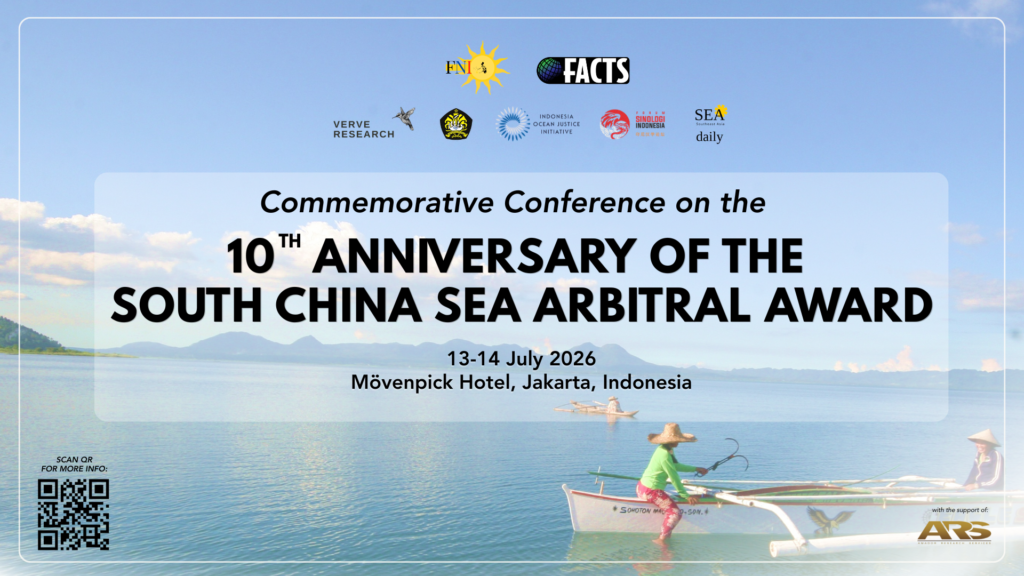
Addressing these complex dynamics—and the challenge of translating this legal bedrock into practical regional policy—is the primary objective of the upcoming “Commemorative Conference on the 10thAnniversary of the South China Sea Arbitral Award” organised by FACTS Asia. Convening from 13-14 July 2026 in ASEAN’s capital of Jakarta in Indonesia, this conference will bring together key voices that will shape the future of Southeast Asia’s maritime architecture.

A member of the Atin Ito Coalition during the symbolic sea action on July 5 to kick off the commemoration of the 10th anniversary of the Philippines’ landmark 2016 Arbitral Ruling. Joined by around 250 fisherfolk, the activity also renewed calls for the government to declare July 12 as National West Philippine Sea Victory Day. (Atin Ito)
Between the Devil and the Deep Blue Sea
International law serves as a vital safeguard and “equaliser” for small and medium-sized nations against a classic Thucydidean scenario where “might makes right”. It establishes standardised rules, grants standing in neutral tribunals and translates unequal power dynamics into objective, adjudicated facts rather than enforced dominance.
It was in this spirit that PCA’s Arbitral Award was issued a decade ago, on July 12, 2016, marking a victory of the frontline, developing nation of the Philippines over the dominant power, China.
Naturally, such a legal framework should function as the baseline from which Manila’s regional partners (specifically fellow ASEAN member states) can support, leverage and thus align their interests.
However, ironically, the ultimate constraint for ASEAN lies in its inability to act collectively on such thorny issues. This institutional paralysis can partly be explained by the ASEAN Way principle, where decision-making operates under a consensus norm. Consequently, each nation holds a “practical veto” right, where if even a single member is unfavourable, a resolution cannot pass.
Furthermore, deep nuances also exist between each of the claimant nations. Given that these claimants are all developing states, their domestic populations primarily demand daily life essentials rather than prioritising “distant”, intangible maritime security matters.
Combined, this means that even a domestic political shift, such as a cabinet change, can turn a nation’s posture—and thus the region’s—in a contrasting manner. Such a case was experienced by the Philippines, where in 2016, just as the PCA granted it the Award, the newly elected former President Rodrigo Duterte “downplayed” the maritime dispute by announcing a “separation” from the US during his first state visit to Beijing, starting a brief period of Philippine approachment with China.
To date, though the Philippines has realigned with its longstanding strategic character, the current state of affairs remains unchanged, and Manila continues to endure the most frequent maritime engagements and disputes among its neighbours.
These regional dynamics will be comprehensively assessed in FACTS Asia’s Commemorative Conference’s first panel titled “ASEAN Views on the Arbitral Award”, before being deepened in the second panel on “Enforcing the Arbitral Award: Law, Technology and Cooperation”. Furthermore, these discussions will be central to the themes explored in the sixth panel, “Geopolitical Considerations and Regional Stability”.
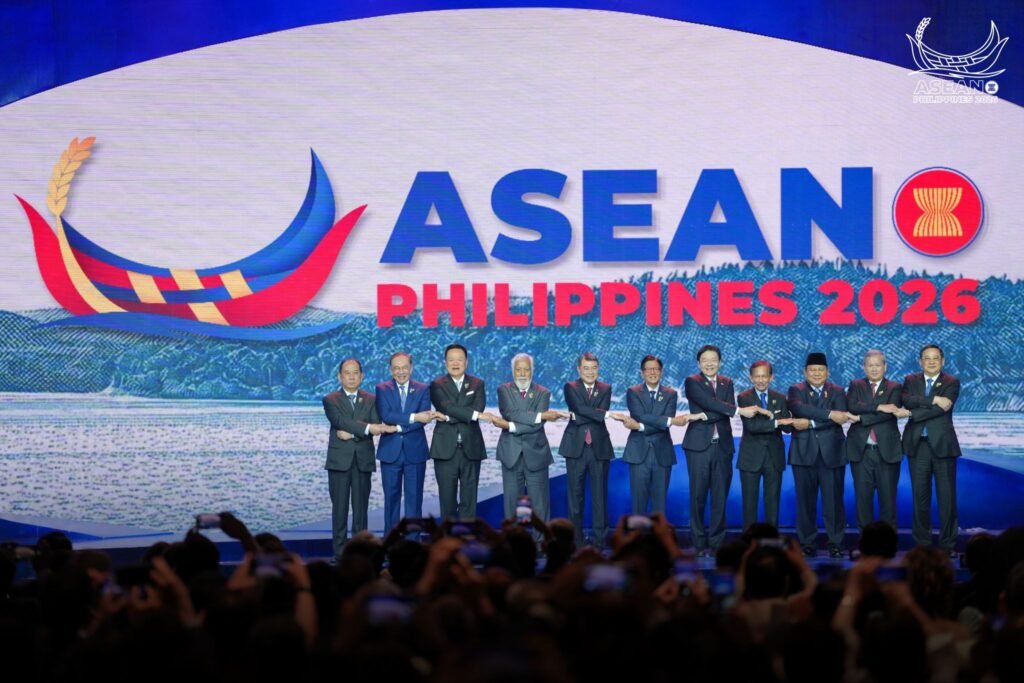
ASEAN member states’ leaders at the opening ceremony of the 48th ASEAN Summit in Cebu, Philippines, May 8, 2026. (ASEAN 2026)
Absolute Law and Subdued Economic Pragmatism
As well as being the primary champion of the 2016 Award, the Philippines has developed strategies to integrate the ruling into its domestic maritime policy. Most recently, Manila signed into law the Philippine Maritime Zones and Archipelagic Sea Lanes Act, which defines and establishes the country’s maritime entitlements, and specifies how foreign ships and aircrafts can pass through. These legislations establish a definitive framework for Manila’s maritime law enforcement to assert its sovereignty and police the country’s waters.
Beyond foundational legislations, the administration of President Ferdinand Marcos. Jr. has also actively sought to publicly expose China’s aggressive manoeuvres and harassment through its “Transparency Initiative” to galvanise public opinion while also diversifying and expanding Manila’s defence partnerships through minilateral and bilateral collaboration, conducting joint patrols in the disputed waters and securing diplomatic support for the adherence of the international rule-based order, on which the UNCLOS is hinged to.
Concurrently, as the 2026 ASEAN Chair, Manila is in a goldilocks position to harness this diplomatic momentum to revitalise the deadlocked, protracted negotiations of the Code of Conduct (CoC) in the South China Sea. Holding the chairmanship grants the Marcos administration substantial agenda-setting authority, fundamentally shaping how ASEAN navigates maritime disputes. While concluding the long-awaited CoC remains a cornerstone objective for Manila, the administration must master a delicate balancing act of harmonising its own national security priorities with the collective economic and diplomatic interests of the wider region. Success depends on Manila’s ability to finalise the treaty as a legally binding, enforceable mechanism rather than another ASEAN non-binding declaration.
Facing a comparable level of threat to the Philippines is Vietnam. Though in economic terms the country is often referred to as China’s “little brother,” Hanoi fiercely opposes Beijing’s unilateral claims. This stance was reflected in Hanoi’s initial welcome of the 2016 Award (which it termed a “North Star”) and its consistent support for the ruling, dating back to its “statement of position” during the tribunal’s proceedings.
Nevertheless, practically, the manoeuvre Vietnam has adopted is cautiously centred on hedging between the two hegemons (the US and China) manifest in its Bamboo Diplomacy. Through this strategy, Hanoi attempts to mitigate geopolitical risks while simultaneously resisting Beijing’s maritime expansion in the South China Sea.
This double-edged sword is most vividly reflected not in the news, but through satellite imagery, where reports show Hanoi ramping up artificial island building in the Spratlys. For context, the Spratlys encompass over 100 small features, including skerries, reefs and atolls spread across 409,000 square kilometres (158,000 square miles), which, under the 2016 Award, were clearly deemed insufficient to be classified as islands, meaning they do not generate territorial seas or entitlements. This means the Spratly features are recognised as shared grounds for international fishing and exploration.
As for the lower-profile claimant nations, namely Malaysia and Brunei, economic pragmatism heavily dictates their geopolitical posturing, leading to more subdued strategies. Kuala Lumpur takes a visibly more cautious approach, prioritising economic ties with China while remaining absolutely unyielding on its commercial activities within its EEZ. The Malaysian government remains committed to safeguarding sovereignty and national interests pushing heavily for the early conclusion of a substantive CoC to prevent military miscalculations without entirely alienating Beijing. Meanwhile, Brunei represents the quietest of the claimant states, consistently choosing economic pragmatism over vocal geopolitical posturing. Relying strictly on UNCLOS and ASEAN consensus, Brunei deliberately refrains from military deployments or occupying its claimed features. Instead, Brunei compartmentalises the dispute, securing lucrative joint ventures with Beijing while quietly upgrading defensive maritime surveillance with US support.
The ASEAN claimant states’ stance on the South China Sea issue and the Arbitral Award—as well as the anticipated CoC—will be closely examined in FACTS Asia Commemorative Conference’s third and fourth panels, titled “The CoC and Its Implications for the Award” and “The Award’s Impact on Resource Sovereignty: Energy, Fisheries and Food Security”. Additionally, panel five, “Provisional Cooperation in the South China Sea,” will explore the potential for minilateral and sub-regional collaboration.
Attendees can also expect insights from the perspective of the host country, Indonesia. Although Jakarta maintains its position as a non-claimant state, it holds a pivotal, strategic role in the wider dispute. As the region’s largest archipelagic state, Jakarta remains a staunch defender of its rights in the North Natuna Sea—the designated name for the northernmost section of Indonesia’s EEZ in the South China Sea, where its boundary overlaps with China’s unilateral ten-dash line claim. Indonesia consistently maintains that its sovereign rights in the area are fully grounded in UNCLOS. This ironclad stance was most vividly demonstrated during the seventh presidential administration, particularly under Susi Pudjiastuti’s tenure as Minister of Maritime Affairs and Fisheries from 2014 to 2019. Her signature policy involved ordering the destruction and sinking of illegal foreign fishing vessels caught stealing fish inside Indonesia’s EEZ, especially around the North Natuna Sea.
As the South China Sea approaches a critical geopolitical crossroads, the upcoming Commemorative Conference on the 10th Anniversary of the South China Sea Arbitral Award will be convened to address this turning point. Bringing together leading diplomats, legal scholars and defense architects, the two-day agenda will dissect the complex, evolving postures of claimant states and bridge the gap between legal bedrock and practical policy. The Conference is not merely a retrospective commemoration, rather an active, urgent high-level forum designed to confront the shifting realities of regional maritime governance. Engaging in this crucial conversation offers a vital opportunity to shape the frameworks that will safeguard the South China Sea for the next decade.
For complete event details and to secure your registration, visit the official conference page.
About The Author





4 thoughts on “The South China Sea Arbitral Award, Ten Years On”