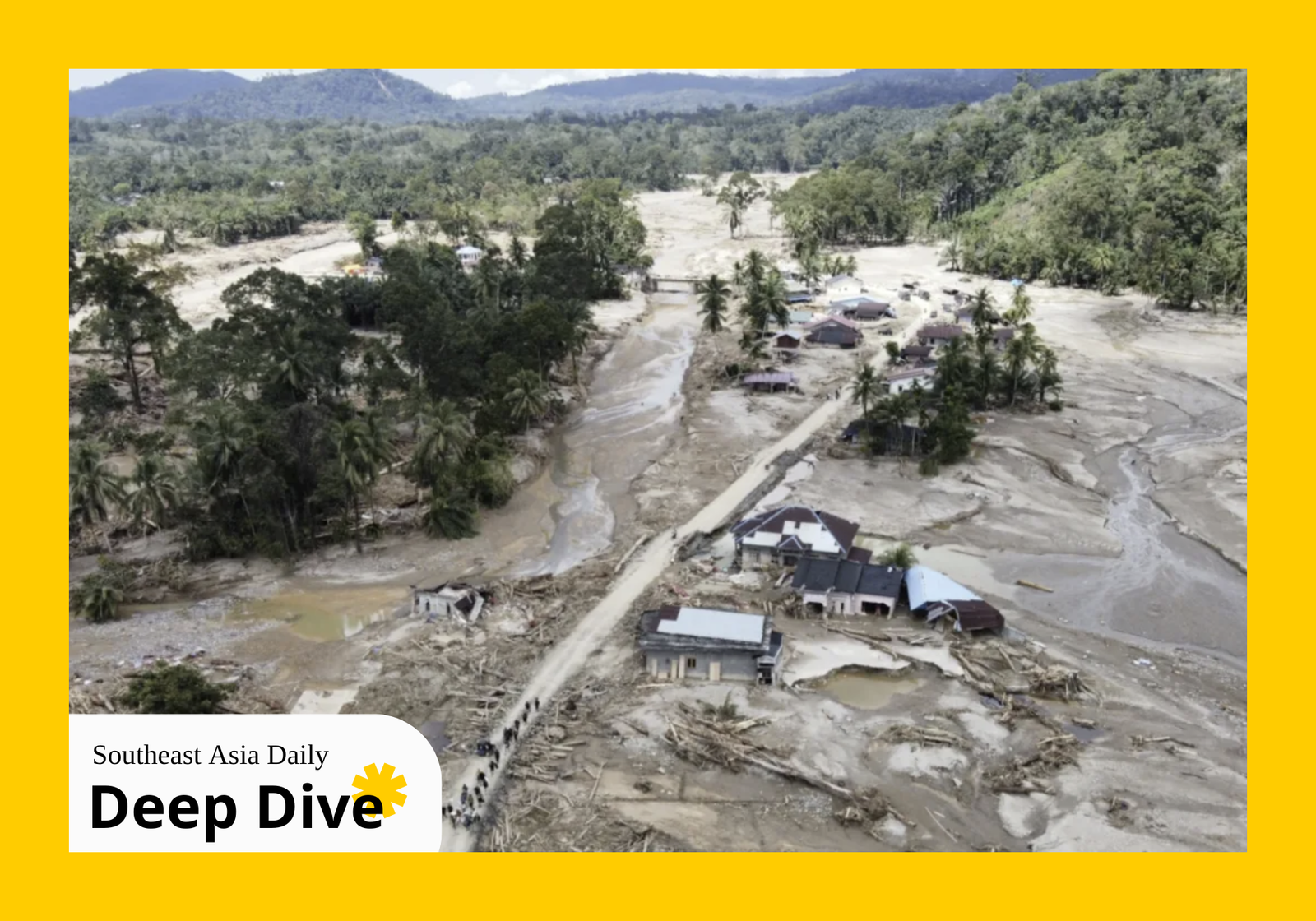
People walk along a road in a village affected by a flash flood in Batang Toru, North Sumatra, Indonesia, December 1, 2025. Courtesy of AP Photo
A Perfect Storm
Between the months of June and October, Southeast Asia goes through an annual monsoon, where warm and moist air flows from the Indian Ocean, bringing heavy and prolonged showers. During this period, the region can receive 200-300 millimetres (mm) of rainfall in a single day. To put that into perspective, the average annual rainfall in London is 600mm.
In 2025, the monsoon season hit Southeast Asia particularly hard. For instance, Bireuen Regency in Indonesia’s Aceh Province, recorded 411mm of rain on November 25 alone. Alongside record-breaking precipitation, the region also faced multiple typhoons and a cyclone. In September, Typhoon Ragasa moved through the northern region of the Philippines, causing at least 10 casualties. Only a month later, Typhoon Matmo made landfall in Vietnam, resulting in a total of 90 deaths. Afterwards, Cyclone Senyar was formed in the Strait of Malacca in late November—an unprecedented phenomenon as cyclones rarely appear in tropical regions. The cyclone wreaked havoc across Indonesia’s Sumatra Island, Peninsular Malaysia and parts of southern Thailand. As of December 12, authorities reported that the death toll has reached at least 921 in Indonesia, 276 in Thailand, and three in Malaysia. It has even impacted countries outside Southeast Asia, with Sri Lanka reporting 618 casualties.
When Nature Becomes a Cover

Vietnamese Prime Minister (PM) Phạm Minh Chính visiting the heavily flooded area of Phú Hữu village, Hoà Thịnh Commune, the central province of Đắk Lắk, November 29, 2025. Courtesy of Viet Nam News
The unprecedented scale of the extreme weather events have been capitalised by governments to avoid accountability. Across the affected countries, national meteorological agencies—which often place the blame on the cyclone and storm-driven torrential rains—dominated the discourse, thus forming a fatalistic narrative around the floods. Such a framing omits an important detail: although the extreme weather events in the region are indeed a key factor in the destruction, inadequate disaster preparedness contributed significantly to the high human and material cost of the floods. By focusing on meteorological factors, this fatalistic narrative allows authorities to refrain from assuming accountability.
Officials often refrain from accepting responsibility to evade economic and political backlash, as seen with Prime Minister Anutin Charnvirakul of Thailand, who faced criticism when acknowledging his administration’s shortcomings in flood management and issuing an apology to those affected. When PM Charnvirakul visited flood-stricken Hat Yai on November 28, people openly complained about the government’s mismanagement of the crisis. In the parliament, the opposition Pheu Thai Party accused him of “chronic mishandling” of national emergencies. To appease public anger and minimize the subsequent political repercussions, he had to roll out a compensation of up to 2 million baht (US$80,800) for each household that lost family members.
The Indonesian, Malaysian, and Vietnamese administrations—who framed the floods and consequent damages as inevitable natural events—have been spared from a resembling blowback. For example, Indonesian President Prabowo Subianto has blamed the cyclone as the main cause of the floods, with only symbolic reference to climate change and “those responsible for deforestation”. Free of any moral responsibility in the devastation, he was welcomed with fanfare during his December 1 visit to flood-ravaged Southeastern Aceh, while the only parliamentary criticism he received was a demand to declare a national emergency. There was likewise no visible backlash during Vietnamese PM Phạm Minh Chính’s visit to the flood hotspot of Dak Lak province. Meanwhile, Malaysian PM Anwar Ibrahim only offered condolences without visiting the affected areas and still faced relatively little repercussions. Without the need to soften any political backlash like PM Charnvirakul, their compensation plans—and hence expenses—were restricted to rebuilding houses and small businesses.
A Catastrophe Waiting to Repeat
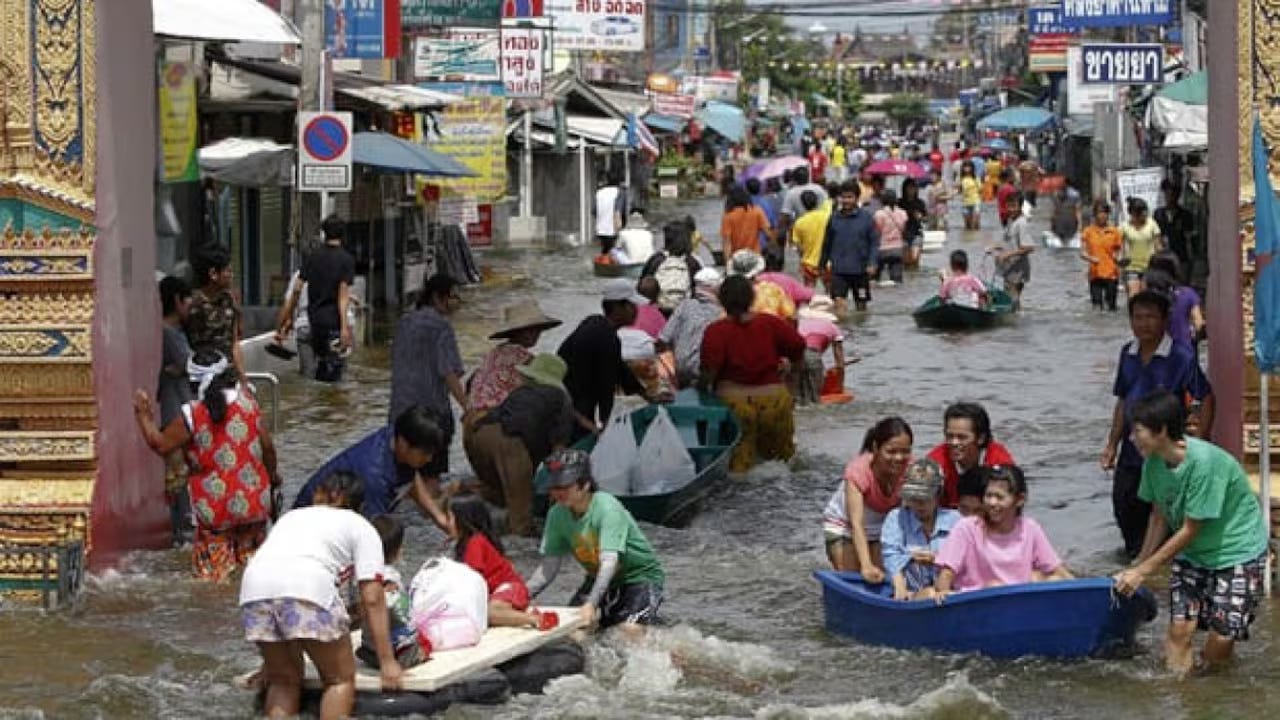
2011 flood in Ayutthaya Province, Thailand, that killed 270, illustrating the recurring nature of the catastrophe. Courtesy of Reuters.
Nevertheless, these short-term gains would lead to catastrophic long-term consequences. While the governments’ fatalistic framing allows them to avoid accountability, it also incentivises inaction as a higher state of emergency—vital in mobilising more emergency resources—could lead to an increased public scrutiny. Consequently, mitigation strategies have been ineffective in the region, despite heavy precipitation being an annual occurrence. Authorities tend to favor stopgap measures instead of sustainable solutions as they require less political and financial investment. For instance, in Indonesia and Vietnam, instead of forbidding habitations in flood-prone areas, officials implemented a “living with water” strategy—an approach not designed to withstand increasingly severe extreme weather events like those occurring in 2025. This trend is likely to continue since both administrations have not announced any permanent relocation plans despite the increasing flood risk—opting instead to repair or rebuild homes in the same high-risk areas.
Furthermore, they did not meaningfully address—or deliberately ignored—an exacerbating factor in the flood crisis, which is environmental destruction. Deforestation continues to rise in each of these countries, mitigation and landslide prevention provided by forest cover. In Indonesia’s Aceh province, for example, deforestation rate has increased by 30% in five years. Although President Subianto has called for forest management reforms in the wake of the floods, past experience suggests these initiatives are likely to be short-lived, meaning the destructive impact of similar disasters will remain.
If similar damage occurs during the next monsoon season, these countries may face heightened scrutiny not only from domestic audiences but also from the international community. Climate change has often become an easy scapegoat for officials when explaining such disasters, and it can even justify requests for more aid from other countries, as seen during COP30 in Brazil. While such grants may provide desperately needed rescue funds, without being directed toward substantial long-term resilience strategies, recurring damages may raise questions from donours as to whether the fund was effectively used—which may jeopardise future assistance.
In sum, Southeast Asian governments’ fatalistic framing of the recent floods in the region may result in short-term political and economic gains. However, past experience shows that this approach incentivises limited responses, as addressing its root causes will require heightened scrutiny. Consequently, responses have largely been limited to cleanup efforts, with little investment in long-term disaster resilience, meaning future floods are likely to cause similar—or even higher—casualties. A change in this fatalistic narrative—despite potential temporary backlash—is necessary to prompt a thorough review and produce meaningful mitigation strategies minimizing the damage caused by future disasters.
About The Author