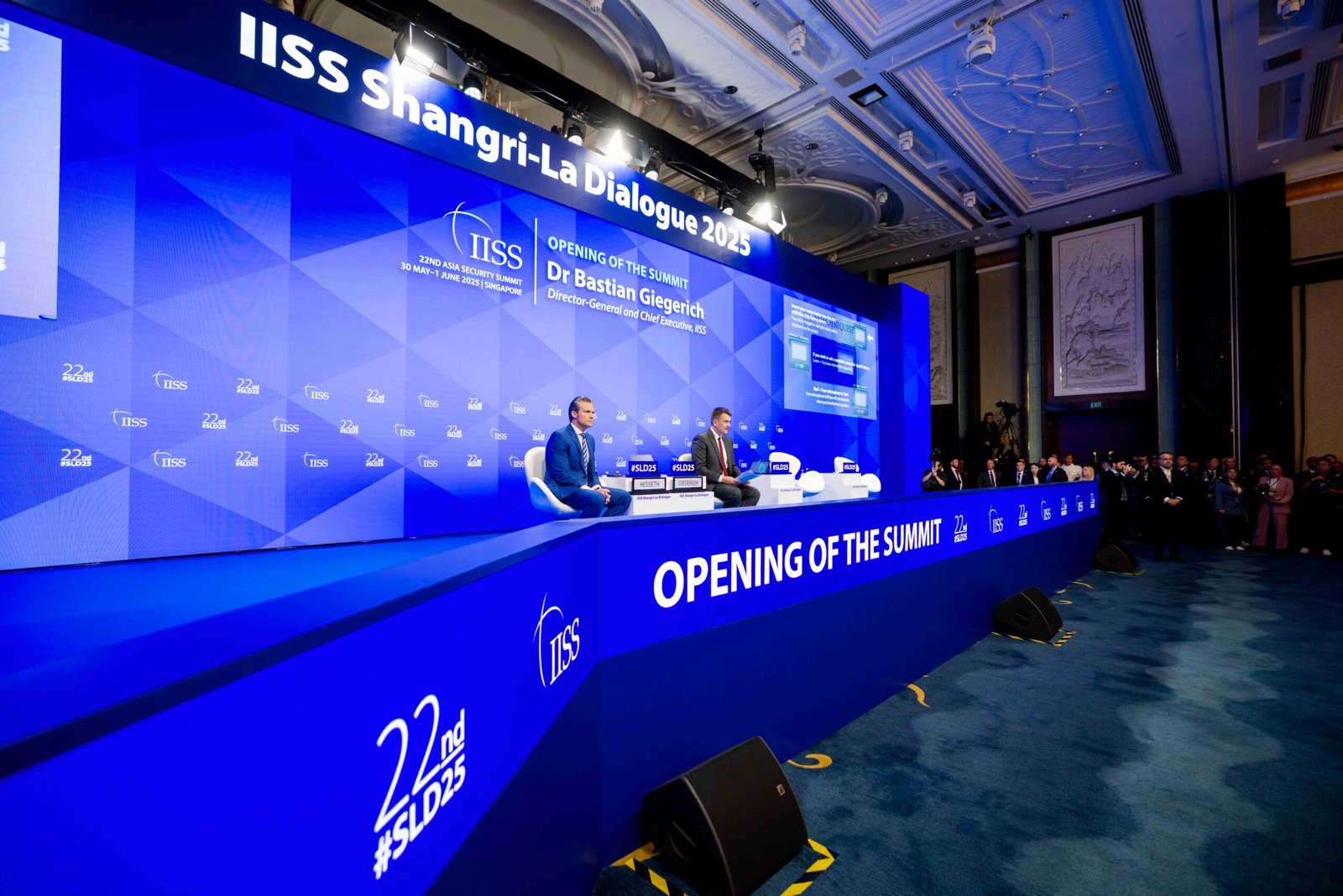
U.S. Defense Secretary Pete Hegseth outlines the evolution of Washington’s Indo‑Pacific strategy amid Sino‑U.S. competition and global conflicts. (International Institute for Strategic Studies)
Singapore is hosting the 2026 Shangri‑La Dialogue 2026 from May 29 to 31, convening high-level representatives from 44 nations around the world to discuss key security issues. Several major themes covered in the dialogue include the international rule-based order, fracturing alliances and contested maritime domains.
Notable attendees included Vietnamese General Secretary and President Tô Lâm, who delivered the keynote address, President José Ramos-Horta of Timor-Leste, US Defence Secretary Pete Hegseth and Australian Defence Minister Richard Marles. Also present were Singapore’s own Defence Minister Chan Chun Sing and Prime Minister Lawrence Wong. Most European and Middle Eastern nations were represented at the ministerial level.
Tô Lâm delivered the keynote, urging unity and strategic autonomy amid a “crisis of the international order, development models and strategic trust took place.” He expressed Vietnam’s readiness to “shape an Asia-Pacific that is safer, more resilient and more prosperous”.
Maritime security dominated the plenary sessions. Australian Defence Minister Richard Marles expressed growing concerns over the maritime security environment, specifically related to subsea communication cables.
On the same day, PM Lawrence Wong met the US Defence Secretary Pete Hegseth, reaffirming Singapore’s support for the US presence in the region, as both countries celebrated their 60th anniversary of Singapore–US diplomatic relations. Both sides pledged continued cooperation, including training for the Singapore Armed Forces in the US.
Secretary Hegseth emphasised Singapore’s role in “consistently punching above its weight by investing heavily in its military and serving as a vital hub for US logistics activities and rotational deployments, strengthening our shared regional posture”. Beyond the US, Singapore also advanced defence relations with various Southeast Asian allies, such as Malaysia, Thailand and Indonesia. Singapore also held talks with officials from defence institutions in France, Italy and Qatar.
A notable milestone was the agreement among 17 nations (Singapore, Brunei, Malaysia, the Philippines, Thailand, Australia, New Zealand, Qatar, Estonia, Finland, France, Italy, Latvia, Lithuania, the Netherlands, Sweden and the United Kingdom) to establish the Guiding Principles for Underwater Infrastructure Defence Exchanges (GUIDE). This framework aims to protect critical underwater infrastructure (CUI), such as subsea internet cables and energy pipelines, to ensure communication channels and energy flows remain secure.
Taken together, the 23rd Shangri-La Dialogue reflected the importance of addressing geopolitical challenges and shaping the architecture of regional security. By linking Western powers with Southeast Asian nations and Middle Eastern countries, this initiative signalled a redefinition of the international security architecture, positioning great and middle powers at the centre of the efforts to sustain it.
About The Author