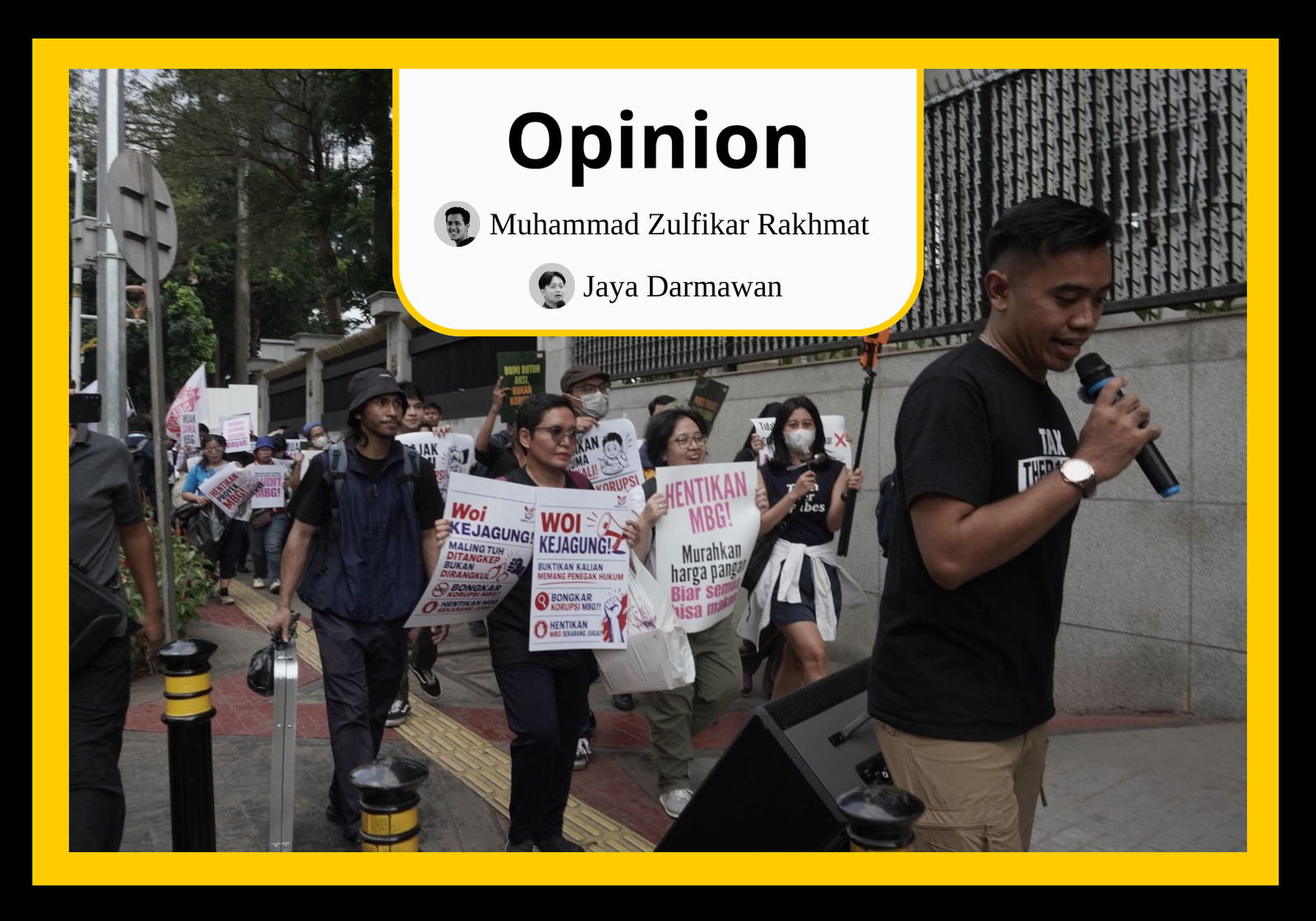
MBG Watch’s protest outside Indonesia’s Office of the Attorney General marked the peak of civil society’s campaign calling for the suspension of the Free Nutritious Meals (MBG) programme. (MBG Watch)
Muhammad Zulfikar Rakhmat is the Director of China-Indonesia and Indonesia-MENA Desks at the Centre of Economic and Law Studies (CELIOS).
Jaya Darmawan is an Economic Researcher at the Centre of Economic and Law Studies (CELIOS).
The views expressed are the authors’ own and do not represent SEA Daily or that of another organisation.
China’s AI Offer Meets Indonesia’s Largest Social Programme
Chinese Ambassador Wang Lutong’s latest offer to help Indonesia’s Free Nutritious Meals (MBG or Makan Bergizi Gratis in Indonesian) programme with artificial intelligence (AI) may appear to be a welcome example of technological cooperation.
Launched in January 2025, MBG is the centrepiece of Indonesian President Prabowo Subianto’s domestic agenda. It is a free daily meal scheme for schoolchildren, pregnant and breastfeeding women, as well as toddlers, aimed at cutting Indonesia’s high rates of childhood stunting and malnutrition. With a 2026 budget of roughly 335 trillion Indonesian rupiah (20 billion US dollar) and a target of 82.9 million beneficiaries, it is one of the largest programmes of its kind in the world.
Speaking after the China-Indonesia Media and Think Tank Forum 2026, Wang revealed that Chinese technology giant Tencent is developing an AI-based system capable of automatically detecting daily student attendance, allowing local nutrition service units (SPPG) to calculate precisely how many meals should be prepared and delivered to each school.
Wang described the initiative as part of China’s commitment to supporting President Prabowo’s priority project and expressed hope that both countries could “learn from one another.”
His remarks came only weeks after National Economic Council Chairman Luhut Binsar Pandjaitan similarly argued that AI-powered government technology should improve MBG management while eventually integrating with Indonesia’s broader social assistance database.
At first glance, the proposal sounds reasonable. AI can reduce waste, improve logistics and enhance administrative efficiency.
Yet China should reconsider its intention, but not because Indonesia should reject Chinese technology. Quite the opposite. Indonesia has every reason to deepen technological cooperation with China in sectors ranging from renewable energy and industrial digitalisation to advanced manufacturing, electric vehicles and scientific research.
The problem lies with MBG itself.
When Technology Enters Politics
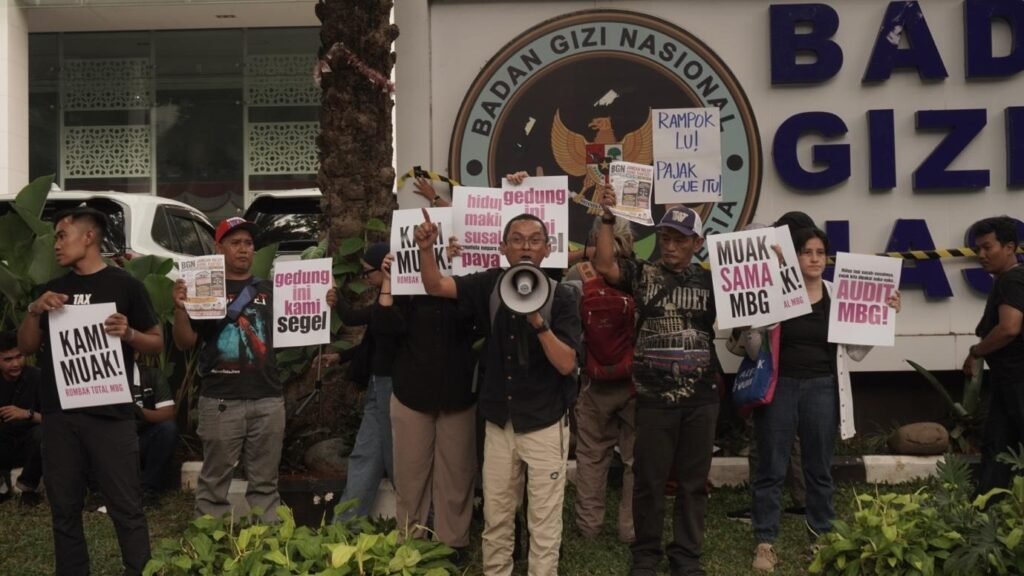
MBG Watch’s first protest outside the National Nutrition Agency (BGN), calling for the suspension and comprehensive evaluation of the Free Nutritious Meals (MBG) programme. (MBG Watch)
AI cannot repair a program whose governance problems are political rather than technical. By embedding its technology into MBG, China risks legitimising an increasingly controversial programme while unnecessarily damaging its own standing among Indonesians.
MBG was originally introduced as an ambitious effort to improve child nutrition. Over time, however, it has become inseparable from domestic politics. The programme was the flagship promise of President Prabowo’s election campaign and remains central to his political legitimacy. Increasingly, implementation has involved military officers, police institutions and political networks, transforming what should have been a professional public health initiative into a politically charged state project.
That distinction matters.
Foreign companies participating in politically sensitive programmes inevitably become associated with their successes and failures. Tencent would no longer simply be supplying software. It would become part of the political ecosystem surrounding MBG.
Unfortunately, that ecosystem remains deeply problematic.
For roughly the first ten months of implementation, MBG operated without an adequate legal foundation. Even after the issuance of a presidential regulation, many crucial aspects of governance, accountability, operational standards and food safety remained insufficiently regulated. A programme involving hundreds of trillions of rupiah should never rely on incomplete institutional safeguards.
China would therefore not merely be helping children receive meals more efficiently. It would be strengthening an institution whose governance remains under serious public scrutiny.
That institution is the National Nutrition Agency (BGN or Badan Gizi Nasional in Indonesian), whose 2026 budget still stands at 228.38 trillion Indonesian rupiah (12.7 billion US dollar) despite two rounds of spending cuts.
Such enormous financial resources require extraordinary institutional independence.
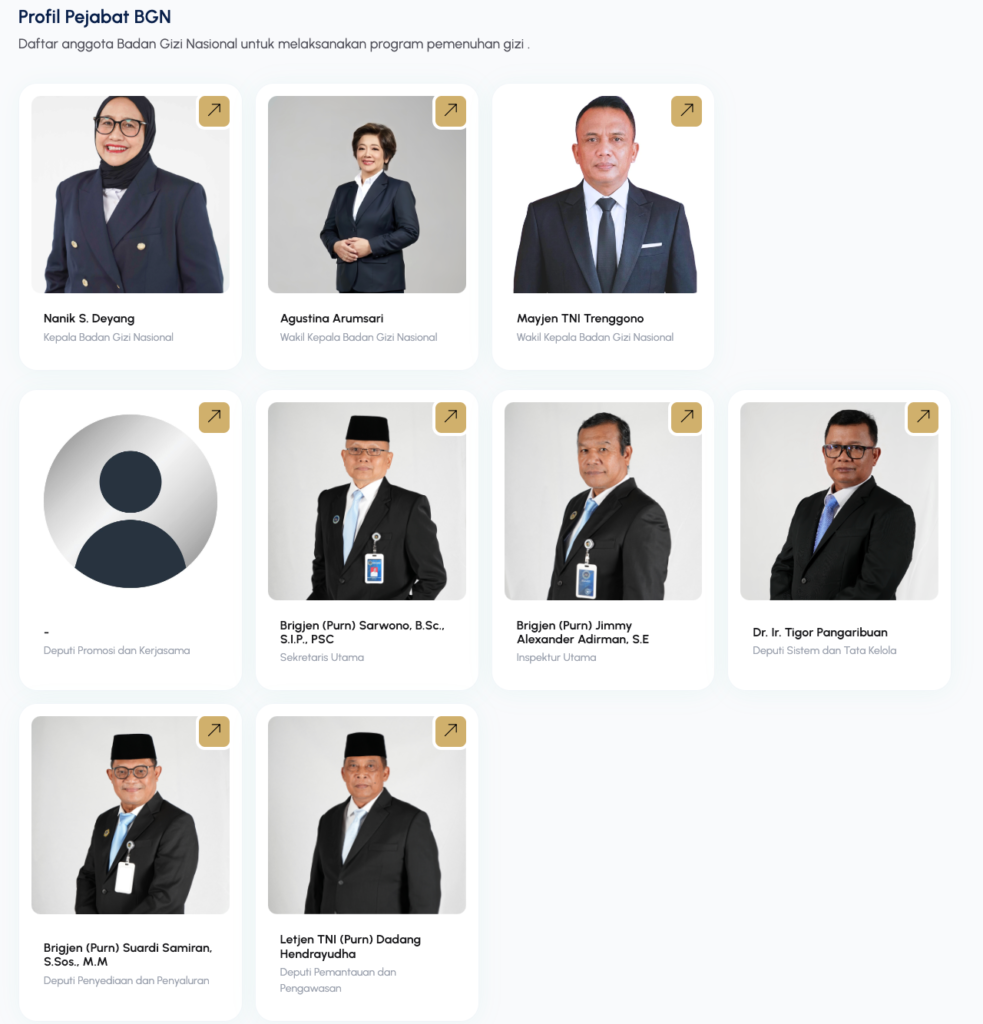
The National Nutrition Agency’s (BGN) leadership includes several government officials, politicians, military officers, and police personnel, raising concerns over overlapping positions and governance. (BGN)
Instead, concerns over conflicts of interest continue to surround the agency’s leadership. Nanik Sudaryati Deyang simultaneously serves as Independent Commissioner of the main state-owned energy company, Pertamina. Agustina Arumsari is both Deputy Head of the Financial and Development Supervisory Agency (BPKP or Badan Pengawasan Keuangan dan Pembangunan in Indonesian) and Vice President Commissioner of Patra Niaga, Pertamina’s commercial subholding. Major General Trenggono also serves as Vice President Director of the state owned agrobusiness company Agrinas Pangan Nusantara.
AI cannot eliminate conflicts of interest.
AI Cannot Fix A Flawed Policy
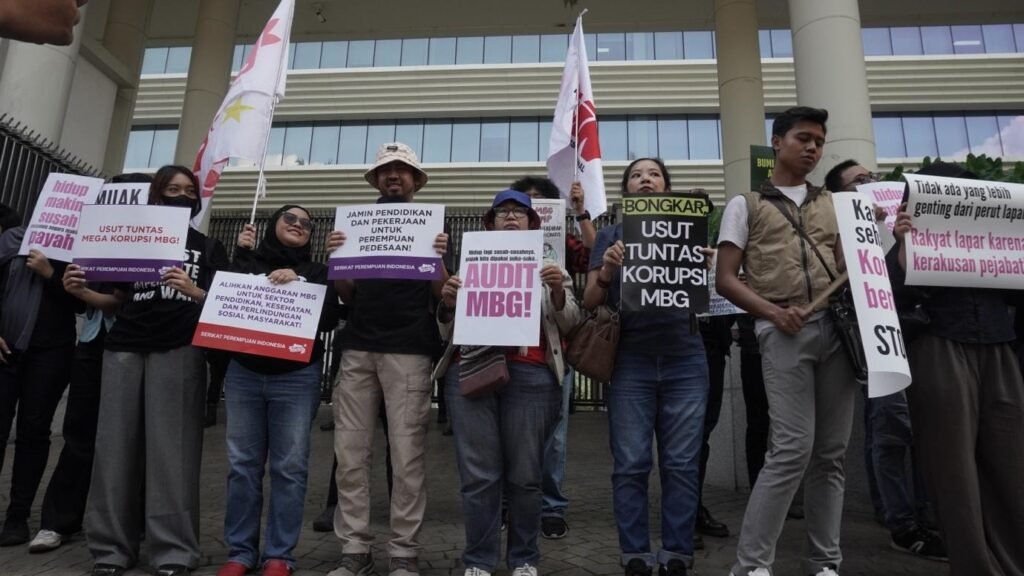
MBG Watch’s second demonstration at the Office of the Attorney General of the Republic of Indonesia, demanding a full investigation into MBG corruption and the dissolution of the National Nutrition Agency (BGN). (MBG Watch)
Nor can it fix questionable policy design.
MBG adopts a universal approach in which virtually every student receives meals regardless of economic need. At the same time, implementation is highly centralised, requiring meals to be supplied through BGN kitchens rather than empowering schools, local governments or neighborhood businesses. The result is significant inclusion error, estimated by critics at around 34.2%, while limiting opportunities for small and medium-sized enterprises located around schools. This figure suggests that, under a universal approach, the Free Nutritious Meals (MBG) program still faces a high risk of mistargeting, leading to inefficient use of public funds and reducing the program’s overall effectiveness and benefits for those who need it most.
Instead of strengthening local economies, centralised procurement concentrates purchasing power in national supply chains.
AI may determine how many meals should be delivered. It cannot determine whether the policy itself is economically sound. The nutritional objectives also deserve closer examination.
Despite being promoted as a nutrition programme, critics argue that MBG relies excessively on industrial food procurement while insufficiently utilising locally produced ingredients. Ultra-processed food and packaged products continue to feature prominently, while opportunities to strengthen local agriculture remain underutilised. The result is growing concern that procurement benefits large corporate suppliers of products such as milk and eggs more than local farmers.
Again, this is not a technological problem.
It is a governance problem.
The programme has also coincided with rising food prices in several regions as centralized procurement places additional pressure on supply chains.
More troubling still are repeated food poisoning incidents.
Reports of widespread food poisoning linked to MBG have continued to accumulate, with tens of thousands of children reportedly affected since implementation began. Independent researchers and legal scholars argue that these recurring incidents expose systemic weaknesses in food safety oversight and accountability rather than isolated operational failures.
No attendance-tracking algorithm can restore public trust after children become sick.
Only transparent investigations, stronger safety standards and genuine accountability can.
China should also consider its own long-term interests.
Although MBG continues to enjoy substantial public support, research suggests that support has become increasingly shallow and more sensitive to implementation failures, while debates over targeting, fairness and governance have intensified.
If Chinese technology becomes closely identified with MBG, public dissatisfaction with the programme may gradually spill over into perceptions of China itself.
That would be an unnecessary strategic mistake.
China has far more constructive ways to contribute to Indonesia’s development. Beijing possesses world-leading expertise in renewable energy, smart electricity grids, battery storage, industrial automation, electric transportation and green manufacturing. Indonesia urgently needs these capabilities to modernise its power system, accelerate decarbonisation and strengthen industrial competitiveness.
Those are sectors where Chinese technology would generate broad national benefits while avoiding unnecessary domestic political controversy.
Technology should reinforce sound governance, not compensate for its absence.
Until MBG demonstrates stronger legal foundations, transparent governance, meaningful accountability, improved food safety and a policy design that genuinely prioritises nutrition over politics, China should resist becoming part of the programme.
Indonesia certainly needs Chinese technology.
It simply needs it in places where good governance already exists—or where technology can create lasting public value rather than helping sustain an increasingly contested political project.
About The Author