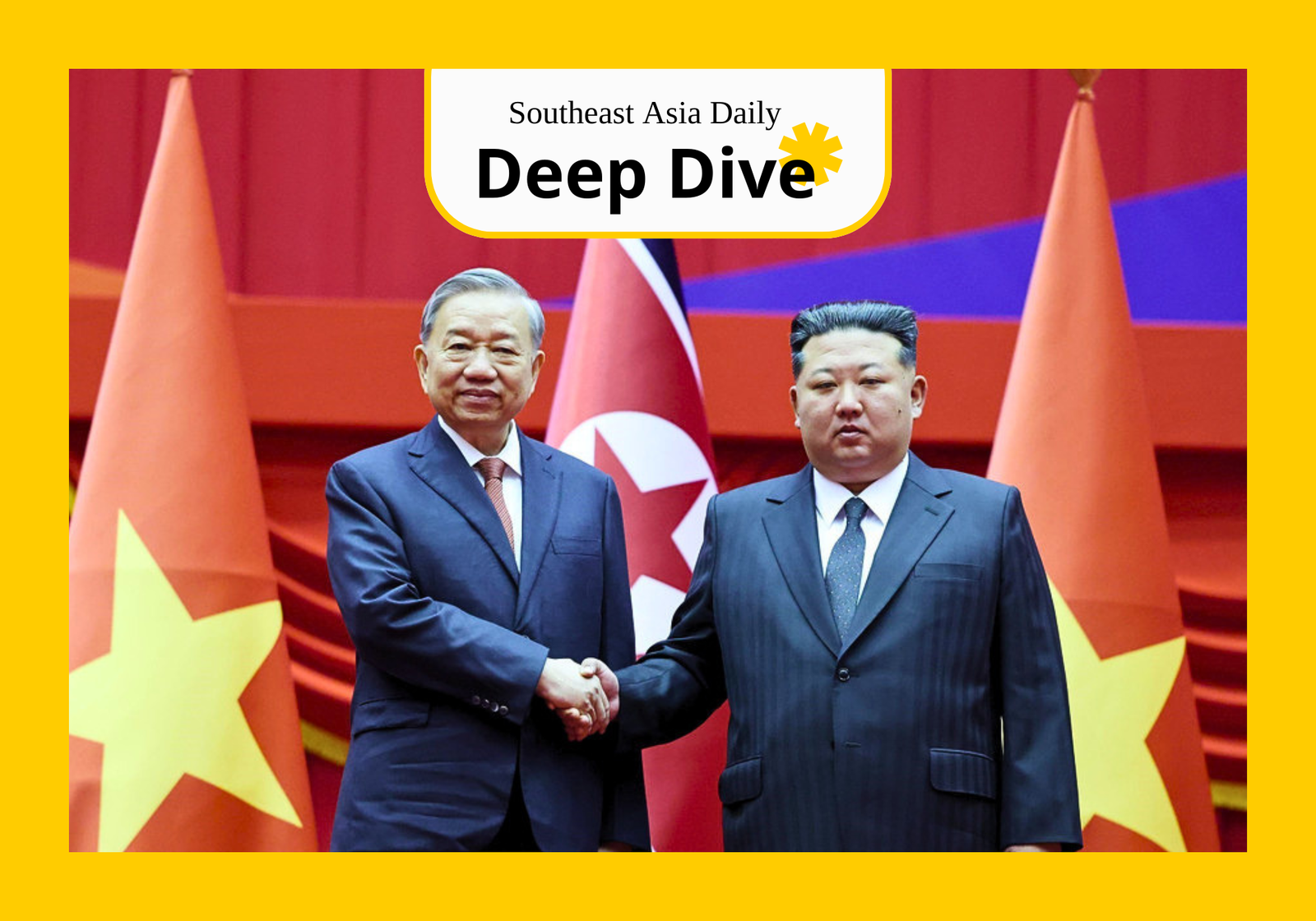
Communist Party of Vietnam Secretary-General Tô Lâm meets with DPRK Leader Kim Jong-un in Pyongyang, North Korea, on October 9, 2025. (VNA)
This article is the first issue of a three-part series on North Korea-Southeast Asia ties.
Part 2—Charm Offensive, Shadow Network—examines the sanction evasion infrastructure: how it works, which states it runs through, and why the diplomatic opening and the evasion network are not two separate stories, but one.
Part 3—The Normalisation Dilemma—analyses the diplomatic convergence on Pyongyang: how Indonesia and Singapore’s divergent engagement logics, and ASEAN’s structural inability to reconcile collective denuclearisation commitments with individual normalisation, are not separate from the evasion network detailed, but its legitimising complement.
On May 5, 2026, Vietnamese President Tô Lâm appointed Doãn Khánh Tâm as Hanoi’s new ambassador to the Democratic People’s Republic of Korea (DPRK) or North Korea. It is the latest signal in a carefully managed sequence: Pyongyang’s deliberate, phased re-engagement with Southeast Asia since the end of its COVID border closure in 2023. Taken individually, each gesture looks unremarkable. Taken together, they sketch the outline of a strategic shift that demands closer attention.
The timeline is striking. In July 2024, North Korea appointed new ambassadors to both Vietnam and Singapore—its first diplomatic appointments to Southeast Asian states since before the pandemic. In March 2025, Laos sent a deputy-ministerial delegation to Pyongyang to mark the 60th anniversary of bilateral ties. In July 2025, Indonesia quietly reopened its embassy in Pyongyang after years of dormancy. That October, Indonesian Foreign Minister Sugiono became the first senior Indonesian official to visit North Korea in twelve years, signing a memorandum of understanding (MoU)—news that immediately triggered concern in Seoul over its implications for the South Korea-Indonesia KF-21 joint fighter jet programme. The same month, Vietnamese Communist Party General Secretary Tô Lâm and Lao President Thongloun Sisoulith both travelled to Pyongyang for the Workers’ Party of Korea’s 80th anniversary celebrations—Tô Lâm’s visit was the first by a top Vietnamese leader in eighteen years. Then, in February 2026, North Korea’s 9th Party Congress constitutionally entrenched nuclear status as a permanent feature of the state. The May 2026 ambassador appointment from Hanoi was not a beginning. It was a continuation.
The state-by-state picture varies considerably. Vietnam maintains the deepest engagement of any ASEAN state—the only country to have sent multiple official delegations to Pyongyang post-reopening, with military cooperation now explicitly on the bilateral agenda. Laos sustains its quiet party-to-party channel, using anniversary milestones as diplomatic anchors. Indonesia has moved from dormancy to active engagement, reopening its embassy and signing cooperation agreements, while navigating a complex tension between its Seoul and Pyongyang relationships simultaneously. Singapore, marking fifty years of diplomatic ties, received a vice-ministerial-rank North Korean ambassador—an unusually senior appointment for a city-state of six million, and a signal that Pyongyang values the relationship strategically. Thailand, also at its fifty-year mark, remains subdued in practice but is positioned as the 2028 ASEAN chair. Cambodia’s historically deep ties—rooted in the personal friendship between Sihanouk and Kim Il-sung—have cooled considerably under Hun Manet, with China now the dominant external relationship. Malaysia has had no formal diplomatic relations since severing ties in the aftermath of the 2017 Kim Jong-nam assassination. The Philippines, under Marcos’s US-anchored security posture, has no practical engagement with Pyongyang.
The Strategic Logic of Re-Engagement
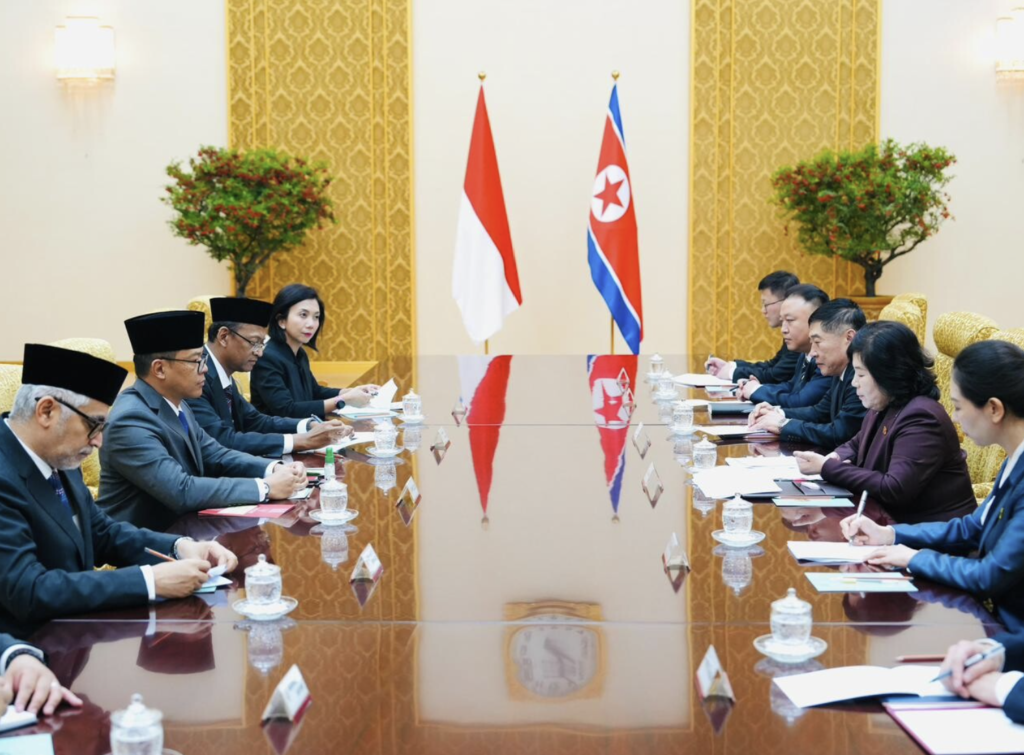
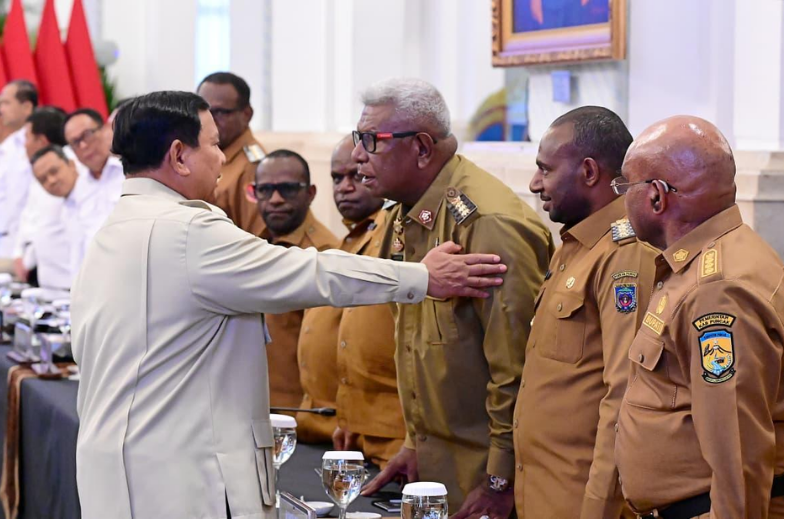
Indonesian Foreign Minister Sugiono and his delegation met with DPRK Foreign Minister Choe Son-hui and her delegation in Pyongyang, North Korea on October 11, 2025. (Indonesian Foreign Ministry)
Selective Diversification, Not Desperation
The conventional framing—that North Korea reaches toward Southeast Asia to escape isolation—no longer holds. Anchored by Russia and China, with trade dependence on Beijing estimated at approximately 96.7%, Pyongyang is not approaching Southeast Asia out of necessity. It is approaching from a position of calculated confidence. Pyongyang’s external activities “operated as a portfolio of differing speeds and objectives tailored to specific counterparts and sectors”. Southeast Asia is one portfolio among many, not a lifeline.
The February 2026 Party Congress matters here. By constitutionally entrenching nuclear status, North Korean Leader Kim Jong-un removed denuclearisation from any future negotiating table and simultaneously repositioned North Korea as a state that can engage the world from strength.Pyongyang’s Southeast Asian engagement reflects an effort to “prioritise enhancing political legitimacy, exploring potential areas of cooperation, and hedging for future diplomacy.” That last phrase is the key: engagement with Southeast Asia is part of a wider image-building project designed to normalise North Korea’s status as a permanent nuclear-armed state, not a pariah in transition. North Korea is “pruning” its diplomatic network toward states where sanctions enforcement is weakest and diplomatic infrastructure already exists. This is a calculus that guides which relationships get invested in and which do not.
Three Distinct Logics of Engagement
Then, why does Southeast Asia respond? The answer differs significantly across the region, and three distinct logics are emerging.
The first is ideological continuity. For Vietnam and Laos, engagement with North Korea is not a policy choice that requires external justification—it is a structural feature of how these party-states organise their international relations. The Communist Party of Vietnam (CPV) maintains formal relations with over a hundred communist and workers’ parties worldwide, and explicitly includes the Workers’ Party of Korea among its priority relationships, described as built on “solidarity, friendship, mutual support in the struggle for socialism in the spirit of Marxism-Leninism.” The roots run deep: the Wilson Center’s archival research documents how Kim Il Sung’s regime mobilised domestic North Korean society around solidarity with Vietnam during the Vietnam War, creating bonds that have outlasted every subsequent pressure cycle. These relationships predate the sanctions regime and have never been seriously disrupted by it. For Hanoi and Vientiane, the question is not whether to engage Pyongyang but at what pace and in what form.
The second logic is strategic autonomy. Indonesia’s bebas aktif—free and active—foreign policy doctrine, born at the 1953 Bandung Conference and codified through the Non-Aligned Movement, is not merely a diplomatic posture. It is a deep “philosophical belief” embedded in how successive Indonesian presidents have understood the country’s global role. For President Prabowo Subianto, this translates into full-spectrum engagement—from Washington to Moscow to Pyongyang—as the operational expression of non-alignment in a polarised world. Crucially, this principle is underwritten by economic pragmatism. Jakarta’ Pyongyang opening sits within the same strategic logic that drove Indonesia to join BRICS+ for favourable economic positioning and led Prabowo to prioritise the St. Petersburg Economic Forum over the G7 summit in June 2025, securing energy and investment deals with Russia. These moves reflect both foreign policy principles and Prabowo’s ambition to position Indonesia as a leader of the Global South. Hedging, for Jakarta, is not just ideological. It pays. The KF-21 tension with Seoul is a cost Jakarta has calculated it can absorb precisely because the diplomatic returns of full-spectrum engagement are judged to outweigh it.
The third logic is pragmatic positioning. Singapore and Thailand are not ideologically aligned with North Korea, nor do they claim the non-aligned tradition as a domestic political identity in the way Indonesia does. What they possess is something Pyongyang values differently: venue value. Singapore’s 2019 hosting of the first Trump-Kim summit demonstrated its utility as a neutral meeting ground. North Korea’s decision to dispatch a vice-ministerial-rank ambassador to Singapore—an unusually senior appointment—signals that Pyongyang continues to see this value and is investing in the relationship accordingly. Thailand’s positioning is more tentative, but the structural logic is similar: as the 2028 ASEAN chair, Bangkok will have both the institutional authority and the diplomatic incentive to position itself as a regional interlocutor. Both states’ traditions of quiet diplomacy make them natural candidates for whatever dialogue architecture emerges from a potential Trump-Kim 2.0 scenario, which 38 North and Brookings both assess as a live possibility in 2026.
The Gap Pyongyang Exploits
Underlying all three engagement logics is a structural feature of ASEAN that Pyongyang has consistently turned to its advantage. The ASEAN–ROK Comprehensive Strategic Partnership, signed in October 2024, formally commits the bloc to supporting “peace and denuclearisation on the Korean Peninsula.” Yet every individual act of bilateral engagement with Pyongyang implicitly cuts against the weight of that commitment. The non-interference principle, which is “embedded in ASEAN’s institutions” since its founding in 1967, protects each member state’s right to manage its own North Korea relationship without collective accountability. The result is an institution that speaks with one voice on denuclearisation and acts with ten on engagement.
North Korea exploits this gap in a specific way. When Pyongyang’s state media KCNA reports on Vietnam’s Tô Lâm’s visit, or Indonesia’s Sugiono’s MoU signing, or Singapore’s anniversary exchanges, it is not simply documenting bilateral relations—it is curating an image of a state that ASEAN partners engage with normally, as a legitimate diplomatic actor. The gap between ASEAN’s collective statement and its members’ individual behaviour is the raw material from which Pyongyang constructs its normalisation narrative. The larger that gap grows, the more credible that narrative becomes.
Quiet Channels, Loud Implications
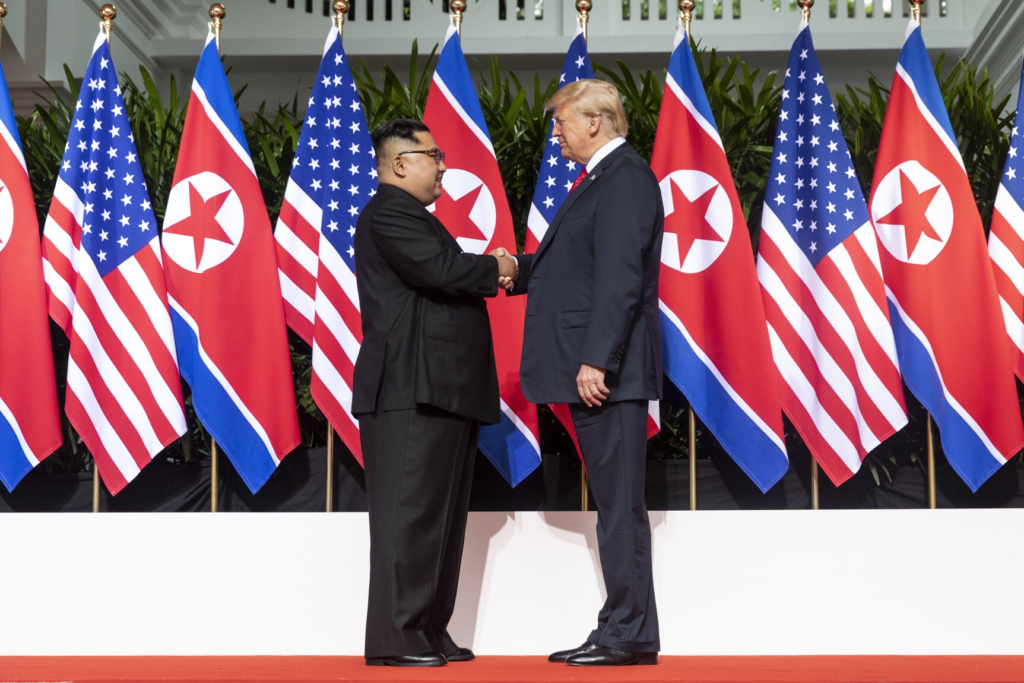
US President Donald Trump and DPRK Leader Kim Jong-un during the DPRK-USA Singapore Summit in 2018. (The White House)
North Korea’s Southeast Asian diplomatic re-engagement will likely continue to deepen through 2026 and into 2027, driven by the constitutional entrenchment of nuclear status and the strategic value of maintaining multiple open channels as a potential US-DPRK diplomatic window approaches. This window has been characterised as a “flickering ember”—conditional on whether US President Donald Trump and North Korea’s Kim can bridge the chasm between personal interest and political reality.
Singapore’s role in that scenario warrants close attention. The combination of a vice-ministerial-rank DPRK ambassador, a fifty-year diplomatic relationship, 2019 summit precedent and the 2027 ASEAN chairmanship makes Singapore the most credible potential venue for resumed US-DPRK contact. Thailand’s 2028 chairmanship creates a second node. For South Korea’s Lee Jae-myung government, which has championed the END (Exchange, Normalisation, Denuclearisation) initiative as a framework for revitalising inter-Korean dialogue, the ASEAN channel offers strategic potential—but also a structural complication. The same states Lee’s government might cultivate as indirect dialogue conduits are the same states where North Korea’s parallel infrastructure operates most freely.
The diplomatic picture documented here looks, on its surface, like a normal reopening—cautious, phased, mutually convenient. What it does not show is what travels alongside the ambassadors and the delegations and the MOU signings. In at least three of the states where North Korea has deepened its diplomatic presence since 2024, the same ideological channels that provide the framework for official engagement have simultaneously provided institutional cover for a sophisticated, evolving infrastructure for sanctions evasion and the collapse of the UN monitoring system has made it much more difficult to ascertain its scale and influence.
About The Author