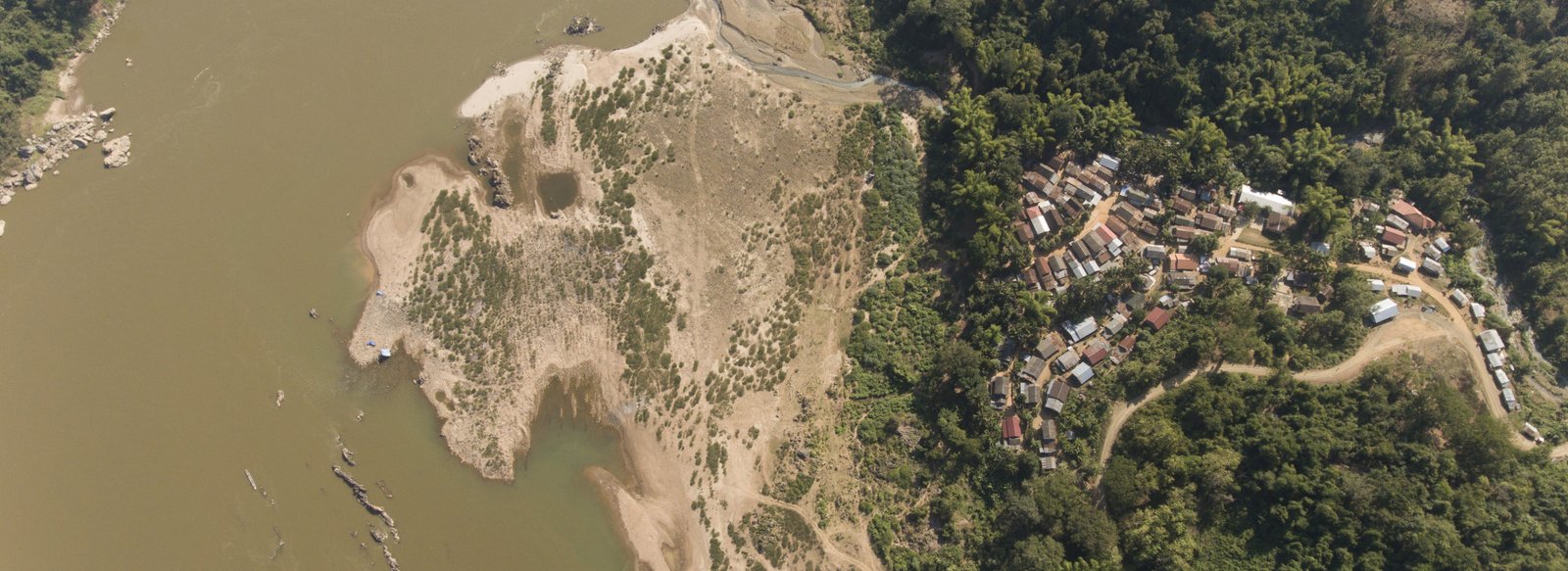
The proposed site of the Luang Prabang hydropower project on the Mekong mainstream, approximately 25 km from the UNESCO World Heritage-listed town, photographed in 2019 before construction began (Mekong River Commission)
The Thai-Lao joint Luang Prabang Mekong Hydropower Project is reportedly 72% complete, as broadcast by municipal television on July 18 after both sides’ representatives inspected the site to assess construction progress.
The delegation was led by Thai Minister of Energy Akanat Promphan and Lao Industry and Commerce Minister Malaithong Kommasith, accompanied by the Head of the Luang Prabang Provincial Department of Industry and Commerce Soulixay Hongsakhone. The site evaluation focused on the construction timeline and how the project will help both nations achieve their clean-energy goals.
Developed primarily by private Thai developers in partnership with the Lao government, the project is valued at 5 billion US dollar. It envisions a massive 1,460-megawatt run-of-river dam by harnessing the hydropower of the Mekong river. Once completed, the dam will strengthen electricity supplies for both nations.
Reportedly, the project is proceeding on schedule, with electricity generation projected to start in 2030. Incorporating lessons from Laos’ previous Xayaburi dam, project managers are said to have tailored designs to local environmental conditions, navigation requirements and fish conservation to ensure the protection of the nearby UNESCO World Heritage town.
The reservoir’s water levels will be capped at 310 metres above sea level, matching historical rainy season peaks, to ensure it does not overflow and submerge adjacent land.
Additionally, engineers have designed the structure to meet international earthquake safety standards, ensuring it can withstand significant seismic vibrations.
What does this mean for business?
As one of the largest infrastructure developments spearheaded by Laos (often dubbed the ‘battery of Southeast Asia’) alongside Thailand, this mega-project directly reinforces regional grid reliability. For commercial enterprises, a more stable power supply significantly reduces operational downtime and lowers long-term utility overheads. Furthermore, the influx of clean, renewable energy offers businesses a vital mechanism to hit their corporate environmental, social and governance (ESG) benchmarks and reduce carbon footprints across manufacturing lines. However, environmental concerns persist regarding the dam’s long-term ecological impact on fish migration patterns, downstream sediment distribution, and the natural flow of the Mekong River.
Kala Advisory helps investors turn openings like these into targeted, country-by-country entry plans across Southeast Asia. Visit kala-advisory.com.
About The Author