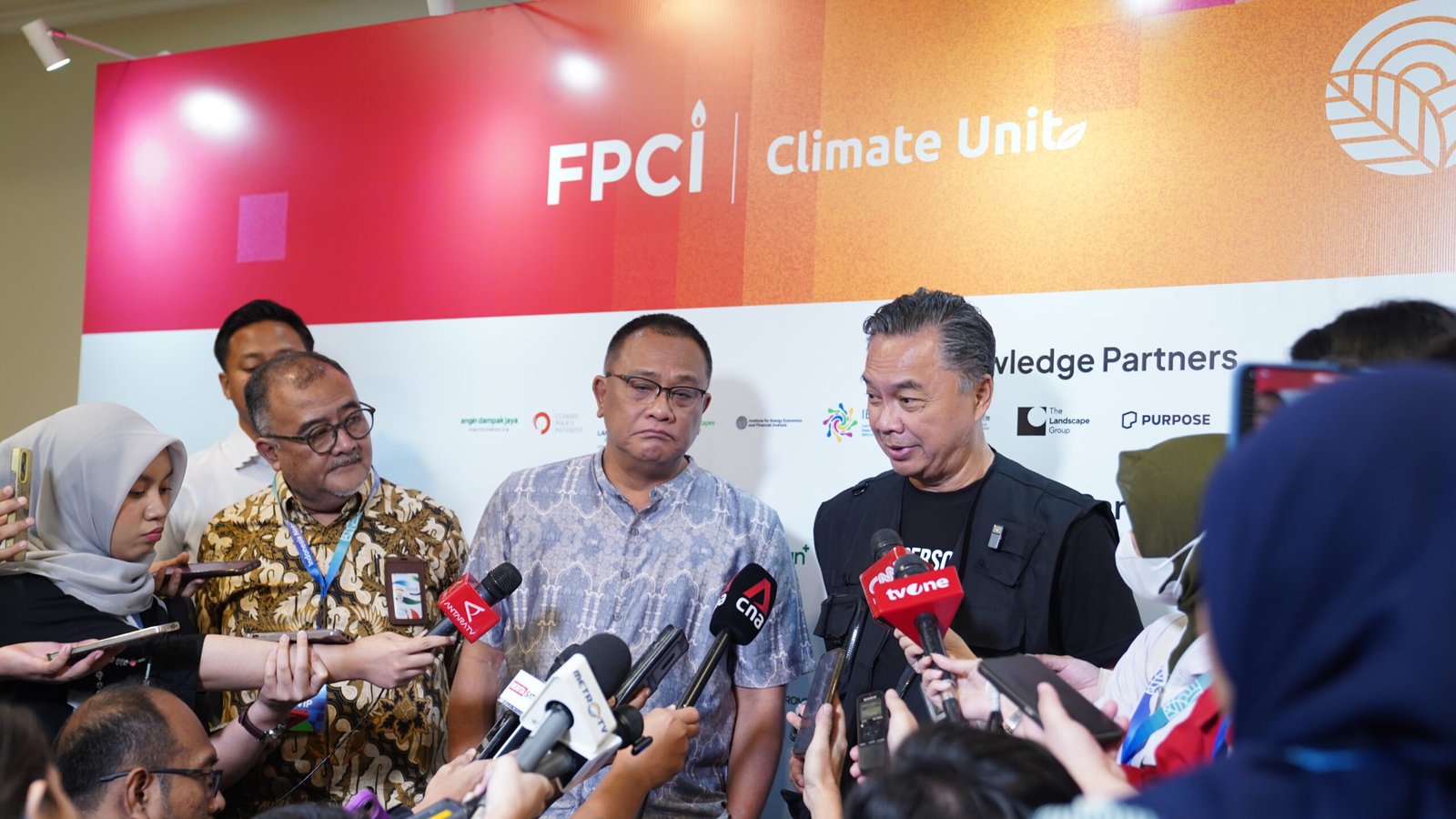
Dino Patti Djalal, Founder and Chairman of FPCI (right), and Moh. Jumhur Hidayat, Indonesia’s Minister of Environment, answering a press doorstop during INZS 2026. (Secretariat FPCI)
Today’s fragmenting, volatile global geopolitical and geoeconomic landscape is the very reason why the net-zero transition is the indispensable pathway for safeguarding national security.
This collective stance emerged as one of the paramount takeaways from the Indonesia Net-Zero Summit (INZS) 2026, the country’s largest independent climate summit that, on August 1, brought together over 10,000 participants from all walks of life.
The conference delivered a clear rebuttal to the ironic, widespread narrative that climate ambitions should be sidelining on a pretext that “high-politics” matters of the economy and security are taking precedence.
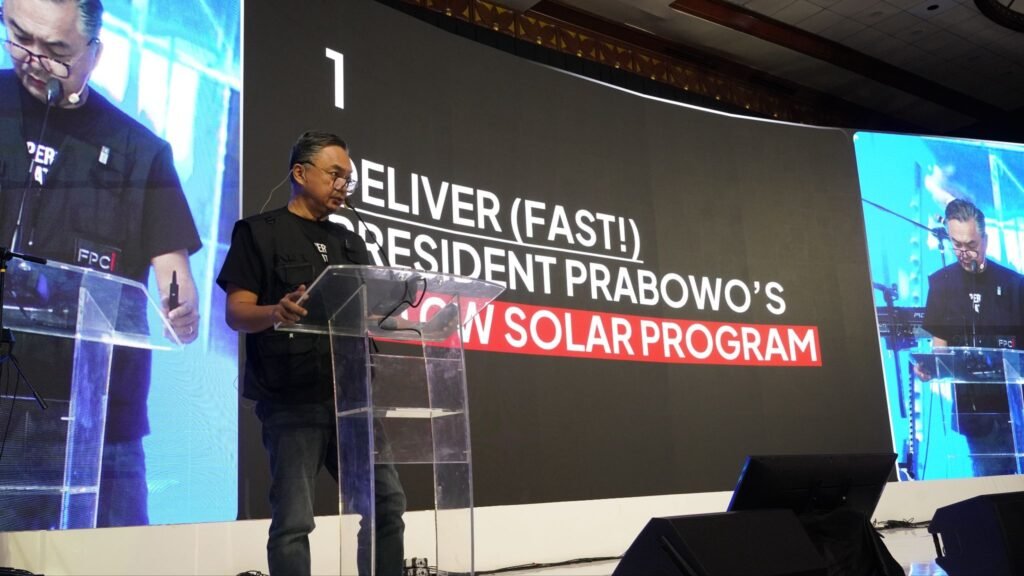
Dino Patti Djalal, Founder and Chairman of FPCI during the opening plenary session of INZS 2026. (Secretariat FPCI)
Dino Patti Djalal, Founder and Chairman of the organising committee of the Foreign Policy Community of Indonesia (FPCI) and former Deputy Foreign Minister, explained it best.
“Climate change is above all else. It must be the number one concern,” he claimed, affirming that “climate change is the underlying force that determines politics, security, peace, economy, industry, migration, health, well-being, food, energy, water, jobs—everything”.
Dino sternly warned that “a world with a 3℃ temperature rise will hurt us all. We will all suffer and it cannot be undone,” as he presented the 2026 summit theme of “It’s Time to Deliver!” as a wake-up call. “We can act now, this is the small remaining window of opportunity until 2030”.
In truth, pursuing energy security is an endeavour to decouple a nation from global vulnerabilities, much like shielding an economy against disruptions like those in the Strait of Hormuz that bring devastating impacts.

Moh. Jumhur Hidayat, Minister of Environment and Head of the Environment Control Agency, delivering his keynote address on national climate priorities during INZS 2026. (Secretariat FPCI)
From a governmental perspective, the Minister of Environment and Head of the Environment Control Agency, Moh. Jumhur Hidayat, pointed out that the “climate agenda and green transition” have been integrated into the administration’s national strategy for “strengthening energy security and economic competitiveness.”
He mentioned that the administration is “formulating a policy approach” built on three interconnected pillars of mitigation, adaptation and prosperity. “All three must move forward together,” he insisted.
Envisioning the execution, the Minister laid out five priorities that must be harmonised, namely “strengthening the integrity of environmental governance, accelerating the low-carbon transformation without exceeding ecological boundaries, prioritising adaptation and resilience, ensuring a just transition and ultimately building tangible implementation partnerships”.

Panelists of Session 1C, “Make the Money Move: How to Unlock the Trillions for Indonesia’s Energy Transition”. (Secretariat FPCI)
What does this mean for businesses?
Indonesia witnessed its currency fall to a historic low due to recent energy supply disruptions; should this recurring crisis fail to be treated as a wake-up call, the nation risks facing systemic economic collapse. With such a massive, cross-sectoral gathering, the INZS is bound to gain significant traction, particularly within government circles. Bearing in mind that the current administration targets an ambitious 8% gross domestic product (GDP) growth rate, up from less than 5% in previous years, a structural transformation towards renewable energy is non-negotiable. Indonesia is racing against itself; if it fails to accelerate its efforts, the price of this delayed transition will become far too costly.
To put this into perspective, undergoing the net-zero transition will prove to be a golden investment for Indonesia. Not only will it yield immense, sustainable economic dividends, but it is also capable of curbing structural issues such as public health crises and systemic poverty. Consequently, businesses must pivot from treating sustainability as an optional compliance exercise to embracing it as a core commercial strategy, embedding decarbonisation into their operations to safeguard their supply chains and unlock the next frontier of green profitability.
About The Author