
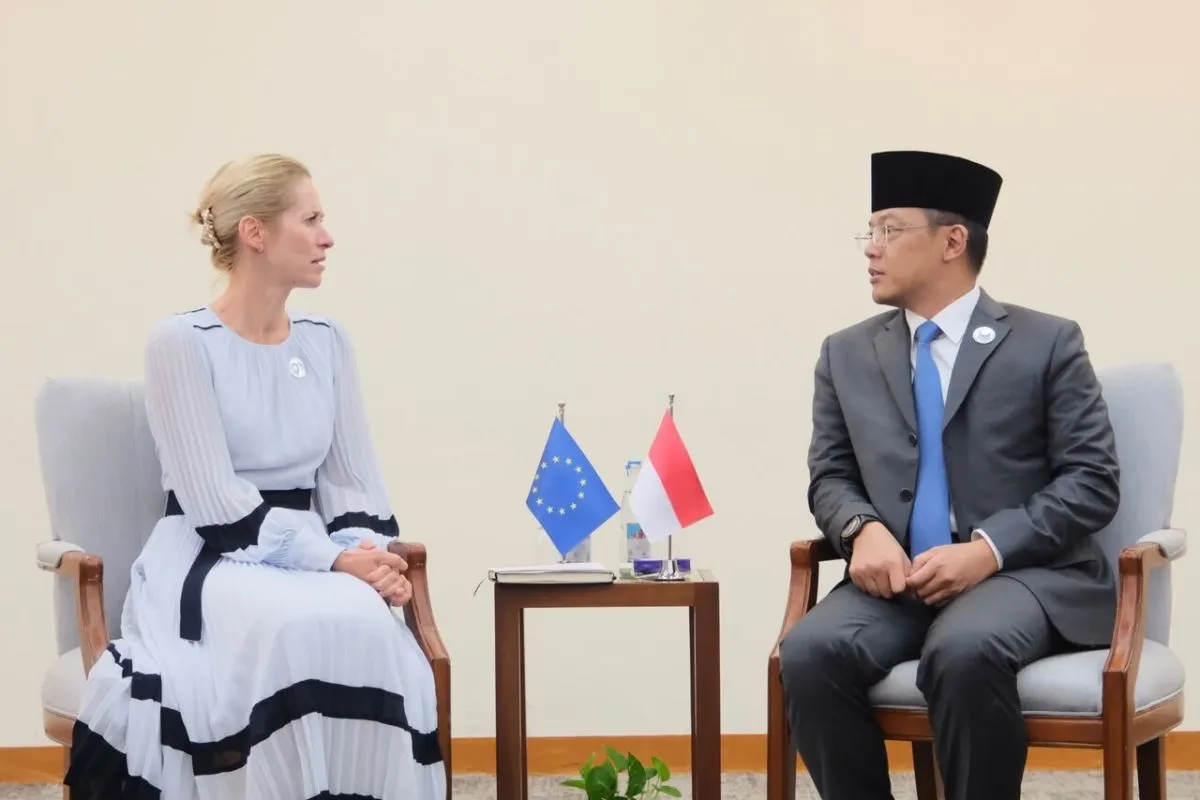
Indonesian Foreign Minister Sugiono and EU High Representative for Foreign Affairs and Security Policy Kaja Kallas during a bilateral meeting on the sidelines of the ASEAN Foreign Ministers’ Meeting in Manila, on July 23. (ANTARA)
The mega-trade deal between Indonesia and the European Union (EU), the Indonesia-European Union Comprehensive Economic Partnership Agreement (IEU-CEPA), is entering its finalisation phase to meet implementation targets by January 1, 2027.
On the sidelines of the recent ASEAN Foreign Ministers’ Meeting on July 23, Indonesian Foreign Minister Sugiono engaged in a bilateral meeting with the EU High Representative for Foreign Affairs and Security Policy Kaja Kallas, reaffirming the need for both sides to wrap up ratification in the second half of 2026.
The Foreign Minister underscored that “the signing of the IEU-CEPA is highly strategic for strengthening trade, investment and economic partnership between Indonesia and the EU”.
For context, the IEU-CEPA aims to establish a massive free trade zone by removing trade barriers, lowering tariffs and boosting mutual capital flows. Most notably, the pact will eliminate import duties on up to 98.5% of tariff lines, alongside pledging robust investment in strategic sectors, namely green technology and pharmaceuticals.
Negotiations advanced significantly earlier this month when the European Commission submitted proposals to the Council of the EU to sign both the IEU-CEPA and the accompanying Investment Protection Agreement (IPA).
Hence this development marks a breakthrough, given that negotiations had previously stalled for nearly a decade due to profound structural and environmental disagreements (particularly regarding palm oil exports and covid 19 disruptions).
What does this mean for businesses?
Recent geopolitical pressures from shifting global supply chains partly jolted both parties back to the negotiating table. As both sides ramp up the final phase, analysts project that the accord will double bilateral trade from around 30 billion US dollar to 60 billion US dollar within five years of implementation. Upon entry into force, major Indonesian industries like textiles, footwear, rubber, electronics and palm oil will face zero or near-zero tariffs to enter Europe. Concurrently, Europe will secure a stable supply chain for raw materials essential for its leading electric vehicles (EV) and battery industries. Additionally, as Foreign Minister Sugiono also brought about Indonesia’s net-zero push, the next layer of collaboration might manifest in the areas of renewable energy development and sustainable investments.
Kala Advisory helps renewable energy and green tech companies turn market openings like the IEU-CEPA into targeted, country-by-country supply chain and market entry plans across Southeast Asia. Visit kala-advisory.com.
About The Author


One thought on “Indonesia-EU Enters Final Approval Phase for 2027 CEPA Launch”