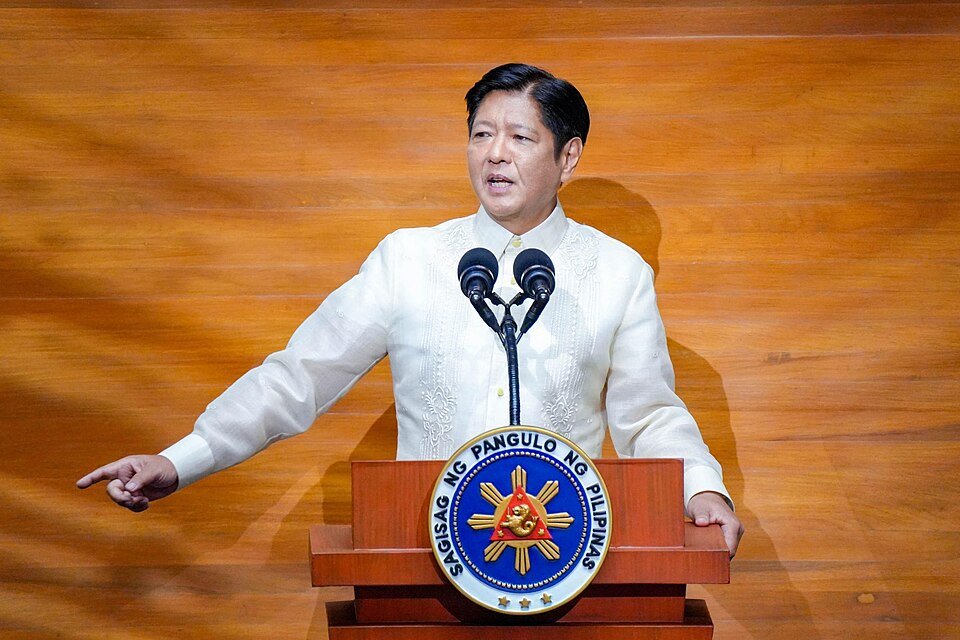
Philippine President Ferdinand Marcos Jr. delivering his speech. (WikiMedia/Presidential Communications Office)
Philippine President Ferdinand Marcos Jr. used his fifth State of the Nation Address (SONA) on July 27 to outline his administration’s priorities for the remainder of its term, placing governance, economic competitiveness, public services and national security at the centre of the government’s agenda.
Addressing a joint session of Congress at the Batasang Pambansa (National Assembly), President Marcos opened his address by highlighting the administration’s efforts to improve public service delivery and strengthen accountability in government. He said investigations into alleged irregularities involving flood control projects had advanced, with multiple cases now being prepared, adding that nearly 25 billion Philippine peso in public funds and assets had been recovered, frozen or preserved.
The President said corruption would continue to be addressed regardless of political affiliation, stressing that public funds must be used for their intended purpose. He also directed government agencies to accelerate infrastructure and disaster mitigation projects while improving transparency in public spending.
On the economic front, President Marcos outlined the government’s strategy of attracting investment in high-value industries, including semiconductors, artificial intelligence (AI), advanced manufacturing, pharmaceuticals and logistics. He said reforms introduced by the administration had facilitated more than 6 trillion Philippine peso in strategic investments and would continue strengthening the country’s position as a regional investment destination.
He also outlined measures to lower electricity costs through proposed amendments to the Electric Power Industry Reform Act (EPIRA) and diversify the country’s energy mix through renewable and nuclear energy. In addition, he highlighted initiatives to strengthen food security, expand healthcare services and improve education through continued investment in classrooms, teachers, student assistance and agricultural productivity.
Turning to foreign policy, President Marcos reiterated the Philippines’ commitment to defending its sovereign rights in the West Philippine Sea (WPS) through peaceful and lawful means. Referring to the 2016 Arbitral Award under the United Nations Convention on the Law of the Sea (UNCLOS), he said the country’s maritime rights remained non-negotiable and paid tribute to members of the Armed Forces of the Philippines (AFP), the Philippine Coast Guard (PCG) and Filipino fisherfolk for their continued role in safeguarding the country’s maritime interests.
Rather than introducing a new set of flagship initiatives, President Marcos’ fifth SONA signalled a shift towards delivering results from programmes already underway. The address framed governance, economic competitiveness, energy security, digital transformation and maritime sovereignty as interconnected priorities, suggesting that the administration increasingly views domestic development and national security as mutually reinforcing. As it enters its final two years, the government’s performance is likely to be judged less by new policy announcements than by its ability to translate these commitments into measurable outcomes.
About The Author