An IDB-ISEAS seminar on regional cooperation and integration in February 2026. (APEC Secretariat)
China vs the US Since 2019, the State of Southeast Asia survey published annually by the ASEAN Studies Centre at the ISEAS Yusof Ishak Institute has become the region’s “leading assessment of regional sentiment among policymakers, business leaders, and academics across Southeast Asia.” This article analyses its eighth edition, released on April 7, 2026, surveyed 2,008 respondents across all eleven ASEAN member states, including Timor-Leste for the first time following its October 2025 accession, fielded between January 5 and February 20, 2026. What sets the survey apart from other polls on the region is its dedicated section on Southeast Asian perceptions of China and the US, with one of the questions being “If ASEAN were forced to align itself with one of the strategic rivals, which should it choose?”.
US leadership under President Trump was named the region’s top geopolitical concern by 51.9% of respondents, narrowly ahead of global scam operations (51.4%) and China’s South China Sea assertiveness (48.2%). The concern is based on reciprocal tariffs imposed by the Trump administration that have hit Singapore, Indonesia, Malaysia and Thailand directly. When asked which power the region would align with if neutrality became untenable, respondents chose China over the US by 52.0% to 48.0%, reversing 2025’s result of 52.3% for the US against 47.7% for China. This is in fact the fourth reversal in as many years: the US led decisively in 2023 at 61.1% to 38.9%, China first overtook it in 2024 by the narrowest of margins (50.5% to 49.5%), the US regained the lead in 2025 and China has now returned in 2026 with slight margin. Additionally, when asked “Apart from your own country, which ASEAN member state has shown the strongest leadership within ASEAN in addressing key regional challenges?” 31.3% answered Singapore, which stands ahead of Indonesia (22.2%) and Malaysia (21.3%), a shift from Indonesia’s more consistent historical lead on this particular indicator.
A Familiar Swing, But Sharper Edges
Statistics of Southeast Asians’ response when asked to align with either China or the US in 2026. (State of Southeast Asia/ISEAS)
What distinguishes 2026 from the previous three reversals is that trust in both superpowers is eroding at once rather than one gaining cleanly at the other’s expense. For the first time since the survey began in 2019, trust in China (39.8%) now exceeds distrust (35.2%), while trust in the US has softened to 44.0% against a rising 35.5% distrust. The two are being judged on different grounds. Concern over China remains anchored in sovereignty and coercion, particularly its conduct in the South China Sea, while concern over Washington has shifted decisively toward economic unpredictability. 43.4% of sceptical respondents now cite the use of sanctions and tariffs as their primary worry, up sharply from 21.3% last year, while the share citing the older complaint that the US is “distracted by its internal affairs” fell over the same period from 29.2% to 21.3%. In other words, the source of regional unease with Washington has migrated from a perception of neglect to a perception of active economic harm.
The regional average, however, flattens considerable variation beneath it. Support for China in the forced-choice question is strongest in Indonesia (80.1%), Malaysia (68.0%) and Singapore (66.3%), while the US retains a clear lead in the Philippines (76.8%), Myanmar (61.4%) and Vietnam (59.2%). It is important to note that the ISEAS report assigns equal weight to the responses of each member state rather than weighting them by population. This is a methodological choice intended to reflect ASEAN’s distinctive consensus-based decision-making process. However, due to this approach, the overall result of 52 to 48 may reflect the situations of a few member states that underwent significant shifts in stance this year more than it captures the prevailing sentiment across the entire region. Furthermore, almost 90% of the respondents have finished tertiary education, a statistic that doesn’t reflect the 12-15% rate of tertiary degree holder in the region.
Middle powers like the EU, Japan or South Korea unevenly gain ground in the region
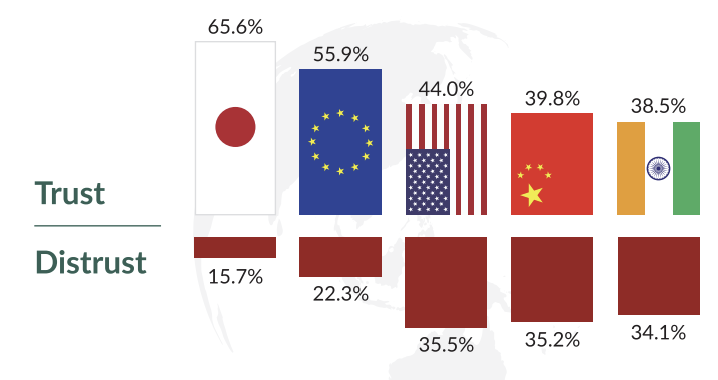
Percentage of Southeast Asians’ trust and distrust towards selected global actors in 2026. (State of Southeast Asia Survey/ISEAS)
Japan (65.6%) and the European Union (55.9%) remain the two most trusted major powers in the region, both credited primarily for a perceived commitment to international law rather than for economic or military weight. 41.4% of those who trust Japan cite it as “a responsible stakeholder that respects and champions international law,” while 34.8% of those who trust the EU cite the same reason, alongside its stance on climate and human rights. Neither power tops the region’s rankings of economic or political-strategic influence, where China and the US still dominate; their advantage lies entirely in the narrower but increasingly decisive category of who is trusted to act responsibly with the influence it already has. As trust in the two major powers faces simultaneous challenges from both sides, this normative confidence in Tokyo and Brussels appears less like a stable reference point and more like a temporary phenomenon or a direction toward which regional public opinion is actively gravitating.
South Korea’s position in this survey is worth emphasising. On the survey’s measure of dialogue partners’ strategic relevance to ASEAN, the Republic of Korea edged ahead of India this year for the first time, a shift the report attributes to “growing technology partnerships and expanded diplomatic outreach.” Yet on the separate question of which partner ASEAN should turn to in order to hedge against US-China rivalry, South Korea registers only 5.1%, trailing the EU (37.7%), Japan (34.2%) and even Australia (9.7%). This illustrates that the gap between a rising technical and diplomatic profile and a still-marginal role as a trusted hedge suggests Seoul’s growing footprint in the region has not yet converted into a normative trust that Tokyo and Brussels have spent decades accumulating.
A rebalancing within ASEAN itself
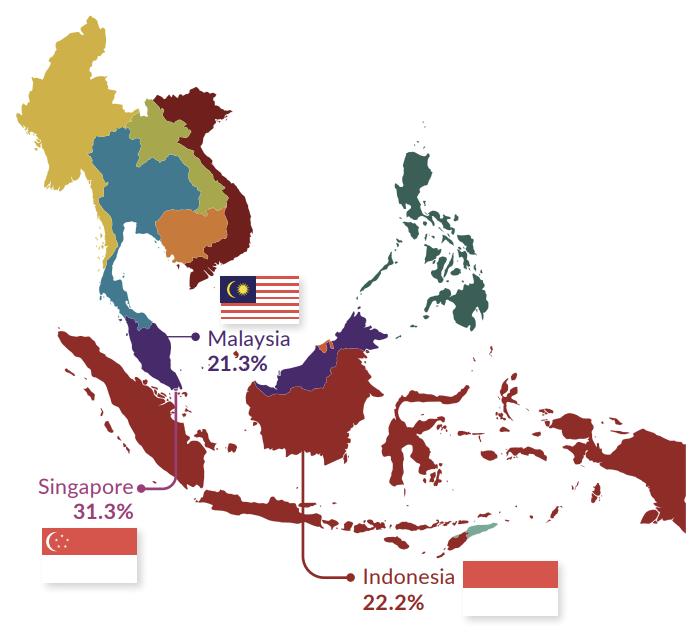
Percentage of Southeast Asians who think that the selected countries have the “strongest leadership in addressing regional challenges” in 2026. To note, respondents cannot pick their own countries. (State of Southeast Asia/ISEAS)
Singapore’s rise on the intra-regional leadership question is highlighted mainly by perceived economic leadership, cited by 38.4% of those who named it, a marked increase from last year. Indonesia, by contrast, has historically been credited more for its ability to build consensus within the bloc, cited by 31.7% of those who named it this year. Malaysia’s third-place showing, meanwhile, is credited overwhelmingly to its 2025 ASEAN chairship, cited by 45.2% of those who named it, suggesting that at least part of this year’s shift reflects the calendar of institutional rotation as much as any deeper shift in national standing. However, the figures clearly indicate that respondents within ASEAN continue to perceive the regional bloc as relying on a handful of member states for leadership. This represents a structural vulnerability that has not been resolved by this year’s shifts in positioning.
Taken together, the 2026 findings describe a region whose long-standing default (prioritising ASEAN’s own resilience and unity over alignment with either power) is being tested not by a single crisis but by the simultaneous erosion of confidence in both superpowers, an alignment of scepticism that has not occurred at this scale since the survey’s inception. The forced-choice swing back to China should therefore be read less as a vote of confidence in Beijing and more as the arithmetic result of Washington’s steeper decline. It is a reminder that hedging in Southeast Asia has never been a fixed strategic orientation so much as a running tally of which power is currently doing more damage to its own credibility.
A Look to 2027
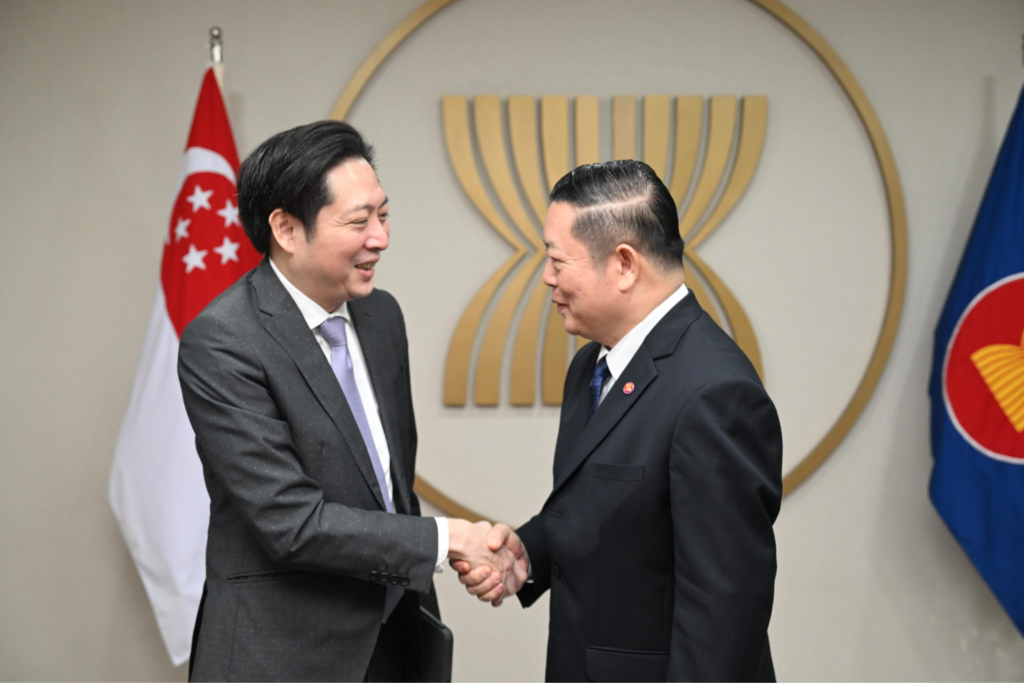
Permanent Representative of the Republic of Singapore to ASEAN, Gerard Ho, met with ASEAN Secretary-General, Kao Kim Hourn, at the ASEAN Headquarters in July 2025. Singapore will hold the ASEAN chairship role in 2027. (ASEAN Secretariat)
Overall, the trajectory of US tariff policy is likely to be the single largest swing factor shaping next year’s alignment question, given that trade measures have now overtaken every other grievances as the leading driver of eroding confidence in Washington. Plus, whether Japan and the EU can convert their normative trust advantage into concrete, visible engagement will test how durable ASEAN’s stated preference for third-party hedging really is. With 37.7% of respondents naming the EU and 34.2% naming Japan as their preferred hedge partner, both blocs have more regional goodwill available to them than their current level of on-the-ground engagement would suggest, a gap that either side could choose to close. Moreover, Singapore’s hold on the ASEAN bloc’s internal leadership question will depend substantially on whether Indonesia’s domestic trajectory stabilises over the coming year. The 2027 survey will be the first real indicator of whether this year’s repositioning reflects a durable reordering of ASEAN’s internal hierarchy or an ad hoc transit tied to a particular political moment in the region..
Across all three of these variables what moves trust in this survey, year after year, is not military capability or gross domestic product (GDP) but the perceived predictability of geopolitics, its demonstrated respect for sovereignty and international law, and the visibility of its economic engagement on the ground. That formula explains why Japan and the EU consistently outperform their hard power in these rankings, and why Washington and Beijing, despite dominating every measure of material influence, continue to face rising skepticism from a region that has learned to price unpredictability as a cost in itself.
This state does not necessarily mean Southeast Asia choosing one side over the other. Rather, it reflects a hedging whereby Southeast Asian countries, wary of the unpredictability associated with each party, constantly weigh the potential costs and diversify their risks accordingly. Consequently, it seems unlikely that this current Southeast Asian countries’ calculus will solidify into a permanent or fixed stance by 2027.
About The Author