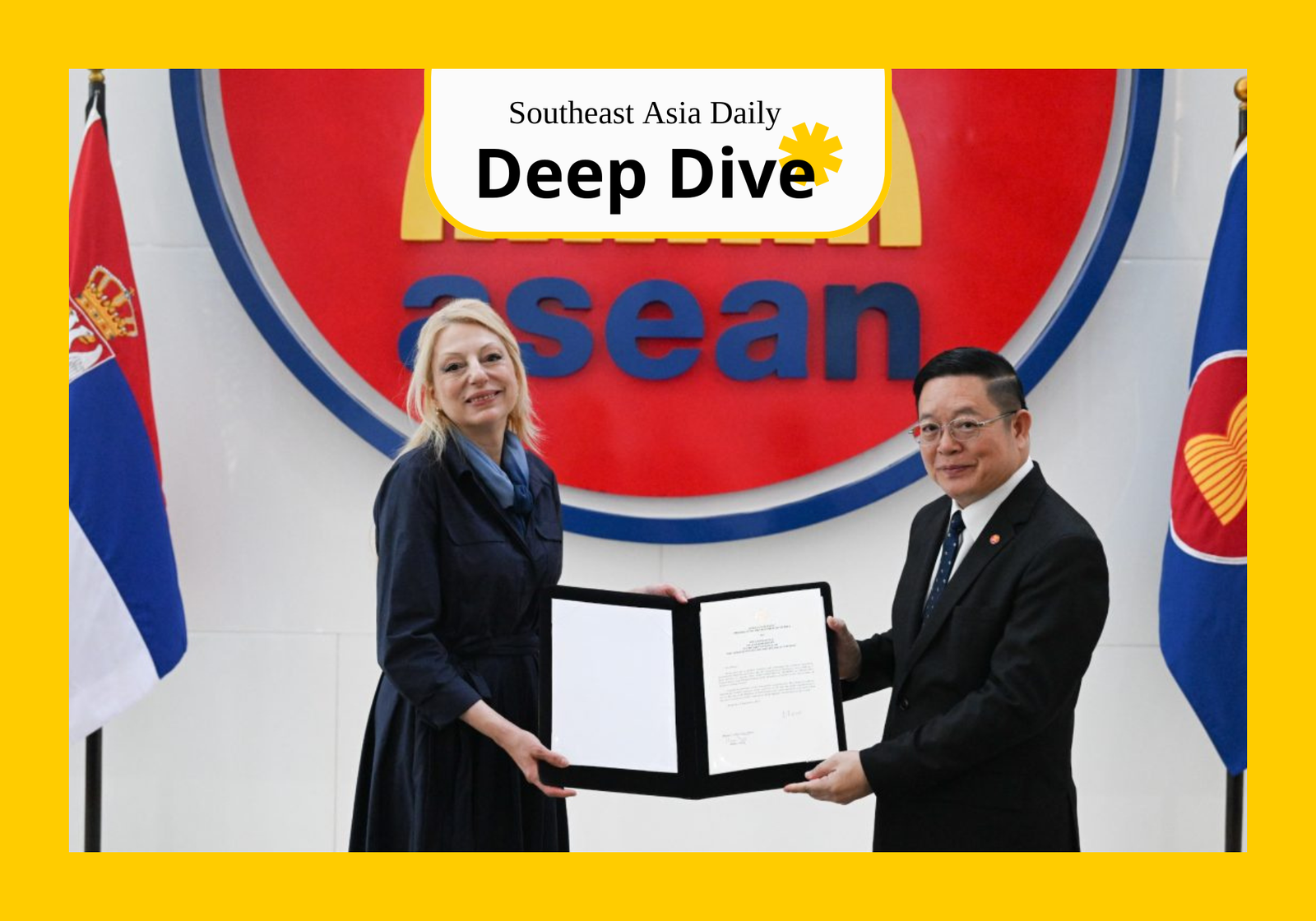
Serbian Ambassador Ivana Golubović-Duboka presented her Letter of Credence to the Secretary-General of ASEAN, Dr. Kao Kim Hourn, at the ASEAN Headquarters on October 20, 2025. (ASEAN Secretariat)
From the Cold War to Modern Diplomacy
After spending more than a decade as a European Union (EU) candidate, with very little chances to join the 27-nation bloc anytime soon, if at all, Serbia—a relatively small country in Southeastern Europe—now seeks to strengthen ties with ASEAN. Given that geography prevents the Balkan state from full integration into ASEAN, Belgrade seems to see the organisation as a counterbalance to the growing Chinese influence in Serbia. But how might Serbia and the Southeast Asian grouping benefit from closer cooperation?
During the Cold War, Yugoslavia—with Serbia as its key part—was one of the founding members of the Non-Aligned Movement in 1961. Several countries in Southeast Asia also joined the movement, including Indonesia, Malaysia, Myanmar (Burma at the time), Cambodia and Laos. In this period, Yugoslavia emerged as an important country among the nonaligned nations in Southeast Asia.
But while political and diplomatic ties were highly prioritised and successful, trade and economic exchanges remained relatively minor due to geographic distance, ideological differences in economic systems and a lack of commercial interest from Yugoslav enterprises. Nevertheless, a foothold remained that allowed Serbia, as the legal successor of Yugoslavia, to gradually renew ties with the region.
In September 2023, during the 43rd ASEAN Summit in Jakarta, then Foreign Minister Ivica Dacic signed a cooperation treaty with the Southeast Asian bloc. Previously, in July 2023, Serbian government announced that at the 56th plenary meeting of ASEAN foreign ministers, the member states “unanimously approved Serbia’s accession request to the Treaty of Amity and Cooperation in Southeast Asia.”
Surprisingly enough, the Serbian government presented it on its official website as if Serbia had “joined ASEAN.” Simultaneously, both pro– and anti-government media have adopted that narrative, even though Serbia cannot technically become a formal member of the association, even if it wanted to.
According to Article 6, Paragraph 2(a) of the ASEAN Charter, a country must be geographically located in Southeast Asia to become an ASEAN member. What Serbia can hypothetically hope to achieve is a Comprehensive Strategic Partnership with the Southeast Asian organisation. However, there is still a long way to go.
After successfully acceding to the Treaty of Amity and Cooperation (TAC), Serbia has become ASEAN’s High Contracting Party. The accession serves as a key framework for closer ties, opening up significant avenues for bilateral and multilateral dialogue, trade, and socio-cultural cooperation with ASEAN member states.
But if Belgrade aims to deepen its engagement with ASEAN, it must elevate its status from a TAC signatory to an official Dialogue Partner. Doing so will be anything but easy or fast, especially given that Belgrade spent 10 years waiting to sign the Treaty of Amity and Cooperation and is still awaiting ASEAN’s approval of the Serbian Parliament’s request for associate membership in the ASEAN Inter-Parliamentary Assembly (AIPA).
Hedging against China
The opening ceremony of the Razanj-Aleksinac road in Serbia after it was rehabilitated by Chinese company POWERCHINA on May 17, 2023. (POWERCHINA)
Still, for a country that has spent the last 14 years in the EU’s “eternal waiting” room, waiting itself does not seem to be a major obstacle. What seems to worry Belgrade more is Brussels’ reaction to its Southeast Asia policy. Serbia’s ASEAN approach, according to the Serbian Foreign Ministry, “does not contradict Belgrade’s principal foreign policy goal of EU membership.” Although Serbia, as an EU candidate, is obliged to follow EU foreign policy, it still has some latitude to maneuver. Its ASEAN strategy seems to be part of this approach.
It is no secret that China is actively taking advantage of Serbia’s state of limbo to increase its economic influence in the country. Julian Assange, the world’s most famous “inconvenient dissident”, has once described Serbia as a country “in-between,” meaning it sits caught between bigger powers and competing influences. He described it as a place where the future arrives early, bringing both the good and the bad before they reach the rest of the world. It is, therefore, no surprise that in 2024, the Balkan state became the first European nation to sign an agreement with China on building a “common future.”
That year, during Chinese President Xi Jinping’s visit to Belgrade, the two nations also signed a series of bilateral agreements, as part of their “ironclad friendship.” As a result, despite being surrounded by European Union member states and candidate countries, it was China—rather than its European neighbours—that became the largest investor in the Serbian economy in 2025.
Serbia also became the first European country that purchased Chinese-made air defense systems, while in March 2026 it became the first in Europe to use the Chinese CM-400AKG hypersonic missile systems. Moreover, back in 2016, the Balkan nation became the first country in Central and Eastern Europe to have made an agreement to abolish the visa regime with China.
Ever since, Serbia has developed a “steel friendship” with the People’s Republic, with Beijing becoming one of Belgrade’s top economic partners. It is particularly evident in the automotive sector, as Chinese companies are building car parts manufacturing plants all over the Balkan country, transforming it into a key European production hub. Minth Automotive Europe, Yanfeng Seating, Shandong Linglong Tire, Xingyu Automotive Lighting Systems, and Mei Ta Europe, are among the Chinese companies operating in Serbia, with output primarily destined for the European Union.
Beijing’s strategy is clear: as Brussels seeks to impose more tariffs on goods made in China, it is using Serbia as a base to access the EU market. The problem, however, is that if relations between Brussels and Beijing further deteriorate, Serbia—surrounded by EU member states and candidate countries—will likely come under pressure to significantly limit its “steel friendship” with China.
Fully aware of such a possibility, Belgrade seems to view ASEAN as a way to diversify its external partnerships and reduce overreliance on any single economic or geopolitical pole. As part of this strategy, it is entirely possible that, in the coming years, Serbia will seek to develop closer partnership with ASEAN, with a free trade agreement potentially serving as the first concrete step.
Besides the European Union and China, Serbia has free trade agreements with all neighboring non-EU countries, the United Arab Emirates, Turkey, and the Eurasian Economic Union—altogether representing around 2.1 billion people. To reach a similar deal with ASEAN, Belgrade must first lobby the eleven member states to upgrade Serbia’s status from a TAC signatory to an official Dialogue Partner.
Every single country or territory that currently holds a collective free trade agreement with ASEAN (China, Japan, South Korea, India, Australia, New Zealand and Hong Kong) is a formal Dialogue Partner. ASEAN has never granted a bloc-wide free trade agreement to a nation sitting outside this tier. However, given that securing a trade agreement with ASEAN as a whole would be a lengthy and politically demanding process, Serbia’s quickest alternative would be to negotiate separate deals with individual member states.
A Gateway in Both Ways

Palm oil trees in Sabah, Malaysia, considered as a commodity where Southeast Asian countries can partner with Serbia in its exploitation. (Wikimedia/Uwe Aranas)
Serbia’s current trade volume with ASEAN member states floats around 700 million US dollar, with Indonesia being the Balkan state’s major economic partner in the region. In 2023, according to Serbian President Aleksandar Vucic, the total trade in goods between Serbia and Indonesia amounted to 251.2 US dollar million, which is 27.4% of the Southeastern European nation’s trade with ASEAN countries.
There is, however, room for strengthening closer economic ties with other Southeast Asian countries as well. Aware of Belgrade’s complex relations with the EU, Malaysia seems to view the Balkan state as a gateway, if not to the EU, then at least to its neighboring non-EU countries.
“Serbia is not yet part of the EU, which makes it a significant opportunity for both Malaysia and Indonesia,” Carmallia Budiaty Bt Che Embi Chargé d’Affaires at the Embassy of Malaysia in Belgrade told Southeast Asia Daily, pointing out that the country’s regulatory framework is not fully aligned with the EU, allowing them to expand their trade presence.
As she explained, Kuala Lumpur hopes to eventually bring in major economic players for direct engagement with the relevant Serbian authorities and to expand ties, particularly in the palm oil sector.
Given Serbia’s free-trade access to the EU through the Stabilisation and Association Agreement, which allows the duty-free export of most Serbian-made industrial products to the European Union, Malaysian and other ASEAN manufacturers could bypass high EU tariffs by establishing production facilities or partnering with businesses in Serbia. Politically, having a European nation actively lobby to join ASEAN networks, could help the Southeast Asian organisation strengthen its role in the global arena.
For Serbia, on the other hand, deepening ties with a non-Western power bloc like ASEAN gives Belgrade additional room to breathe. Serbia is under constant geopolitical pressure from the EU and the US regarding its ties with Russia, its stance on China, and the normalisation of relations with Kosovo, which Belgrade sees as its breakaway province. Thus, a stronger cooperation with ASEAN and its member states would signal to Brussels, Washington, as well as to Beijing, that Serbia has viable global alternatives, reducing Western leverage and proving that Serbia cannot be easily isolated.
At the same time, ASEAN stands to benefit from closer engagement with a European nation that can serve as a gateway to both the EU market and the broader Balkan region.
About The Author