
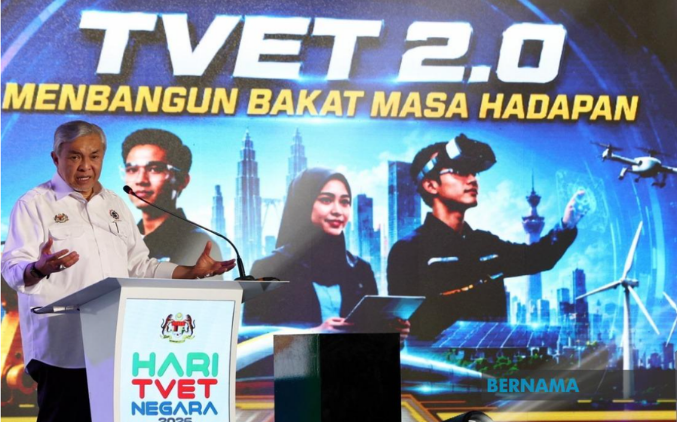
Deputy Prime Minister Ahmad Zahid Hamidi speaks to reporters on the TVET 2.0 fund priorities at the National TVET Day 2026 opening ceremony in Putrajaya, Malaysia, June 6. (BERNAMA)
On June 6, Malaysia’s Prime Minister Anwar Ibrahim delivered a keynote speech to officiate the National TVET Day as he debuted the Technical and Vocational Education and Training (TVET) 2.0 initiative with a pledge of 50 million Malaysian ringgit (12.4 million US dollar) in funding.
The funds were drawn from the allocated High-Impact Programme budget and will be administered by the statutory body of the Malaysian Ministry of Human Resources, the Skill Development Fund Corporation (PTPK).
Prime Minister Anwar stressed that the implementation of TVET 2.0 is a “wise decision”, noting that artificial intelligence (AI), cryptocurrency and renewable energy have become key global priorities.
Crucially, on the same day, Deputy Prime Minister Ahmad Zahid Hamidi launched the Government-Industry TVET Coordination Body (GITC) TVET Placement Centre (GTPC). As Malaysia’s first national tech-voc talent placement ecosystem, the platform aims to bridge the gap between industry requirements and skilled graduates, addressing the country’s chronic structural problem of skills mismatch.
Prominent Malaysian industrialist Tan Sri Dr Soh Thian Lai, who chairs the newly launched body, outlined the initiative’s initial road map during his welcoming address. He stated that the ecosystem has “set clear targets of 1,000 participating companies by the end of this year,” with the ultimate goal of securing “between 50,000 and 100,000 job placements by next year”.
These moves reflect the government’s commitment to execution. Nevertheless, Prime Minister Anwar, who also serves as the Finance Minister, underscored that this initiative needs to be backed by cross-sector collaboration. He reminded the audience that, “there are conditions. Employers and industry must cooperate with the government.” He pointed to the private sector, stakeholders and multinational corporations, encouraging their participation in providing specialised training for TVET students.
What does this mean for business?
Malaysia has undeniably set the standard as a leading benchmark for vocational education in the Southeast Asian region. To further leverage this as an instrument for the country to escape its middle-income trap, Kuala Lumpur is attempting to structurally level up its semiconductor value chain towards integrated circuit (IC) design. The main challenge to note is that, while Malaysia is actively attracting foreign capital, the country is racing to cope with its severe skills mismatch. This problem has also caused a spillover effect, resulting in a brain drain of these talents to neighbouring countries. Therefore, while investment progresses, it must be synchronised with efforts to address this fundamental issue.
Nevertheless, the formation of the new GTPC signals optimism. For businesses and foreign investors looking to tap into the market, this platform acts as a de-risking mechanism by providing a direct, friction-free pipeline to industry-ready talent, effectively lowering recruitment costs and eliminating the traditional onboarding bottlenecks.
Kala Advisory helps European investors turn openings like these, from talent placement schemes to a maturing semiconductor base, into a workable entry plan in Malaysia. Visit kala-advisory.com.
About The Author


One thought on “Malaysia debuts TVET 2.0 and new talent placement platform, targeting 100,000 jobs by 2027”