
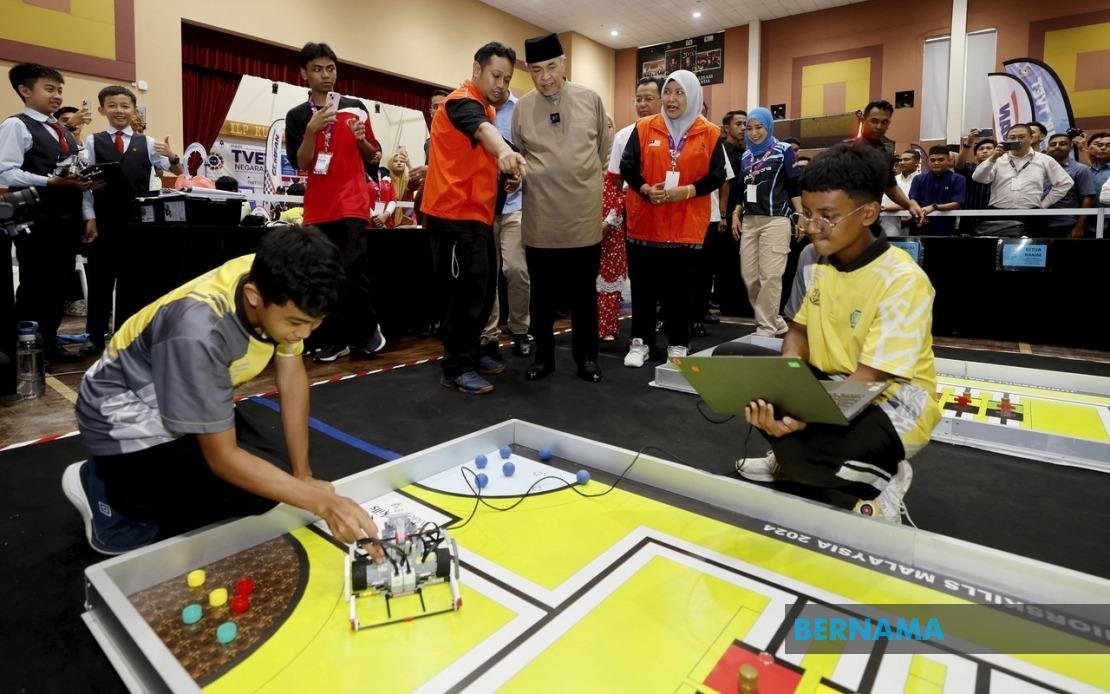
Deputy Prime Minister Datuk Seri Dr Ahmad Zahid Hamidi visiting the National TVET Day 2024 exhibition at the Kuala Langat Industrial Training Institute. (Bernama)
Malaysia is set to debut its Technical and Vocational Education and Training (TVET) curriculum, named TVET 2.0, in June.
Speaking at the press briefing, Deputy Prime Minister Ahmad Zahid noted that the new curriculum will focus on high-technology sectors and high-impact skills. He elaborated that alongside maintaining traditional courses, the government will also “reinforce areas such as robotics, the Internet of Things (IoT), artificial intelligence (AI), renewable energy and other fields that are in high demand in the market”.
Notably, he highlighted that TVET 2.0 will prioritise high-potential areas, namely animation. He pointed to the fact that “many global animation companies have outsourced animation production to Malaysian firms,” adding that “there is a shortage of talent in the animation sector”. The government hopes that TVET 2.0 will encourage more people to enter the field.
Deputy Prime Minister Ahmad Zahid further disclosed that the government is reviewing plans to implement a TVET Act and establish a TVET Commission to strengthen the nation’s vocational training framework.
What does this mean for businesses?
For businesses, especially those in high-tech, creative and industrial sectors, this news signals a major shift from a talent-scarce market to a government-backed, industry-ready pipeline. Businesses stand to gain access to highly skilled specialists, whether in focused technical roles or full-time capacities, potentially elevating the overall quality of their service ecosystems.
That said, the true test lies in execution. Vocational training in Malaysia has long been fragmented across multiple ministries, resulting in overlapping and often confusing certifications. The proposed TVET Act and centralised TVET Commission aim to address this directly by standardising qualifications. This will give businesses a single, reliable benchmark to assess candidates and streamlining the hiring process as a result.
About The Author


3 thoughts on “Malaysia to launch TVET 2.0, targeting in-demand skills shortage”