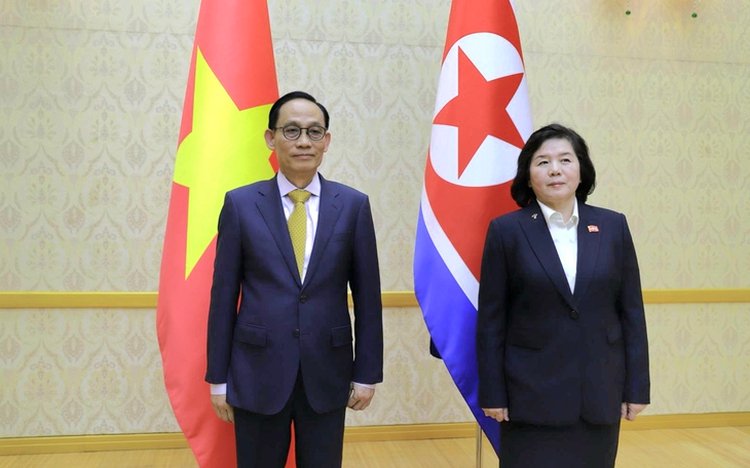
Vietnamese Foreign Minister Le Hoai Trung, special envoy of Party General Secretary and President Tô Lâm, meets North Korean Foreign Minister Choe Son Hui in Pyongyang, May 13, 2026. (Vietnam News Agency)
Vietnamese Foreign Minister Lê Hoài Trung, who serves as Special Envoy of General Secretary and President Tô Lâm, visited the Democratic People’s Republic of Korea (DPRK) on May 13. He conferred with several senior North Korean officials, including Foreign Minister Choe Son-hui, , International Affairs Department (IAD) Director Kim Song Nam as well as Chairman of the Standing Committee of the Supreme People’s Assembly Jo Yong-won.
Lê Hoài Trung congratulated the DPRK government on the successful 9th Congress of the Workers’ Party of Korea (WPK) and reaffirmed Vietnam’s commitment to advancing bilateral ties in the interest of peace and stability.
During his meeting with North Korean Foreign Minister Choe Son-hui, Lê Hoài Trung visited the Central Cadres Training School of the Workers’ Party of Korea. In response, Choe congratulated Vietnam on its 14th National Party Congress and praised its socio‑economic achievements. Both sides pledged to strengthen political trust through exchanges and visits. Additionally, they agreed to coordinate more closely at international and regional bodies, such as the UN and ASEAN Regional Forum.
Subsequently, during his meeting with Jo Yong-won on May 15, Lê Hoài Trung underlined Hanoi’s long-term strategy grounded in the 14th National Congress of the Communist Party of Vietnam (CPV) in January 2026—a congress that set national directives and goals for the coming five years to realise strategic autonomy and pursue an ambitious development trajectory. He further reaffirmed Vietnam’s commitment to foster ties with Pyongyang to elevate their bilateral relationship to a new level of cooperation. Jo, in turn, also expressed Pyongyang’s readiness to develop its relationship with Hanoi as “traditional friends” and highlighted the potential for broader cooperation frameworks in economics and politics.
This visit followed Tô Lâm’s visit to Pyongyang when he met Kim Jong Un, the General Secretary of the WPK and President of the State Affairs of the DPRK, in October, 2025, during the sidelines of the commemoration of the 75th anniversary of Vietnam-DPRK relations.
That summit, designated as the “Friendship Year”, saw both nations sign a bundle of new cooperation agreements. This included a mutual Letter of Intent on defense cooperation, a new framework partnership between the Ministries of Foreign Affairs, a Memorandum of Understanding (MoU) on medical and public healthcare as well as official cooperation accords linking state media agencies—the Vietnam News Agency and the Korean Central News Agency—alongside their respective business chambers.
For background, Vietnam and North Korea’s ties stretch back to January 31, 1950, where shared communist ideological foundations determined their diplomatic relations. The relationship has since developed more complex, particularly when Pyongyang aligned with Beijing during the Sino-Vietnamese border disputes in the late 1970s. After the Cold War, Vietnam opted for sweeping Đổi Mới reforms in 1986, reshaping its political and economic structures and adopting a more open and multilateral foreign policy.
Today, Hanoi’s active gesture reflects Tô Lâm’s vision of “bamboo diplomacy”—a results-driven approach aiming to align Vietnam’s modernisation efforts while elevating its position in the global supply chain.
About The Author