
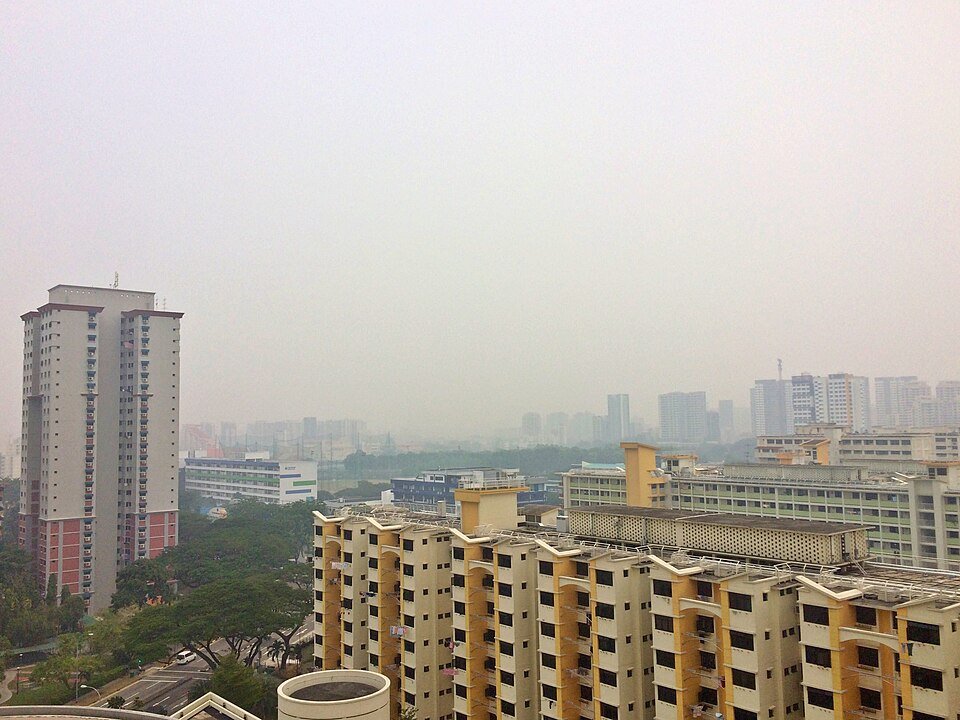
Haze reduces visibility across Singapore’s skyline amid concerns over transboundary air pollution in Southeast Asia. (Wikimedia)
Forest and land fires in Indonesia have heightened concerns over transboundary haze in Southeast Asia, with Singapore recording unhealthy air quality and Timor-Leste suspending in-person classes nationwide from October 15 to 17 as a precaution against worsening pollution.
Indonesia’s Meteorology, Climatology and Geophysics Agency (BMKG) detected more than 1,200 high-confidence fire hotspots across Papua, Maluku, Kalimantan and Sumatra as of October 7. Satellite observations also showed smoke across parts of the Indonesian archipelago, while prolonged dry conditions increased the risk of further fires.
Singapore’s National Environment Agency (NEA) reported elevated fine-particle pollution on October 14, with one-hour PM2.5 readings ranging from 139 to 251 micrograms per cubic metre. The 24-hour Pollutant Standards Index (PSI) reached 168 in some areas, within the unhealthy category.
The NEA also said smoke haze from fires in Kalimantan was drifting towards Singapore under prevailing south-easterly winds and advised residents to limit prolonged or strenuous outdoor activity according to pollution levels.
In Timor-Leste, authorities suspended in-person classes across public, private and cooperative schools after the National Directorate of Meteorology and Geophysics (DNMG) warned of unhealthy to very unhealthy air quality. The government said the measure was intended to protect students and teachers, while residents were advised to limit outdoor activity during periods of heavy smoke.
The ASEAN Specialised Meteorological Centre (ASMC) warned that the northern ASEAN region could enter its dry season towards the end of the year, potentially increasing hotspot and smoke-haze activity in areas forecast to receive below-normal rainfall.
The recurring haze raises questions about the effectiveness of ASEAN’s efforts to address transboundary pollution. While public-health advisories and school suspensions can limit immediate exposure, preventing further fires requires stronger enforcement and coordination at their source. Without more effective implementation of regional commitments, neighbouring countries will continue to bear the health and economic costs of pollution crossing their borders.
About The Author


One thought on “Indonesia Fires Raise Haze Concerns as Air Quality Worsens in Singapore and Timor-Leste”