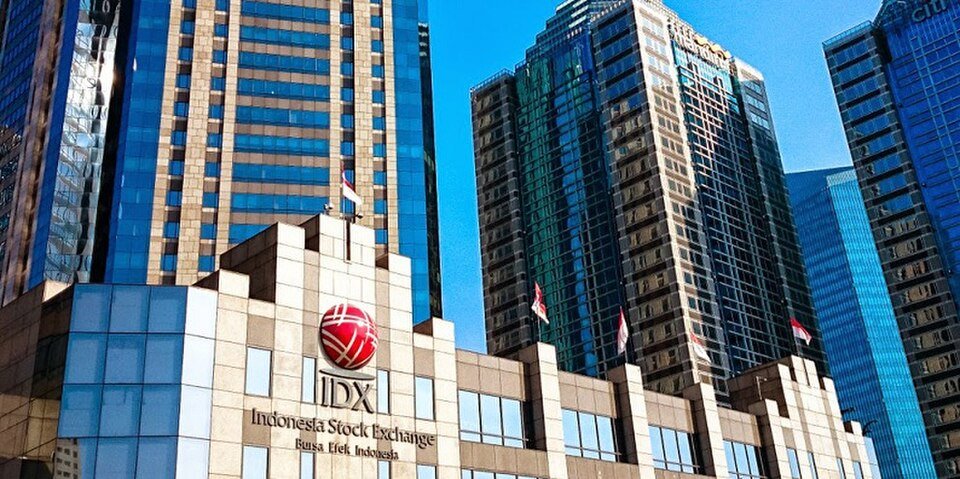
The Indonesia Stock Exchange (IDX) building in Jakarta. (Wikimedia)
On October 15, the MSCI announced a consultation to reclassify Indonesia from an emerging market to a standalone market status, bypassing a lesser frontier-market downgrade.
On the subsequent day, the Jakarta Composite Index (JCI) tumbled by 11.57%, shedding 678.68 points to 5,185.10. The severity of the decline forced a 30-minute trading halt at the market open and marked the index’s worst single-day drop since the 1998 Asian financial crisis. Inevitably, the Indonesian rupiah weakened past 18,000 against the US dollar, trading around 18,050.
Cumulatively, this pushed Indonesia’s benchmark JCI to experience a roughly 40% year-to-date loss, prompting the largest economy in Southeast Asia to become the worst-performing market in the region.
For context, the market has faced intense pressure since January 2026, when MSCI first flagged opaque share ownership, hidden concentrated floats and suspected price manipulation, whilst threatening to demote it to frontier market status. Prior to the October 16 crash, foreign investors had substantially dumped Indonesian equities, recording over 4.6 billion US dollar in net sales.
In its latest announcement, MSCI stated that Indonesia is no longer appropriate to be classified as an emerging market, citing that “significant concerns remain around market dysfunction, including continued suspected coordinated trading behaviour and lack of evidence of meaningful enforcement”.
Reportedly, MSCI is collecting feedback through April 2027 and will announce its final decision by the end of June 2027.
What does this mean for business?
Should the proposed downgrade manifest, Indonesia will be the patient zero of a standalone market in the Asia-Pacific region. While its current emerging market status places Indonesia on par with large economies like China, Brazil, India and South Korea, a standalone grade will align the country equally with Lebanon, Palestine, Argentina and Zimbabwe. Crucially, the moment the country is downgraded, the “passive” index funds (ETFs) will automatically sell every single Indonesian stock they own. As foreign capital flees, the government and local corporations will find it much harder and vastly more expensive to borrow money internationally or raise capital. Indonesia will effectively be excluded from the global indexes. Perpetuation of business-as-usual won’t be viable.
Kala Advisory helps investors transform market volatility and governance risks into secure, country-by-country entry plans across Southeast Asia. Visit kala-advisory.com.
About The Author