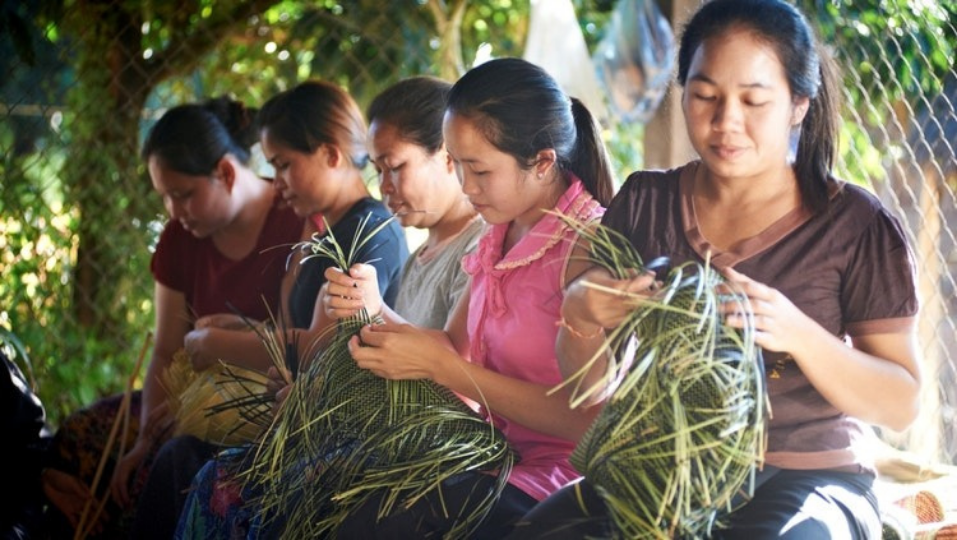
A Lao factory. (KPL)
“Higher wages” plainly appears to be the main reason the majority of Laotians choose to work abroad. However, the government remains perverse in rolling out the wrong countermeasures to avoid an increasing brain drain. The policy disconnect was once again evident when Lao Minister of Labour and Social Welfare Phoxay Sayasone addressed the second ordinary session of the 10th National Assembly on October 9.
First to call attention to is the glaring figure the ministry reported, that out of 119,382 Laotians who secured employment during the first nine months of this year, 103,610 of them chose to work abroad. Such a stark disparity signals that, for Laotians, seeking overseas employment is not a matter of preference, but rather a vital means of survival.
Perpetuation of this state would further expose Laos to an inherent risk of becoming a remittance-dependent economy—which is counterproductive given that the money goes directly towards immediate household consumption, rather than serving as a tool for commercial investment. As an illustration, the first seven months of 2026 already recorded an over 30% increase in personal transfers, hitting an estimated 500 million US dollar. Bearing this in mind, it is critical to note that when a country truly prospers, the remittances-to-GDP ratio typically declines.
Consequently, this points to the lingering, structural problems within the states’ capacity to institute policies. To begin with, it should be emphasised that the current brain drain “trap” coincides with a vital juncture as Laos is nearing graduation from the United Nations (UN)’s Least Developed Countries (LDC) status—implying that they will no longer qualify for their historically vital source of inflows, the Official Development Assistance (ODA).
While labour migration has historically occurred, it was only following the post-pandemic period that the Lao government began to “seriously” view it as a “crisis” that demanded attention.
The talent crunch issue officially broke into the highest levels of government policy in June 2023. During sessions of the National Assembly of Laos, lawmakers directly raised alarms that critical domestic sectors—such as agriculture, garment manufacturing and construction—were facing severe worker deficits. A wage hike subsequently became the remediation tool. In October 2024, the Ministry of Labor and Social Welfare enacted a 56% surge in the minimum wage (raising it from 1.6 million Lao kip (71 US dollar) to 2.5 million Lao kip (111 US dollar)). However, this baseline remains exceptionally low, positioning the country at the lowest in the entire ASEAN region in terms of minimum wage. And importantly, it remains severely inadequate because the continuous collapse of the Lao Kip and high inflation have completely wiped out those gains.
For context, in 2022, Laos experienced a chronic economic crisis, marked by a steep currency collapse (due to over-reliance on foreign-currency-denominated investments), which triggered a hyperinflation peaking at 31% in 2023. Per the latest report in September 2026, though the country substantially moderated its inflation rate to an average of 7.9%, basic essentials continued to skyrocket. The Lao Statistics Bureau reported a staggering 30.7% price hike for housing water, electricity and gas year-to-year in September 2026.
In the second ordinary session of the 10th National Assembly this year, another superficial intervention plan was reintroduced. During the proceedings, Labour and Social Welfare Minister Phoxay stated that the government is reserving “specific occupations” for local workers in the tourism sector tied to cultural promotion and traditional knowledge. Additionally, vocational training programmes for economically disadvantaged individuals are set to encourage entrepreneurial initiatives.
While well-intentioned, these measures fail to confront the foundational issues driving workers to flee the country in the first place; the local wage simply cannot support their lives and those of their families.
Laotians are consequently compelled to pursue a lifeline abroad—utilising both regular and irregular migration channels—primarily in their neighbour, Thailand (due to a mutually intelligible language, given that both nations share roughly 70% of their core vocabulary). In general, these migrant workers are reportedly satisfied with their income and living conditions, and are able to help their families at home.
However, this trend simultaneously reveals an economic paradox Thailand is experiencing as the country battles acute labour shortages driven by a rapidly ageing population and a heavy reliance on foreign workers—who comprise a significant portion of its workforce. The latter has recently been severely disrupted by the border conflicts involving Cambodia.
On the other side of the border, Phnom Penh encountered an overwhelming influx of returnees throughout the second half of 2025, reaching over 900,000 people. It inevitably prompted a labour protection crisis, on top of an already-vulnerable economy—profoundly strained by household debt. This sudden crisis exacerbated the skills mismatch issues that systematically halt the country’s development goals. Ironically as it may be, Cambodia is actually experiencing a jobs boom (especially in the industry and services sectors), creating hundreds of thousands of opportunities yet failing to find the right local talent to fill them. Data from the Cambodian Ministry of Labour and Vocational Training (MLVT) disclosed that fewer than 50% of Cambodian workers are employed at their actual education level.
All in all, brain drain and skill mismatch concerns are unfortunately common in the developing states’ neighbourhood of Southeast Asia. Such an underlying matter seems to be sidelined as leaders of these nations pivot their focus towards meeting the fast-paced demand of transitioning towards green, modern manufacturing. As seen in Laos, disingenuous interventions will fall short—meaning that a converse approach is the only viable, sustainable solution. Yet, it is equally important to weigh in on the colonialisation experiences that have turned these nations into resource extraction sites, leaving them perennially vulnerable to global market volatility.
About The Author