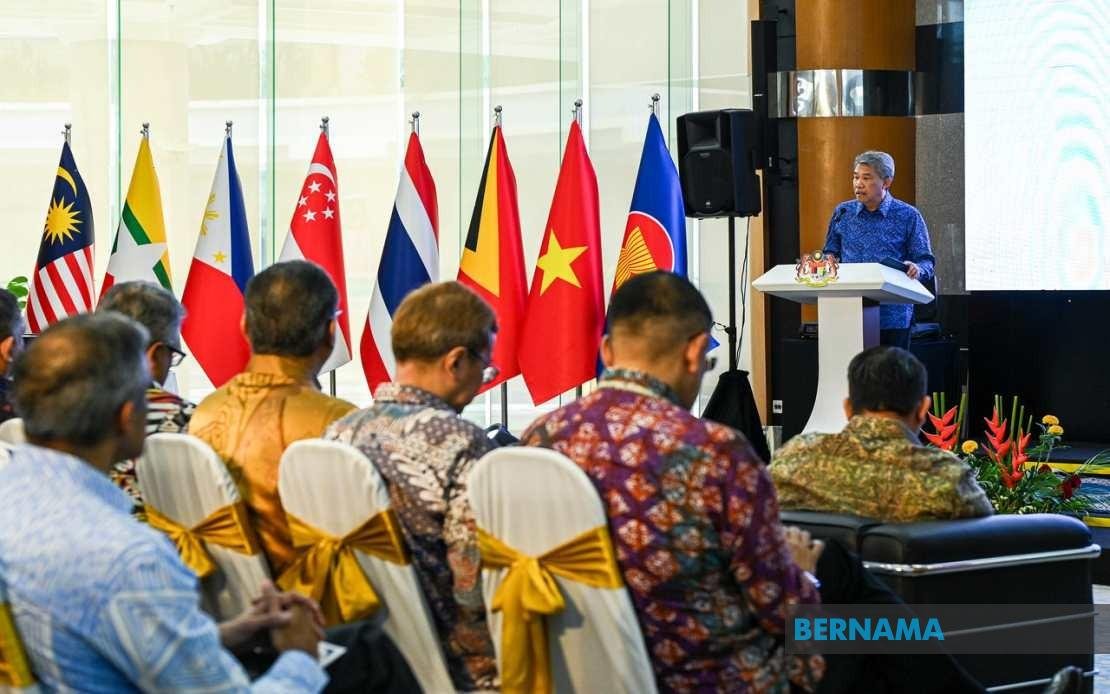
Malaysian Foreign Minister Mohamad Hasan delivers his speech during the 59th ASEAN Day commemoration in Putrajaya, Malaysia, on August 10. (BERNAMA)
“In a fragmented world, our (ASEAN) centrality and unity matter more than ever. The existing international order is not just under strain; it is facing unprecedented levels of fragmentation, characterised by major power rivalries, geo-economic competition and frayed multilateralism, the world now is increasingly more complex, analytical and unpredictable,” the foreign minister stated.
He further underscored that ASEAN “must confront this sobering reality with clarity of purpose and ambition,” noting that “to navigate the uncertain strategic landscape” ASEAN must maintain its relevance to be “the voice of reason and a resilient community committed to peace and shared prosperity”.
The event gathered roughly 300 dignitaries under the theme “59 Years of Navigating Together”, honouring regional solidarity and cooperation. Also present were Tourism, Arts and Culture Minister Tiong Kin Sing and Deputy Foreign Affairs Minister Lukanisman Awang Sauni, alongside representatives from the diplomatic corps, government officials and international organisations.
In the subsequent press conference, Foreign Minister Hasan pointed to intra-ASEAN trade, which currently accounts for less than 25% of the bloc’s total trade. According to him, boosting commerce among member states is critical if the region is to realise its full market potential in becoming the world’s fourth-largest economy by 2030.
“Insya-Allah, with Malaysia entrusted as the Permanent Shepherd or Permanent Auditor of the ASEAN 2045 Vision (ASEAN Community 2045), we want to ensure that our foundation, namely intra-ASEAN trade, can be further strengthened and successfully advanced together,” he concluded.
What does this mean for businesses?
Existing regulations that primarily focus on dismantling trade and tariff barriers will likely prove inadequate if ASEAN aims to climb into the global top ranks. The stark reality is that businesses remain overly reliant on extra-regional trade with major global economies such as China, the US and Europe, rather than leveraging regional supply chains within Southeast Asia.
With intra-regional trade accounting for barely a quarter of total volumes, member states must pivot from traditional pacts toward structural industrial upgrading and integrated cross-border foreign direct investment (FDI).
Kala Advisory helps investors turn regional supply chain shifts and cross-border FDI integration into targeted, country-by-country entry plans across Southeast Asia. Visit kala-advisory.com.
About The Author