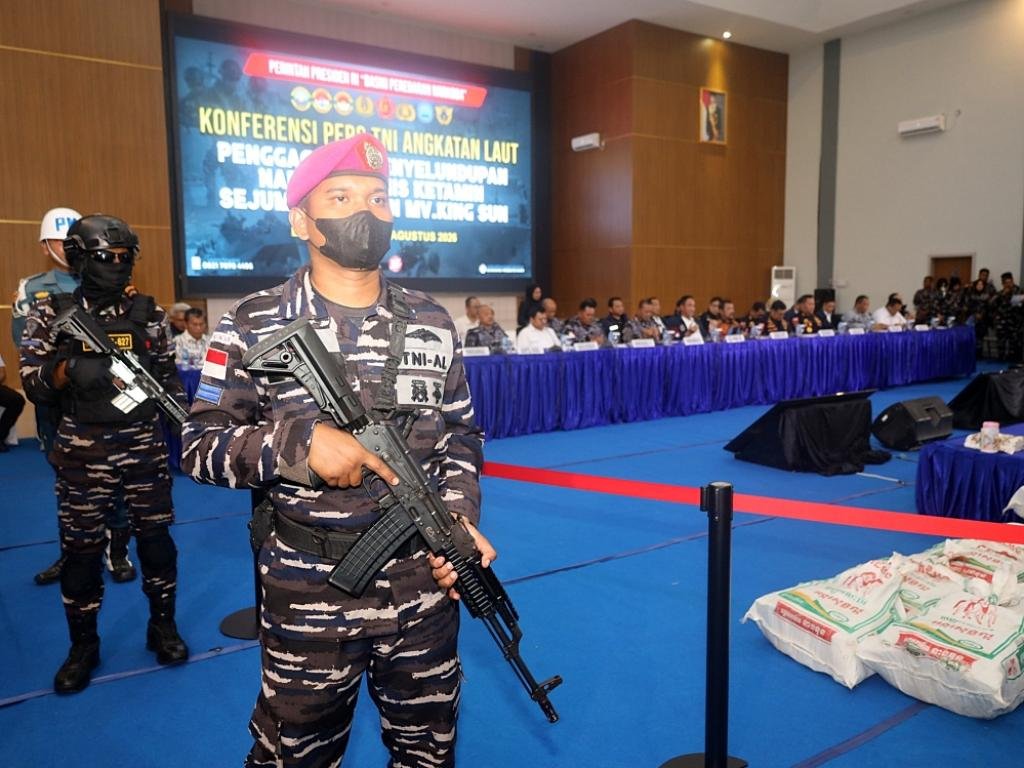
Indonesian Navy personnel stand guard during a press conference following the seizure of nearly 1.3 tonnes of ketamine from a foreign vessel. (Indonesian Navy)
On August 9, Indonesia announced plans to strengthen maritime security and inter-agency cooperation after authorities intercepted a foreign vessel carrying nearly 1.3 tonnes of ketamine, highlighting concerns over the country being used as a transit route for transnational drug trafficking.
Indonesian Fleet Commander Vice Admiral Denih Hendrata said the Indonesian Navy (TNI AL) would reinforce patrols and surveillance along vulnerable maritime corridors, particularly around the Riau Islands, where the country’s extensive coastline and numerous entry points create challenges for border enforcement.
The move followed the interception of the MV King Sun north of Tanjung Berakit on August 6. Joint forces seized the drugs after radar systems and vessel-tracking applications detected suspicious movements. Authorities are investigating whether the vessel used false documents or altered its identity to evade detection.
Vice Admiral Hendrata said the Navy would work more closely with the National Narcotics Agency (BNN), Customs and Excise, intelligence agencies and other authorities to identify so-called “dark ships” that disable tracking systems or manipulate their identities to evade detection.
The case came days after Indonesian authorities arrested a Malaysian Airlines pilot accused of attempting to smuggle more than 70,000 ecstasy pills and methamphetamine through Jakarta’s Soekarno-Hatta International Airport. Indonesian customs officers reportedly detected suspicious behaviour through risk-based analysis despite the suspect being directed to an aircrew fast-track lane.
The two cases highlight how trafficking networks can exploit weaknesses across different transport and enforcement systems. For Indonesia, the incidents emphasises the need to link maritime surveillance with aviation, customs, intelligence and narcotics enforcement to prevent traffickers from shifting routes when pressure increases in one area.
In regional security level, the cases also highlight the importance of ASEAN cooperation against transnational organised crime. Greater intelligence-sharing, coordinated risk assessment and cross-border enforcement could help identify trafficking networks before they exploit Southeast Asia’s highly connected maritime and aviation corridors.
About The Author