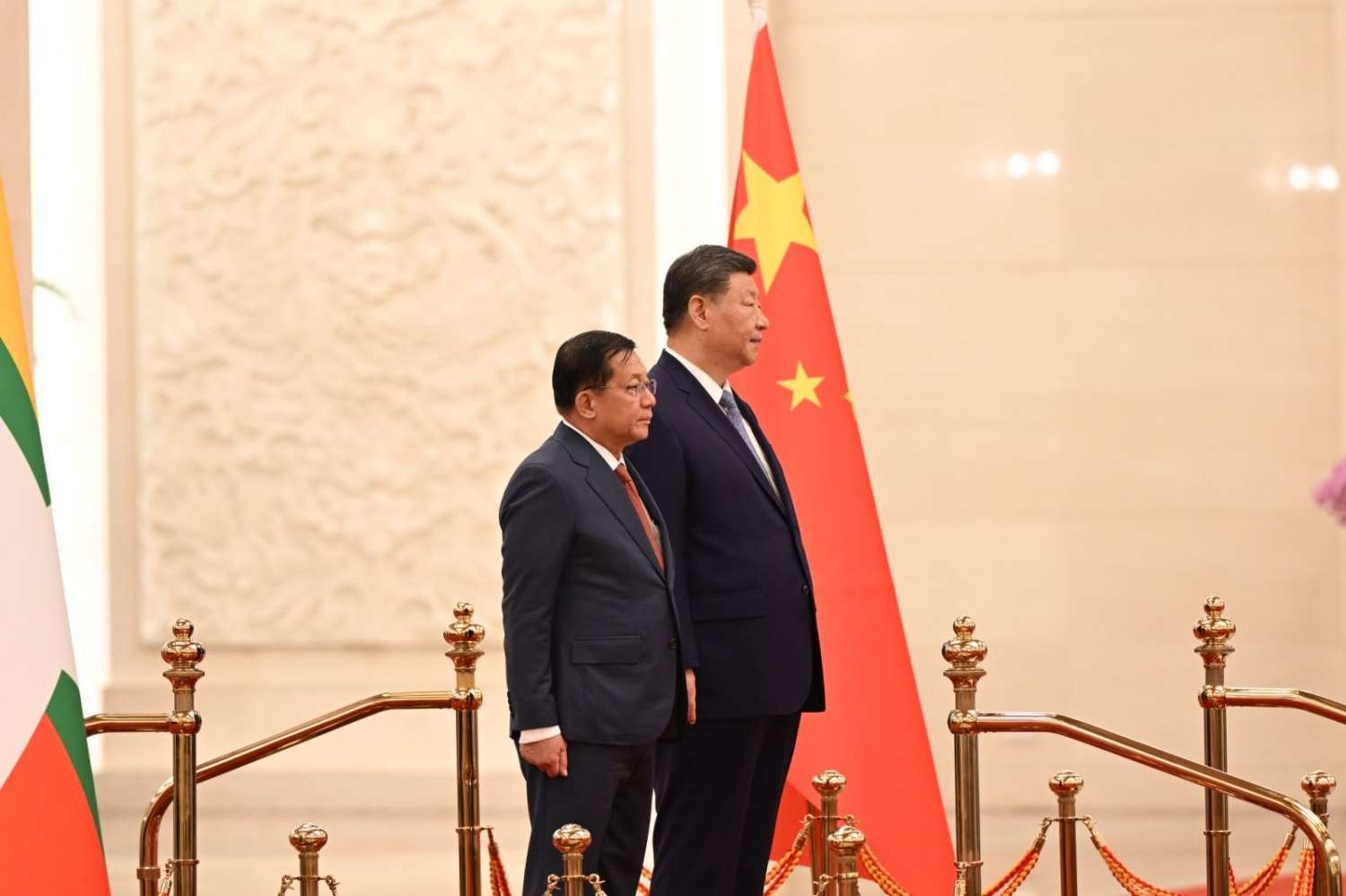
At the invitation of Chinese President Xi Jinping, Myanmar’s President, on a state visit to China, met with Xi at the Great Hall of the People in Beijing this morning. (Myanmar Ministry of Information)
Myanmar President Min Aung Hlaing paid a five-day official state visit to Beijing from June 15 to 19. This trip underscored the manifestation of “pauk-phaw” friendship and aimed to strengthen bilateral ties between Naypyidaw and Beijing.
The president met with his Chinese counterpart, President Xi Jinping, signing 18 agreements across several strategic sectors, including human resource development, agriculture, trade promotion, media and humanitarian cooperation as well as and technology and knowledge exchange. Myanmar also committed to the frameworks of the Global Development Initiative, the Global Security Initiative, the Global Civilization Initiative and the Global Governance Initiative.
The Belt and Road Initiative (BRI) was also brought to the fore, particularly the establishment of the China-Myanmar Economic Corridor (CMEC) to integrate trade. Within this framework, two major projects are to be accelerated, including the Kyaukpyu Deep-Sea Port and the Muse-Mandalay Railway .
A highlight of the visit was a joint statement in which Myanmar reiterated the Five Principles of Peaceful Coexistence as the foundation of bilateral relations. China offered support through its national development agenda, security umbrella and protection against international pressure or sanctions. In return, Myanmar pledged its commitment to the One-China principle, formally recognising the indivisibility of Chinese sovereignty.
Consistent with this diplomatic stance, Myanmar explicitly opposed any manifestation advocating Taiwan independence, renounced all formal bilateral exchanges with Taipei, and suppored Beijing’s strategic initiatives for national reunification.
It also promised to treat the geopolitical dynamics of Hong Kong, Xinjiang and Xizang as strictly internal matters of Beijing, refusing any endorsement or recognition of external involvement in these regions.
On the cultural front, the Buddha Tooth Relic was brought from China to Myanmar for the fifth time, alongside the establishment of memorial facilities honouring the Chinese Expeditionary Force in Myanmar.
This visit marked a monumental achievement for Beijing. China secured direct energy and trade access to the Indian Ocean. Furthermore, both sides were able to connect Yunnan Province directly to Myanmar’s central economic zones, aligning with the 15th Five-Year Plan.
The strategy aimed to bolster energy security strategy through pipelines and ensure that the shared 2,100-km is free from transnational crime networks as well as hinder insurgent groups such as the Arakan Army near Kyaukphyu from disrupting a critical energy chokepoint. Concurrently, Naypyidaw gained a guarantee of a longstanding government under the junta, reinforcing its grip on power while helping national infrastructure projects as both a security and political tool.
About The Author