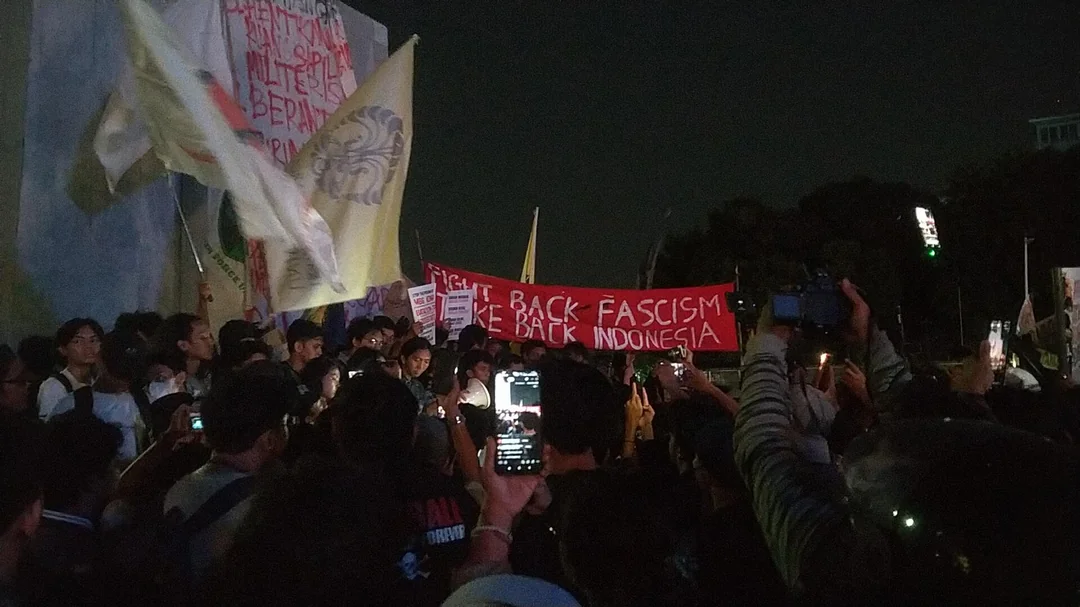
Demonstrators gather during a nighttime protest in Indonesia on 20 October. (Daniel Anak Budi)
On October 20, protests spread across several Indonesian cities over forest fires and toxic haze that have affected public health for weeks, putting renewed pressure on Indonesian President Prabowo Subianto’s government as it marked its second year in office.
Demonstrations took place in Jakarta, Bandung, Yogyakarta, Pekanbaru and Makassar, where students and activists criticised the government’s handling of the fires and raised broader concerns over governance and corruption. Protesters called for immediate action to extinguish the blazes, with banners highlighting their right to breathe clean air.
The fires, which have affected parts of Sumatra and Borneo since July, have left residents struggling with persistent smoke and worsening air quality. The haze has also affected neighbouring countries, with Singapore reporting unhealthy air quality and Timor-Leste suspending in-person classes amid worsening pollution.
Indonesian authorities have deployed more than 60,000 firefighters, including volunteers, to tackle the fires nationwide. The National Disaster Mitigation Agency (BNPB) also reported that 49 aircraft were available for water-bombing and cloud-seeding operations, although haze had intermittently grounded some aircraft.
The government has also intensified firefighting operations and ordered investigations into the causes of the fires. Additional helicopters and aircraft have been deployed for aerial operations, alongside personnel from the military, police and forestry agencies. President Prabowo has called for investigations into suspected deliberate burning and possible corporate involvement, directing relevant authorities to take action against those found to have violated the law.
As of October 19, firefighting teams had extinguished 454.25 hectares of the 1,024.33 hectares targeted for operations, with suppression and cooling efforts continuing in the remaining areas. Meanwhile, high-confidence hotspots increased sharply in Central and West Kalimantan, while smoke was detected across parts of Sumatra, Kalimantan, Sulawesi, Maluku and Papua.
The protests highlight the gap between Indonesia’s immediate firefighting response and the longer-term measures needed to prevent recurring wildfires. While deploying personnel and aircraft can help contain active fires, repeated haze episodes underscore the challenges of fire prevention and sustainable land management. The effects on neighbouring countries also reinforce the importance of regional cooperation in addressing transboundary pollution.
About The Author