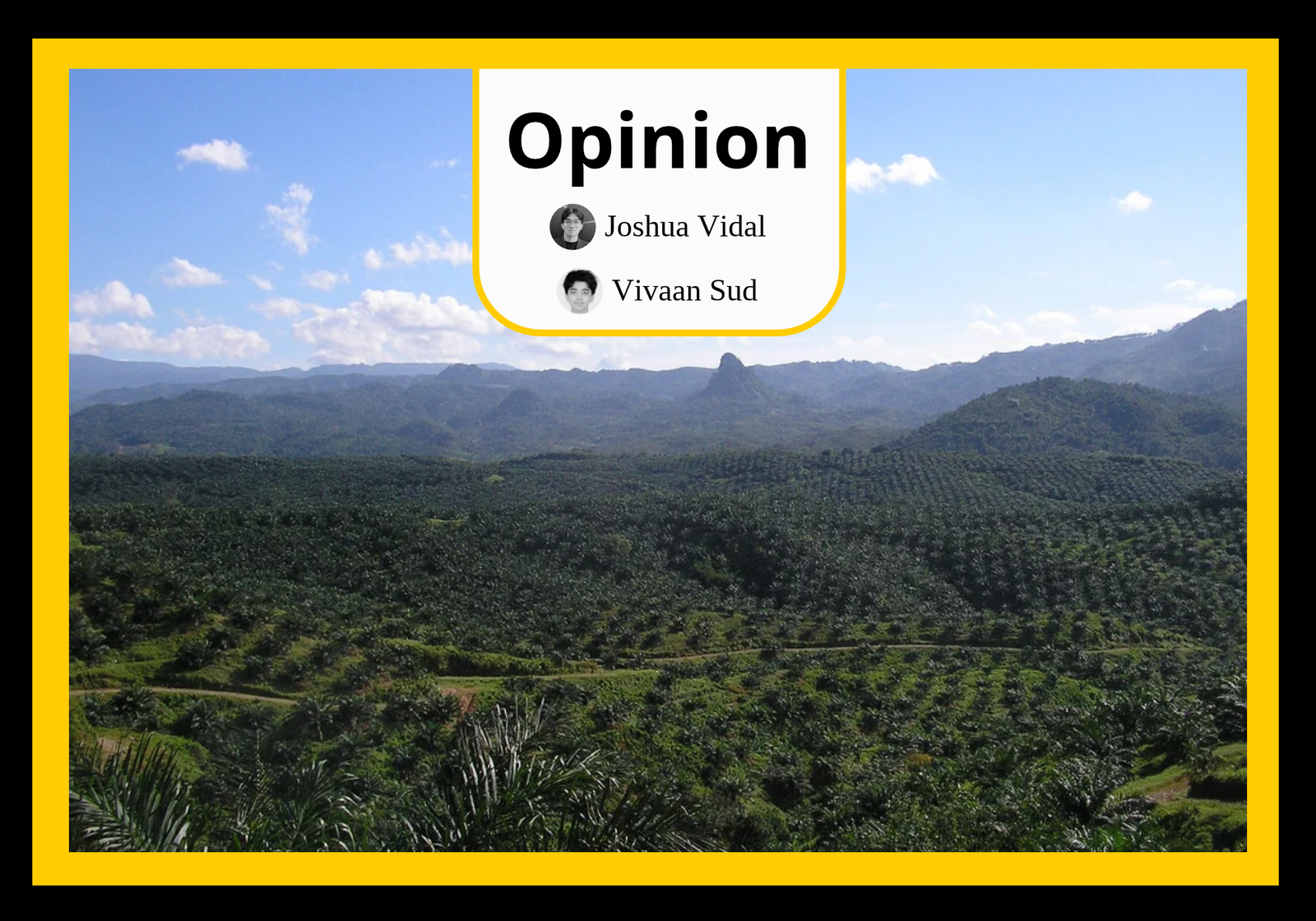
View of palm oil plantation in Cigudeg, Bogor in 2008. (Wikimedia/Achmad Rabin Taim)
Joshua Vidal, MAEd is a Transdisciplinary Research Associate on Coastal Cities at Risk in the Philippines-Ateneo de Manila University, Editor-in-Chief for the Electronic Paper for Science and Technology Education-The Publication Office, and Founder of Schools Climate Action Projects.
Vivaan Sud is the Founder of BeyondThePalm, and a Student Researcher at GSCRAN.ORG
The views expressed are the author’s own and do not necessarily represent those of any affiliated institution.
The future of Indonesian palm oil should not be reduced to a choice between economic development and environmental protection. The more difficult question is whether one of the world’s most productive agricultural industries can continue creating “values” for both livelihoods and trade, without making ecological loss the hidden cost of growth.
Palm oil is one of those commodities that appears ordinary until its entire system is revealed.
It is found in cooking oil, processed food, cosmetics, detergents, personal-care products, industrial materials and, clearly, energy supply chains. Behind these everyday products sits an industry that has transformed rural landscapes, generated export earnings, supported farmers and workers, and ultimately placed Indonesia at the centre of global palm-oil production.
The scale is impossible to overlook. For the 2025/26 marketing year, the US Department of Agriculture estimates Indonesian palm-oil production at 46.7 million metric tonnes, equivalent to 57.3% of global output. Indonesia therefore produces substantially more than half of the world’s palm oil. Figure 1 situates Indonesia’s production relative to the other leading global producers.
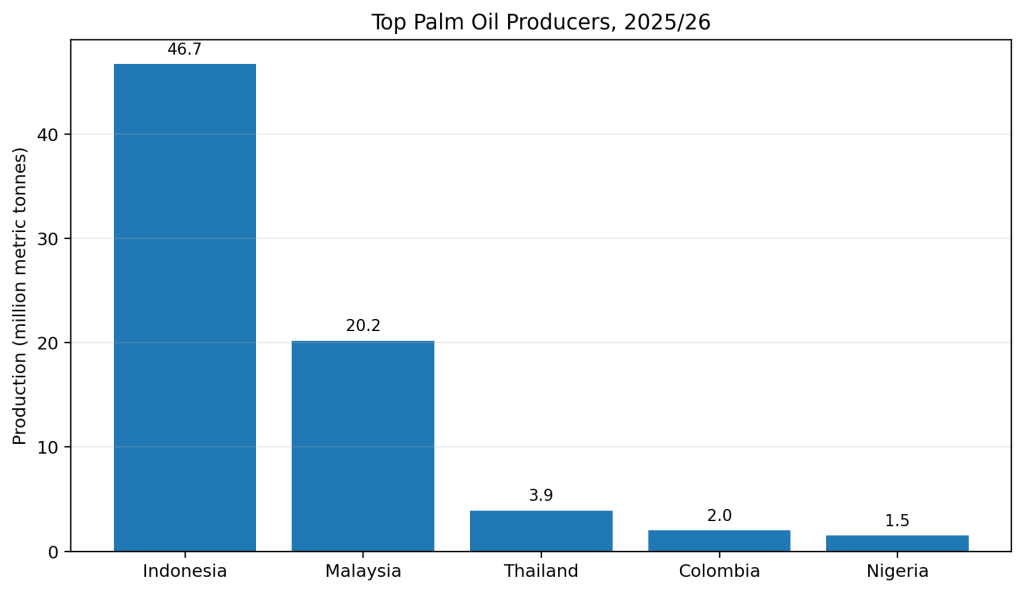
Figure 1. Top palm oil-producing countries in 2025/26. Indonesia is projected to account for 57.3% of global production. Source: USDA Foreign Agricultural Service (2026).
The economic significance is also visible in trade. BPS-Statistics Indonesia reported that exports of crude palm oil and its derivatives reached 11.43 billion US dollar from January toJune 2025, an increase of 24.81% compared with the same period in the previous year.
But size creates responsibility.
The expansion of the palm oil sector is essentially inseparable from land conversion, forest loss, peatland disturbance, biodiversity pressures, fire risk, labour conditions and disputes involving communities. Yet, treating palm oil simply as a crop that should be entirely boycotted overlooks the millions of people, small farms, companies and local economies already embedded in its supply chain.
The question is therefore not whether palm oil matters to Indonesia. It clearly does. The matter is whether this significance can be utilised to drive sustainable growth, rather than as a justification to continue business-as-usual.
The Growth Problem
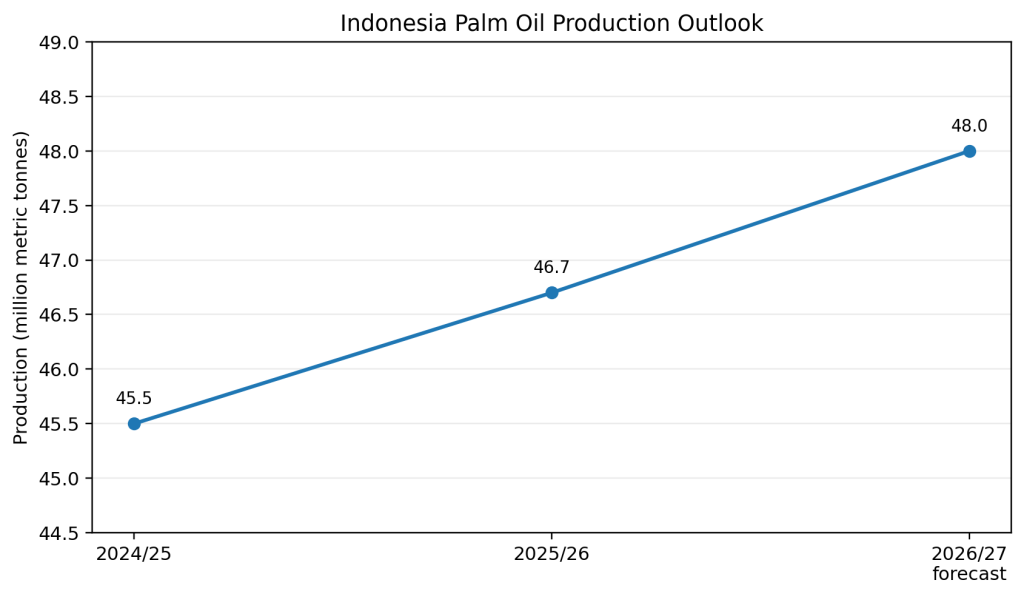
Figure 2. Indonesia palm oil production, 2024/25–2026/27. The 2026/27 value is a USDA forecast. Sources: USDA Foreign Agricultural Service (2025, 2026).
Agricultural growth has traditionally followed a simple logic: more demand requires more production, and more production requires more land. That logic becomes dangerous when the need to open up land for agriculture eventually came at the expense of forests or other ecologically important landscapes
BeyondThePalm, an educational project on palm oil in Indonesia, conducted an interview with Kaw Kar Mun of the Roundtable on Sustainable Palm Oil (RSPO), who introduced a different way to frame the problem. Discussing Indonesia and Malaysia, she argued that “sustainable action and economic growth can go hand in hand” when greater production is pursued through higher yields and agricultural efficiency on existing, legally managed plantations rather than expansion into forested areas.
That argument matters because oil palm is already an exceptionally productive oil crop. A comparative synthesis presented by Our World in Data, using Food and Agriculture Organisation (FAO) data, reported that palm oil accounted for 36% of global vegetable-oil production in 2017 while occupying “only” 8.6% of land devoted to vegetable-oil crops. The same analysis shows that oil palm produces substantially more oil per hectare than major alternatives such as soybean, sunflower, rapeseed and coconut.
This juxtaposition clearly does not absolve the industry of environmental responsibility. A high-yield crop can still produce severe ecological damage when expansion occurs in sensitive landscapes. It does, however, complicate the assumption that removing palm oil would automatically reduce agricultural pressure. Replacing a high-yield crop with lower-yield alternatives may just shift land demand rather than eliminate it.
The sustainability test is therefore not whether oil palm is biologically “efficient”. It is whether that efficiency is used to reduce pressure on land.
The Role of the Smallholders
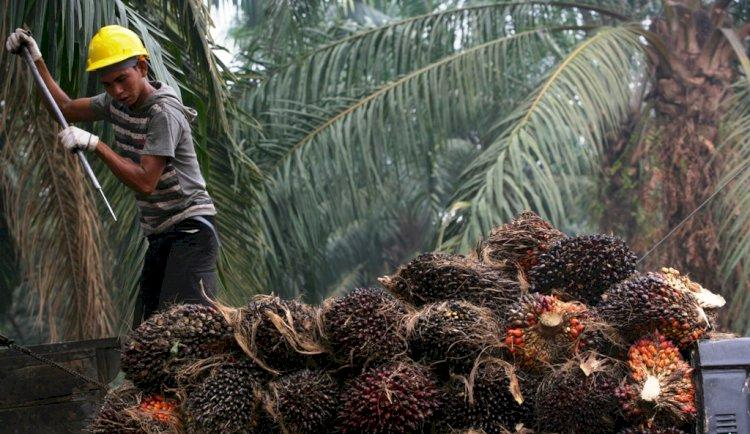
A palm oil plantation worker in Indonesia. (Indonesian Ministry of Energy and Minerals)
Palm-oil debates often focus on large companies because they occupy the most visible part of the supply chain. Yet the transition towards sustainability cannot succeed without smallholders.
RSPO stated that more than seven million smallholders around the world make a living from oil palm and that, in Indonesia and Malaysia alone, smallholdings represent approximately 40% of total oil-palm production area.
The interview with Kaw Kar Mun makes the implication explicit. She argued that because smallholders are vital to the future of sustainable agriculture, “excluding them from global supply chains would undermine broader sustainability goals”.
This is more than an inclusion argument. It is a practical implementation problem.
Global markets increasingly demand traceability, certification, land documentation, environmental safeguards and evidence of responsible sourcing. Yet ironically, many smallholders face constraints in finance, agronomic knowledge, planting materials, market access, certification costs and administrative capacity. A sustainability framework risks becoming exclusionary if the standards become more demanding faster than farmers’ capacity to meet them.
RSPO’s response includes the Independent Smallholder Standard, the Smallholder Support Fund, the Smallholder Trainer Academy and the Smallholder Engagement Platform. In the interview, Mun described these mechanisms as ways of helping small-scale farmers enter regulated and certified supply chains without being left behind as requirements evolve.
The challenge is becoming more urgent because productivity remains uneven. A 2026 study highlighted by RSPO, drawing on data from the Indonesian Ministry of Agriculture, reported that independent smallholders manage around 41% of plantation area but currently reach only about 26.5% of estimated productivity potential (the yield smallholder plantations could achieve per hectare with good seedlings, adequate inputs and sound farming practices, compared with what they actually produce today); the study estimated that structural constraints could cost Indonesia up to 4.73 million tonnes of CPO production potential.
That figure should not be read as a reason to intensify production. It should be read as evidence that part of Indonesia’s future production may already be hidden inside existing plantations—in the form of untapped productivity potential.
Farmers cannot simply be instructed to “become sustainable”. They need the financial, technical and institutional capacity to do so.
Certification and Traceability
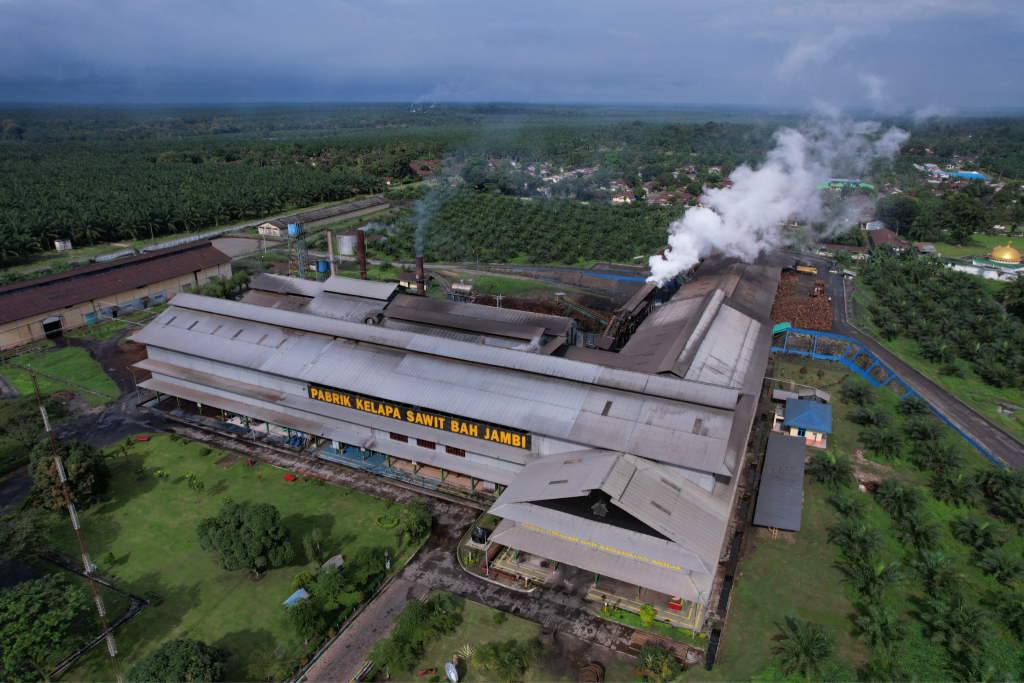
A palm oil processing factory in Indonesia. (PTPN IV)
For many consumers, certification appears as a small logo on product packaging.But behind that logo sits a broader governance problem.
Can a company transparently demonstrate where its palm oil came from? Can plantation boundaries be verified? Can environmental risks be detected? Can buyers follow material through complex supply chains? Can sustainability claims survive scrutiny beyond advertising?
In the interview, Mun described a significant shift in the role of certification and traceability. She explained that they have moved from voluntary market differentiators towards increasingly important requirements shaped by due-diligence rules and changing expectations around ethical sourcing.
This is where technology becomes important. Mun described technology as “an essential bridge between standards compliance and market verification” because digital systems can replace manual, error-prone tracking with records that are more transparent and auditable.
RSPO’s digital ecosystem includes prisma (which stands for PalmResource Information and Sustainability Management) for certification trade, and traceability; GeoRSPO for geospatial visibility over member concessions; and the RSPO Hotspot Hub, which uses satellite imagery to identify heat signatures that may signal potential fires. In Mun’s description, these tools are not merely administrative conveniences;they form part of the infrastructure through which environmental performance and supply-chain claims can be checked.
That distinction matters because transparency and accountability are not identical. Technology can reveal information, but institutions must still decide what to do with it. A satellite can identify a hotspot, but it cannot by itself explain why governance failed. A traceability platform can record origin, but it cannot guarantee fair treatment of workers. A database can improve visibility, but it cannot replace enforcement.
Nevertheless, technology changes the cost of invisibility. When more of the supply chain can be traced, mapped and audited, sustainability claims become more testable.
Traceability does not automatically produce accountability. But accountability becomes much harder without traceability.
The sustainable palm-oil market has expanded significantly. But it has not become universal. Figure 3 shows the proportion of global production already certified, in certification, and outside those categories.
RSPO reported that certified sustainable palm-oil production reached 16.2 million metric tonnes in 2024, representing 20.1% of global production). RSPO members accounted for 39% of global palm-oil production in the same reporting cycle, with a further 18.9% of production reported as being in the process of certification under RSPO rules.
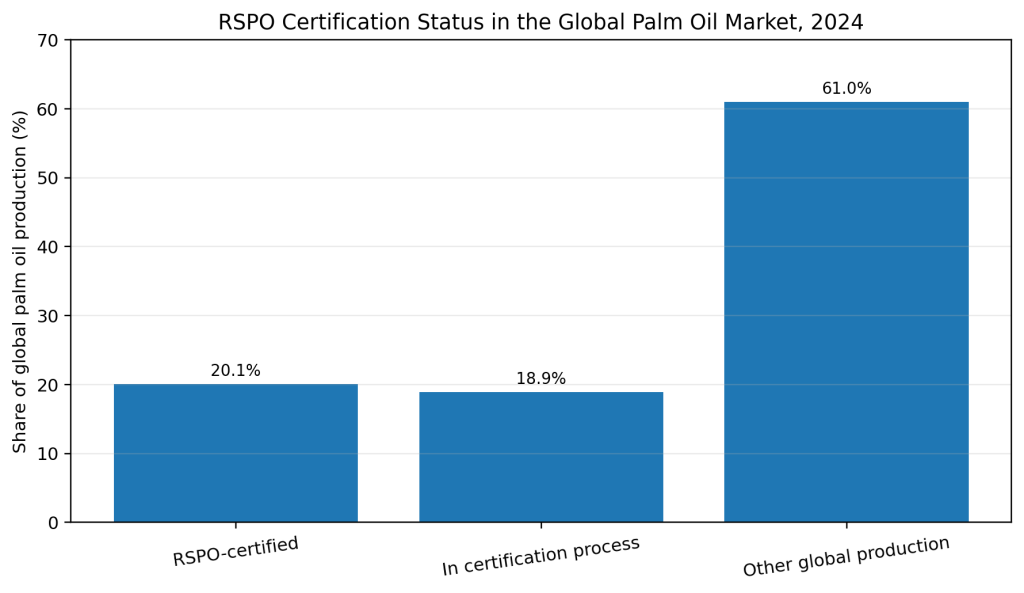
Figure 3. RSPO certification status in the global palm oil market, 2024. Certified production represented 20.1% of global output, while a further 18.9% was reported as being in the certification process under RSPO rules. Source: RSPO (2025).
These figures show that certification has moved far beyond a niche initiative. They also show how much of the sector remains outside certified supply.
This is why certification should be treated as infrastructure for change rather than proof that the broader problem has been solved.
Mun’s interview reinforces this point. She described RSPO’s future priorities as strengthening credibility and assurance, increasing demand for certified sustainable palm oil, expanding smallholder inclusion and strengthening the traceability ecosystem.
The significance lies in the direction of travel. Palm oil does not become sustainable merely because a sustainable segment exists. The larger transformation occurs when better standards, better monitoring and better accountability increasingly become normal practice across the wider sector.
Palm oil has become an environmental symbol and symbols encourage simple choices. Avoid the commodity and the problem appears to disappear.
But agriculture does not work through symbols. It works through land, yields, markets, labour and substitution.
Because oil palm produces far more oil per hectare than many competing crops, a blanket replacement strategy could require more agricultural land to produce the same quantity of vegetable oil. This does not make palm oil harmless. It makes comparison necessary.
In the BeyondThePalm interview, Mun made the distinction directly, “the core issue is not the oil palm plant itself, but the methods used to cultivate it”. She also argued that younger consumers should understand the difference between conventional palm oil and certified sustainable palm oil and use available labelling and sourcing information to make more informed choices.
That is a more difficult message than simply telling consumers to buy or boycott a product.
It asks where the palm oil came from. Whether the forest was converted. Whether the source can be traced. Whether labour and community safeguards were followed. Whether smallholders were included. Whether the claim is independently verified.
Consumers matter, but individual choice does not absolve the actors behind the production of their structural responsibility. Governments establish regulation. Companies determine sourcing. Plantation managers shape land-use decisions. Financial institutions influence investment. Certification organisations create standards. Technology providers increasingly build the systems through which verification occurs.
Expecting a person standing in a supermarket to solve a global agricultural problem through one purchasing decision is not sustainability governance. It is outsourcing governance.
The Future of Palm Oil
| Signal | Evidence | Implication |
| Global production | Indonesia: 46.7 million metric tonnes in 2025/26, equal to 57.3% of global palm-oil production (USDA FAS, 2026). | Indonesia’s production and policy choices influence the global palm-oil market. |
| Export importance | CPO and derivative exports reached 11.43 billion US dollar in Jan–Jun 2025, up 24.81% year-on-year (BPS-Statistics Indonesia, 2025). | Palm oil remains economically important to Indonesian trade. |
| Smallholder scale | More than 7 million smallholders globally depend on oil palm; smallholdings represent about 40% of oil-palm area in Indonesia and Malaysia (RSPO, n.d.-a). | Any transition that excludes smallholders will struggle to achieve sector-wide sustainability. |
| Indonesia smallholder productivity | Independent smallholders manage about 41% of Indonesia’s plantation area but are reported to operate at about 26.5% of estimated productivity potential (RSPO, 2026). | Improving existing farm productivity may reduce pressure for expansion while supporting livelihoods. |
| Crop efficiency | Palm oil produced 36% of global vegetable oil in 2017 while using 8.6% of vegetable-oil cropland (Ritchie, 2021). | Substitution with lower-yield crops can shift land-use pressure rather than eliminate it. |
| Certification reach | RSPO-certified production reached 16.2 million metric tonnes in 2024, or 20.1% of global output (RSPO, 2025). | Certification has meaningful scale but still covers only part of the global market. |
Table 1. Evidence snapshot of the economic, smallholder, productivity, land-use, and certification dimensions of palm oil. The indicators use different units and should not be interpreted as a single sustainability score.
The palm-oil sector is increasingly becoming a data system as much as an agricultural system.
The research materials behind BeyondThePalm point towards plantation-level technologies used for workforce management, material tracking, supply-chain traceability, geolocation, plantation mapping, and monitoring of inputs. The same material points toward emerging applications in mechanisation, biological inputs, drone-supported operations, leaf scanning, nutrient monitoring, and internet-of-things-based pest detection.
These technologies matter because the sustainability problem is not a lone-standing matter. Productivity matters. Chemical use matters. Labour efficiency matters. Waste matters. Fire risk matters. Land conversion matters. Traceability matters. No single technology resolves all of them.
But technology can help make agricultural decisions more precise. Earlier detection of nutrient deficiencies can improve input management. Better pest monitoring can support more targeted interventions. Digital traceability can make origin claims easier to verify. Satellite monitoring can identify environmental risk faster than purely manual systems.
However, the danger is blindly assuming that digitalisation itself is evidence of sustainability. A highly digital plantation can still be poorly governed. A technologically efficient plantation can still expand into the wrong places, exploit its workforce, ignore community land rights or suffer from weak local management.
The important question is therefore not whether plantations adopt more technology, but whether that technology produces measurable reductions in environmental pressure, waste, risk and avoidable land expansion.
This brings us to the question of whether the palm oil sector can grow without consuming its future. This depends on how Indonesia defines growth. If growth continues to mean principally more production from more land, the contradiction between economic expansion and environmental protection will remain. If growth increasingly means higher productivity from existing plantations, stronger protection of high-value ecosystems, better support for smallholders, measurable traceability, responsible innovation and credible enforcement, a different pathway becomes possible.
None of these conditions is easy. Higher productivity does not automatically stop land expansion. Certification does not eliminate implementation failures. Technology does not remove politics from land. Consumer awareness does not guarantee responsible corporate behaviour. Sustainability labels do not make difficult trade-offs disappear.
But complexity is not an excuse for reducing the debate to a choice between defending palm oil and rejecting it.
The next achievement of the industry should therefore not simply be another production record. It should be proving that more economic value no longer requires more ecological sacrifice proportionately.
Mun’s final observation during the interview offers an appropriate way to frame that task. “Sustainability is a continuous journey rather than a static destination,” she said, emphasising continuous improvement and partnership across the supply chain.
For Indonesia, this means that there may never be a single year in which palm oil suddenly becomes sustainable. What matters is whether the direction of the system is changing.
Are yields rising faster than land expansion? Are smallholders becoming more capable rather than more excluded? Are supply chains becoming more visible? Are forests becoming harder to convert? Are sustainability claims becoming easier to verify? And are economic gains becoming less dependent on ecological loss?
Those are more difficult measures than tonnes produced or dollars exported. They are also more meaningful.
Palm oil helped Indonesia build an economic giant. Its next test is whether the industry can become strong enough to stop treating the landscape that sustains it as an unlimited source of growth.
About The Author