
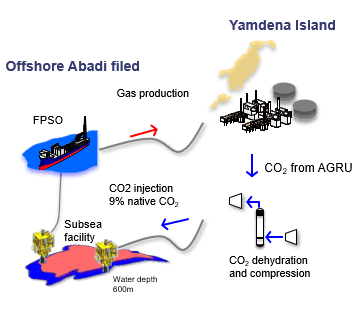
A diagram illustrates the Abadi LNG Project’s offshore gas production and CO₂ injection process near Yamdena Island, Indonesia. (INPEX)
Indonesian President Prabowo Subianto officially launched the groundbreaking of the Abadi Masela Liquefied Natural Gas (LNG) National Strategic Project on July 16. He officiated the ceremony virtually via video conference from the Merdeka Palace in Jakarta.
“I am confident this project will become a catalyst for Indonesia’s advancement, especially for eastern Indonesia,” the President remarked.
This historic event marks the formal start of construction on one of Indonesia’s largest energy initiatives, located in the Tanimbar Islands Regency, Maluku province. It ends a developmental delay lasting nearly three decades since the initial production-sharing contract was signed in 1998.
The project, backed by a 20.9 billion US dollar investment, is a joint venture between Indonesia’s state energy company Pertamina, Japan’s INPEX Masela and Malaysia’s Petronas.
The facility is projected to yield an annual output of 9.5 million metric tons of annual LNG, alongside 150 million standard cubic feet of daily domestic pipeline gas and roughly 35,000 barrels of daily condensate
Reportedly, as of early July 2026, the project’s front-end engineering design exceeded targets at 79.56% completion, with key licensing and design milestones on track for a year-end final investment decision.
Analysts estimate this project will contribute over 130 billion US dollar to the country’s GDP by 2055. It is also expected to generate over 12,000 jobs during the construction phase alone, boosting revenues for both regional and central governments.
What does this mean for business?
The multi-billion-dollar enterprise unlocks massive opportunities across supply chains. Local and multinational firms stand to gain from extensive infrastructure contracts, while the newly introduced CCS component creates a brand-new domestic market for green technology providers and environmental engineering specialists. However, this project could be a major setback for Indonesia’s net-zero emission goals, introducing massive ecological risks to a pristine marine environment. Not to mention that moving the LNG processing plant onshore to the Tanimbar Islands requires clearing large tracts of land. This causes immediate habitat fragmentation, localised pollution and severe strain on the islands’ limited freshwater resources.
About The Author


One thought on “Indonesia Begins $20bn Abadi Masela LNG Hub Construction”