
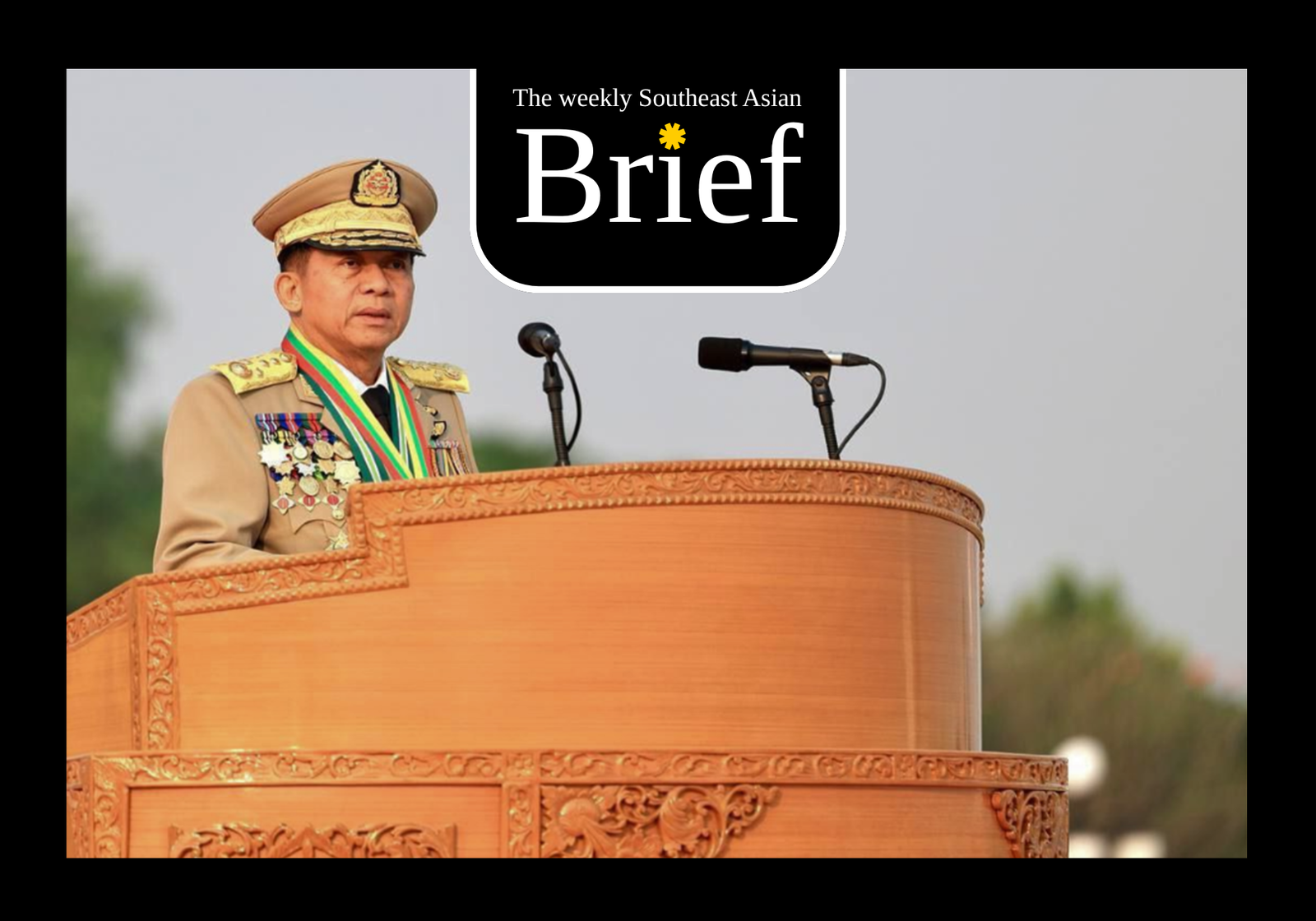
Then-Senior General Min Aung Hlaing delivering his speech during the Parade of 78th Anniversary of Armed Forces Day in March 2023. (Myanmar Government)
During the informal gathering, the minister briefed his counterparts on the newly established administration’s agenda, including on the thornier issue of the humanitarian crisis that is happening in the country.
He laid out the administration’s efforts to implement the 2021 ASEAN-proposed five-point consensus (5PC) framework, as well as President Min Aung Hlain’s self-proclaimed “100-Day Plan”.
Launched on April 20, the junta leader-turned-president set a 100-day deadline for the regime to achieve conflict resolution and restore national stability. The strategy compromises two core pillars: ministry-specific development projects and the national peace process.
However, approaching the July 31 deadline, there is a distinct lack of evidence that the initiative has yielded its rhetorical targets. Instead of infrastructure development and peace, the period has been defined by trade choking, military escalations and performative diplomacy.
In terms of “peace talk” engagement with resistance groups, the junta’s National Solidarity and Peacemaking Negotiation Committee (NSPNC) has admittedly held a series of meeting with both signatories and non-signatories of the 2015 Nationwide Ceasefire Agreement (NCA)
Nevertheless, analysts dismissed these talks as a hollow public relations stunt designed to stimulate progress for international observers.
Concrete examples illustrate this failure. First, the framework intentionally barred the main post-coup democratic opposition groups (which the regime labels as “terrorist organisation”), including the National Unity Government (NUG) and the Committee Representing Pyidaungsu Hluttaw (CPRH). Major ethnic armed organisations (EAOs), notably the Karen National Union (KNU), the Chin National Front (CNF) and the All Burma Students’ Democratic Front (ABSDF), have also openly boycotted the plan from day one.
The latest dispatch reveals that the NSPNC only ended up negotiating with the 7 EAO Alliance, a collection of smaller, highly fragmented signatories of the NCA who are not actively fighting the regime.
Second, and fatally, military operations have actually intensified, where the Myanmar Air Force reportedly killed at least 143 civilians and injured over 260 others within just the first month of the plan. To put the number into perspective, 982 civilians were killed from armed clashes in the whole year of 2025.
This irony suggests that the plan was designed to be rejected and thereby justifying further planned military operations, which is highly winnable for the regime that has acquired advanced technology and electronic warfare.
On the other, vital side lies the grassroots vulnerability. Since the 2021 military takeover, Myanmar’s economy has collapsed into a severe, protracted crisis.
Prior to the coup, Myanmar was a booming frontier market. Between 2011 and 2017, the country achieved an average annual gross domestic product (GDP) growth of 7.3%. The economy is currently estimated to be roughly 30% smaller than it would have been without the twin shocks of COVID-19 and the coup.
All output, sales and profits remain severely depressed below pre-coup levels. Such problems compounded the already problematic, overvalued multi-exchange rate system.
Strict, unrealistic currency exchange controls from the central bank valued the Myanmarese kyat far below its actual market value. Because this mechanism forced local businesses to convert their export earnings using the artificial official rate, it diminished economic incentives and productivity, while further fueling black markets.
Theoretically, an overvalued exchange system should have made imports less expensive. However, in Myanmar’s case, the coup not only triggered international sanctions and aid restrictions, but it also sparked massive capital outflow and decimated foreign investor confidence. Hence, foreign exchange (US dollars) became rare, ultimately driving the prices of essential goods (such as oil and medicine) even higher.
There is no concrete mechanism to address these structural problems within the 100-Day Plan. Notably, the project only allocates blueprints to five out of the total 31 ministries within the administration. Its key commercial sector, agriculture (which was hit hardest by the economic downturn), is not even receiving concrete policies to remedy the slump, with only temporary “loan measures” currently being rolled out.
Glaring also is the fact that the implementation of the scheme is centralised to only areas controlled by the junta’s armed forces (mainly Naypyitaw, Yangon and Mandalay). These areas are where the December 2025 elections were held, meaning development projects are intentionally withheld from territories under the control of resistance forces.
Such an ingenuous, non-inclusive framework has proven entirely performative, offering no viable path forward. At the very least, the near-term outlook points to a distinct diplomatic divergence. While an ASEAN special envoy is expected to lead a new humanitarian mission to Myanmar, the junta will likely prioritise deepening its strategic relationship with Beijing over adhering to the regional consensus.
Concurrently, military operations against EAOs are poised to intensify as regional and international pressure softens following the regime’s sham elections. This geopolitical shift is already underscored by Cambodia and Vietnam sending official observers to the polls, effectively granting the junta a veneer of regional legitimacy to pursue further domestic crackdowns.
For private enterprise and foreign investment, the overriding climate remains deeply pessimistic due to the administration’s inability to establish a reliable business environment. No meaningful investment or market recovery can occur while the state’s regulatory frameworks continue to be weaponised for political and military survival rather than economic stability.
About The Author



3 thoughts on “Myanmar’s Flawed 100-day Plan Risks Deepening Its Economic and Humanitarian Crisis”