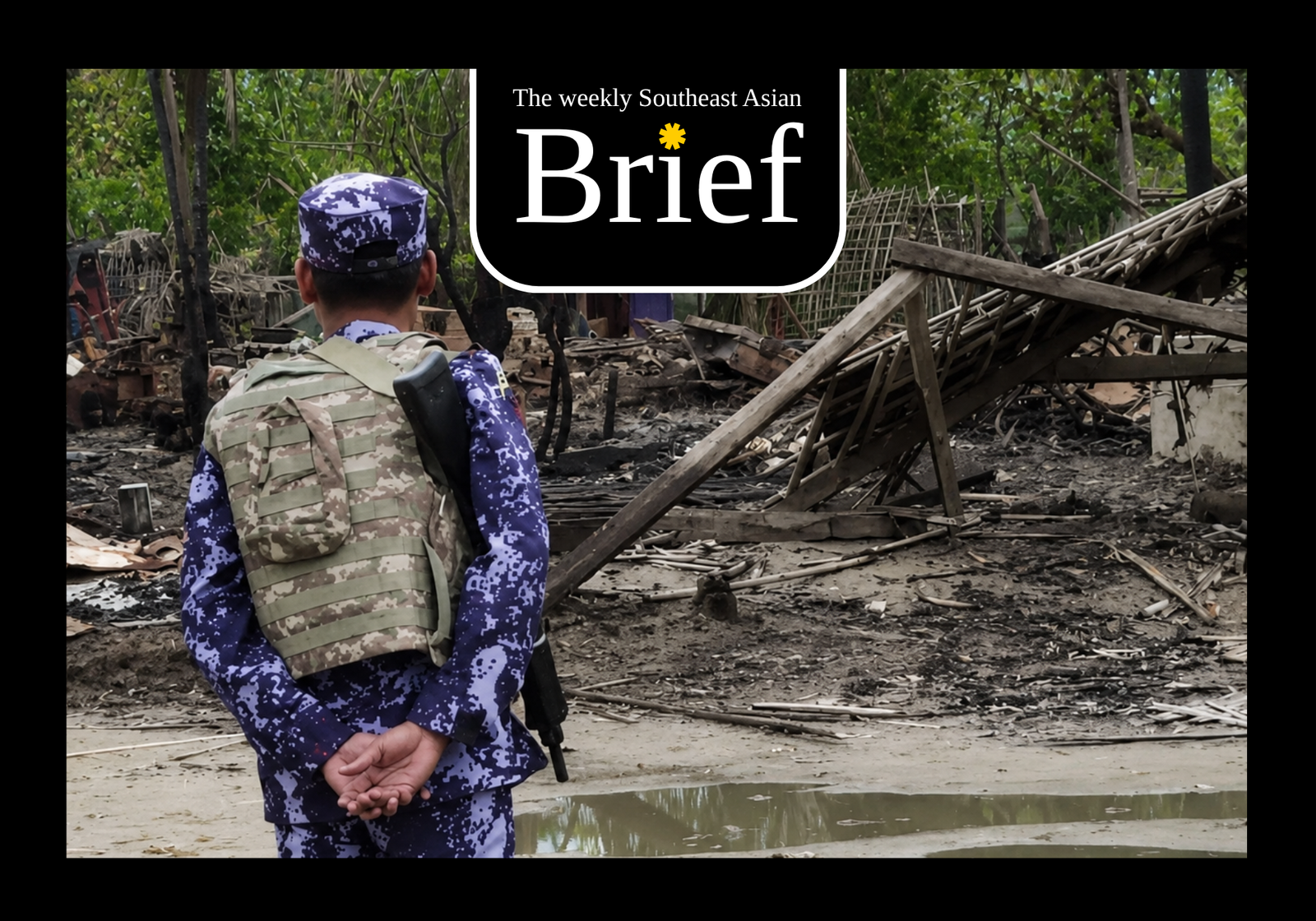
A member of Myanmar’s Border Guard Police inspects a house burnt down in an arson attack. (Wikimedia/Steve Stanford)
ASEAN’s renewed calls for broader humanitarian access, the unconditional release of detained political figures in Myanmar on August 3 and support for a Myanmar-led and Myanmar-owned peace process have once again highlighted the bloc’s reliance on the Five-Point Consensus (5PC) as its principal framework for engagement. Its continued reaffirmation at successive summits and ministerial meetings has increasingly raised questions over ASEAN’s strategic integrity, credibility and centrality in responding to one of the region’s most enduring security challenges.
Myanmar’s political landscape has long been shaped by the military’s influence. ASEAN admitted Myanmar in 1997 partly in the expectation that regional engagement would encourage gradual political reform. Those expectations appeared to gain momentum following the National League for Democracy’s (NLD) electoral victories in 2015 and 2020 under Former Burmese State Counsellor Daw Aung San Suu Kyi. However, that trajectory was interrupted in February 2021, when the military prevented the newly elected parliament from convening, detained civilian leaders and assumed power, prompting ASEAN to formulate the 5PC later that year.
Adopted at the ASEAN Leaders’ Meeting in Jakarta in April 2021, the 5PC called for an immediate cessation of violence, constructive dialogue among all parties, the appointment of a Special Envoy of the ASEAN Chair, humanitarian assistance through the ASEAN Coordinating Centre for Humanitarian Assistance on Disaster Management (AHA Centre) and the Special Envoy’s engagement with all relevant stakeholders. At the time, it represented ASEAN’s most significant collective response to a political crisis involving one of its own member states.
Implementation has nevertheless fallen well short of the framework’s objectives. Violence has continued across Myanmar, inclusive political dialogue remains limited and humanitarian conditions have deteriorated amid the protracted conflict. Although ASEAN has maintained humanitarian engagement and appointed successive Special Envoys, the framework’s core political commitments, including ending violence, facilitating dialogue and enabling the Special Envoy to engage all relevant stakeholders have largely remained unfulfilled.
Rather than replacing the 5PC, ASEAN has consistently reaffirmed it as the core of its engagement with Myanmar. As ASEAN Chair in 2026, the Philippines has prioritised strengthening the framework’s implementation, while Thailand has advocated a policy of calibrated re-engagement that links Myanmar’s gradual reintegration into ASEAN with progress on the 5PC. These approaches illustrate the challenge of maintaining unity within a regional organisation comprising diverse political systems and strategic priorities while adhering to ASEAN’s principles of consensus and non-interference.
From a strategic perspective, ASEAN’s continued reliance on the 5PC reflects an effort to preserve institutional coherence. Replacing the framework without an agreed alternative could expose divisions among member states and weaken confidence in ASEAN’s ability to formulate collective responses to regional crises. Maintaining the consensus therefore serves not only as a policy towards Myanmar but also as a means of safeguarding ASEAN’s unity and central role in regional diplomacy.
At the same time, this approach carries reputational risks. As implementation remains limited, ASEAN increasingly faces scrutiny over whether the 5PC is facilitating meaningful progress or simply managing a prolonged crisis. While ASEAN has restricted Myanmar’s political representation at high-level meetings, it has continued diplomatic engagement to facilitate humanitarian assistance and encourage dialogue. This balancing act reflects ASEAN’s attempt to remain engaged without departing from its longstanding principles.
The implications extend beyond Myanmar itself. ASEAN has long promoted its centrality within the wider Indo-Pacific regional architecture through forums such as the East Asia Summit (EAS), the ASEAN Regional Forum (ARF) and the ASEAN Defence Ministers’ Meeting-Plus (ADMM Plus). The credibility of these mechanisms depends partly on ASEAN’s ability to respond effectively to challenges within its own membership. The prolonged crisis within one of its member states has generated humanitarian displacement in the region, disrupted border communities and contributed to transnational challenges including illicit trafficking and organised crime. The 5PC functions not only as a diplomatic initiative but also as part of ASEAN’s broader effort to contain wider regional security risks.
Looking ahead, ASEAN is unlikely to abandon the 5PC in the near term. Instead, the bloc is expected to continue refining its implementation through humanitarian initiatives, diplomatic engagement and the work of successive Special Envoys. Such an approach reflects ASEAN’s longstanding preference for gradual confidence-building rather than abrupt policy shifts.
Whether this strategy ultimately strengthens ASEAN’s credibility will depend less on the continued existence of the framework than on its ability to produce measurable progress. Incremental improvements in humanitarian access, reductions in violence and broader political dialogue could reinforce confidence in ASEAN’s role as a regional conflict manager. Conversely, if implementation continues to stall, questions are likely to grow over whether the organisation is preserving an important diplomatic framework or merely adapting to a prolonged status quo.
On a regional level, the 5PC has evolved beyond its original purpose as an emergency response to Myanmar’s political crisis. It has become a measure of ASEAN’s ability to reconcile its principles of consensus, sovereignty and non-interference with growing expectations that it should play a more effective role in addressing regional security challenges. How ASEAN balances these competing priorities will shape not only its future engagement with Myanmar but also its long-term strategic integrity, credibility and centrality within the Indo-Pacific regional order.
About The Author