

Firing of M28A1 Reduced Range Practice Rocket from an M142 High Mobility Artillery Rocket System (HIMARS) after rolling off a runnymede-class large landing craft during maritime key terrain security operations as part of Balikatan 2026, at Balabac Island, Palawan on May 3, 2026. (US Army/Staff Sgt. Vadim Bolfun)
The blazing arc of light and uproar that defied the darkness of night in Nueva Ecija was more than a mere military test. The sound emanated from the Typhon Mid-Range Capability system, which launched the Tomahawk missile—for the first time on Philippine soil—as a strategic signal directed to Beijing and to domestic audiences in Manila and Washington. This unprecedented move shows a massive shift in the strategic approach of the Republic of the Philippines.
On April 20, the Philippines commenced the 41st iteration of Balikatan, a joint military exercise with over 17,000 participants across the continents. Along with the US, Australia, New Zealand, Canada, France and Japan, this iteration marks an important trajectory in the Philippines’ defence posture. The joint exercise marks an important shift from the “independent foreign policy” of former Philippine President Rodrigo Duterte (2016-2022) to the active deterrence policy of current president Ferdinand Marcos Jr., which can be seen as a concrete proactive response to China’s rise.
During Duterte’s presidency, the Philippines sought to balance its relations with Beijing amid the 2016 Permanent Court of Arbitration (PCA) ruling that favoured Manila in the South China Sea dispute. Today, under Marcos Jr., more active balancing attempts came to the fore in the country’s foreign and defence policy. The drill no longer acts as an ordinary exercise, but a manifestation of the Comprehensive Archipelagic Defense Concept (CADC), a framework that aims to counter Beijing’s regional hegemony and secure Manila’s sovereignty in what it calls the West Philippine Sea.
Heightened Threat Perception
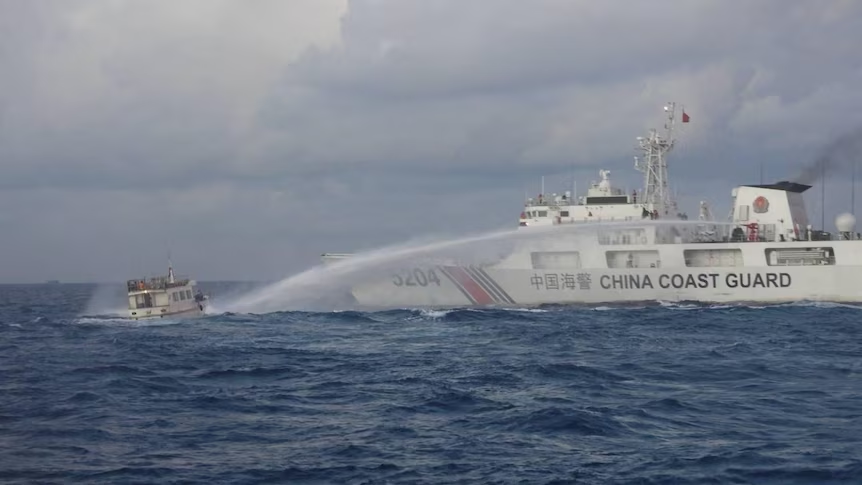
A Chinese Coast Guard ship uses a water cannon against a Filipino resupply vessel heading towards the disputed Second Thomas Shoal, in the South China Sea in December 2023. (Philippine Coast Guard)
To understand the magnitude of the current policy shift, one must grasp the country’s evolving threat perception. For nearly 60 years after its independence, the Philippines witnessed severe internal security dynamics. The rise of the New People’s Army (NPA) and various Islamic secessionist groups in Mindanao. These organisations became significant political forces that precipitated a domestic legitimacy crisis.
The long-standing insurgency led by the Communist Terrorist Groups (CTGs)—active since the 1960s—pushed the government to allocate massive resources against the movement, such as forming the National Task Force to End Local Communist Armed Conflict (NTF-ELCAC). Concurrently, the Moro National Liberation Front (MNLF) and the Moro Islamic Liberation Front (MILF), the Maute Group and Abu Sayyaf Group (ASG)—that besieged Marawi City in May 2017—presented an adverse challenge to the state’s legitimacy in the southern part.
The Philippines’ security landscape is thus localised and traditional in nature, one that is confined to a certain geographic area, combined with asymmetric tactics which rely on ground infantry rather than naval and air forces or integrated air and missile defence systems. However, the conflict over overlapping claims along the West Philippine Sea stands apart from Manila’s classical threats, representing a completely different challenge to the country.
The emergence of China as a revisionist actor in the South China Sea presented a different challenge for Manila, one of which the Armed Forces of the Philippines (AFP) was underprepared. Between December 2013 and October 2015, it was reported that China built 3,000 acres on seven coral reefs by dredging and land reclamation. This raised an alarm for the Philippine authorities as the geoengineering projects along the artificial islands collided with the Philippine-claimed Kalayaan Island Group (KIG), within the Spratly Islands and Scarborough Shoal.
In 2016, the Permanent Court of Arbitration issued a weighty ruling that invalidated the ‘nine-dash line’ territorial claim and affirmed the Philippines’ sovereign rights within its exclusive economic zone (EEZ). Beijing dismissed that claim, and the militarisation of the artificial islands by the People’s Liberation Army Navy (PLAN), such as the Mischief Reef and Fiery Cross Reef. Moreover, water cannons, aggressive ramming and blocking manoeuvres, as well as laser dazzlers by Chinese vessels, have forced the Philippines to respond more assertively to address coercion in the grey-zone areas and encroachment in maritime domains.
To face this existing challenge in its territorial area, the government established the National Task Force for the West Philippine Sea (NTF-WPS). These efforts are in harmony with the AFP Modernisation Act, which intends to “develop its capability to uphold the sovereignty and territorial integrity of the Republic and to secure the national territory from all forms of intrusion and encroachment”.
Furthemore, the National Security Policy (NSP) 2023–2028 mandates Manila to leverage its defense posture and modernisation to secure economic resources. The element of “fortitude” serves as a fundamental pillar focusing on the resilience of the nation against both natural and human-induced threats. The NSP prioritises the protection of private entities, public facilities, agriculture and manufacturing assets, including supply chain networks, from all forms of potential intrusions.
Balikatan as Philippine Power Projection
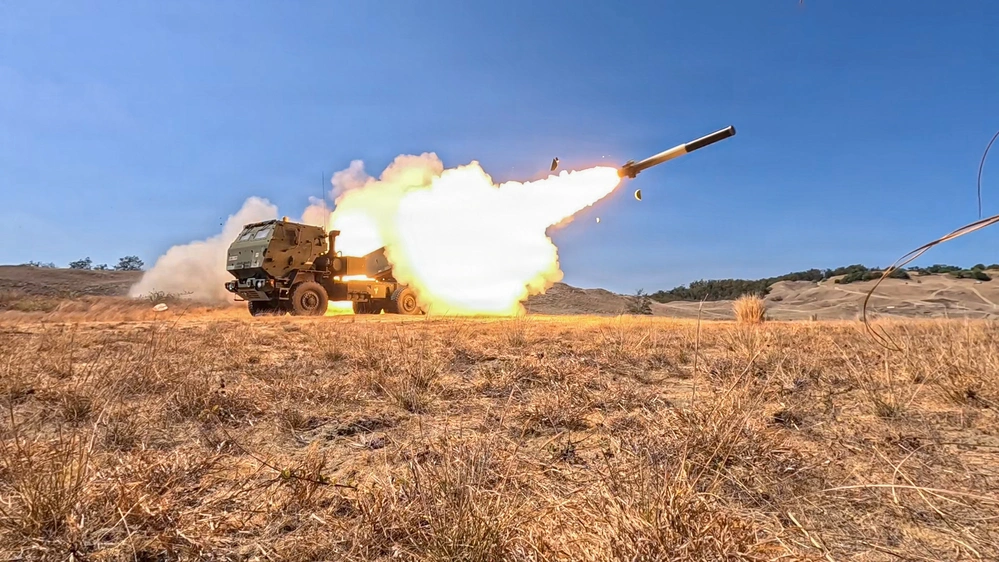
Firing of a HIMARS during a counter-landing live-fire exercise as part of Exercise Balikatan 2026 at La Paz Sand Dunes, Laoag City, Philippines, May 4, 2026. (US Army/Sgt. Duke Edwards)
The 41st iteration of the Balikatan exercise in 2026 combined multiple ground, air and naval exercises. It focuses on interoperability, territorial defence, live-fire drills, amphibious and humanitarian operations. Beyond traditional combat training, this year’s Balikatan also included cybersecurity training for the officers to ensure readiness for modern warfare.
The selection of locations was among the most consequential strategic decisions of the Balikatan drill, as it took place at various locations in the Philippines facing the South China Sea. Northern Luzon—especially Laoag—is strikingly close to the Strait of Taiwan, a geography which shows a visible intent for the preparation for a Taiwan contingency scenario. Similarly, Palawan’s is close to the West Philippine Sea, which can be seen as an effort to project force against PLAN surface combatants—which routinely operate in the area. Meanwhile, Zambales was formerly home to Subic Bay Naval Base, which sits as a strategic gateway in the eastern part of the South China Sea.
The Luzon and West Philippine Sea areas were designated for specific coastal defense trials and exercises, invasion simulations, and live-fire exercises. The counter-landing live-fire exercise site allowed Philippine, US and Japanese forces to simulate coastal defense and repel a mock invasion. The area was also used by the US Army to test the Typhon Mid-Range Capability (MRC).
Palawan served as a live-fire training ground for the US Army HIMARS. The combined force launched live-fire drills off Palawan, employing M142 HIMARS against moving targets, M252 and M224 mortars on designated zones and BGM 71 TOW and FGM 148 Javelin missiles against simulated landing craft. The MRF-D ground combat element provided suppressive fire with M2-caliber machine guns, while the Philippine Marines provided artillery support and air defense.
In addition, forces trained in air assault, amphibious landing, airfield seizure, airfield damage assessment, reconnaissance and ground refueling operations from the Balabac Islands in Southern Palawan to the Batanes Islands and Cagayan in Northern Luzon. In Zambales, the focus was on maritime defense zones and amphibious operations, particularly training on cover fire. Cyberspace exercises were also held at Camp Aguinaldo.
Beyond its scope of drill, Balikatan is also a shift from a strict bilateral exercise to a multilateral platform. For example, both the Philippines and Canada intensified their Status of Visiting Forces Agreement (SOVFA), particularly on the C4ISR (command, control, communications, intelligence, surveillance and reconnaissance) and cyber defense.
Together with Japan, both countries also reaffirmed their adherence to a rules-based international order and the clauses under the United Nations Convention on the Law of the Sea (UNCLOS). This year’s iteration also became an opportunity for Japan to test its new weapons, especially the Japanese Type 88 surface-to-ship missile system as a part of maritime strike (MARSTRIKE) drills. Both countries also engaged in a dialogue on humanitarian assistance and disaster relief (HADR) as well as external security operations (ESO).
| Exercise Domain | Key Assets/Capabilities Deployed | Strategic Objective |
|---|---|---|
| Coastal & Maritime Strike | M142 HIMARS, Typhon MRC, Japanese Type 88 Missiles | Anti-access/area denial (A2/AD) and repelling amphibious invasions. |
| Cyber & C4ISR | Joint Cyberspace Operations Centers (with Canada/US) | Securing communication lines and protecting critical military infrastructure. |
| Amphibious Operations | Landing craft, BGM-71 TOW, FGM-148 Javelins | Island retaking protocols and rapid troop deployment across archipelagic chokepoints. |
Western Security Umbrella
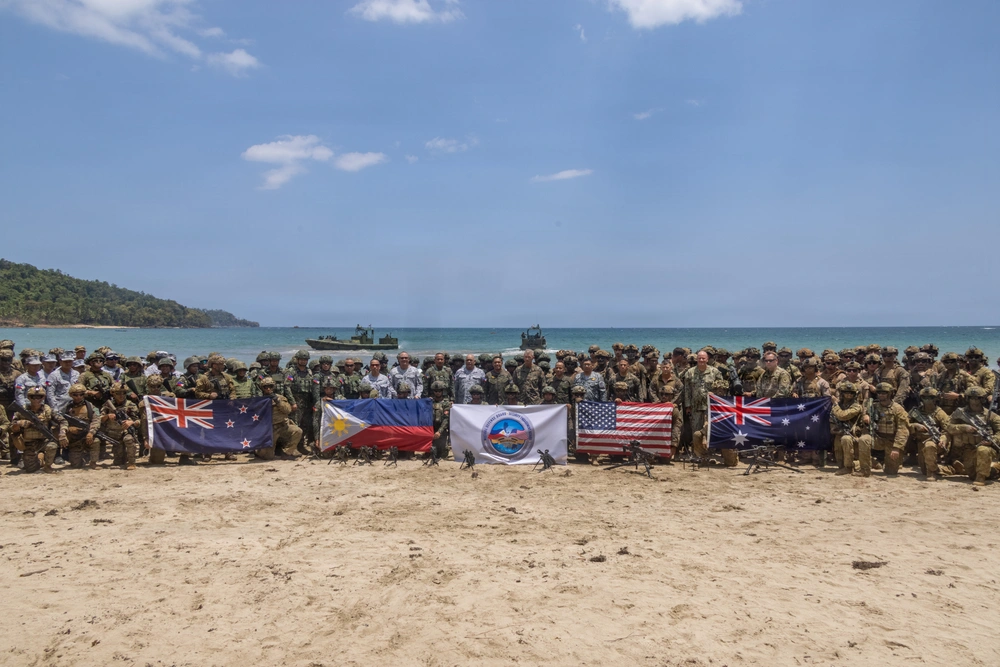
Service members from the Philippines, US, Australia, New Zealand and other observing countries, pose for a group photo following the counter landing live-fire event during Exercise Balikatan 2026 at Aporawan Beach, Palawan, Philippines, April 27, 2026. (US Marine Corps/Lance Cpl. Aaliyah Hunt)
The Philippines’ close relations with the US are manifested through the 1951 Mutual Defense Treaty (MDT), augmented by the Visiting Forces Agreement (VFA) and the vital Enhanced Defense Cooperation Agreement (EDCA), which has expanded from five to nine sites. These frameworks grant legal protections, enable rotational US access to Philippine bases, as well as facilitating logistics, training and humanitarian operations, while providing Manila with an unparalleled security deterrent.
To realise a 40 billion US dollar military modernisation program through 2027, the Philippines sought backup from the US. Since 2015, Washington has provided over 700 million US dollar in security assistance, with active Foreign Military Sales (FMS) totaling 1.03 billion US dollar (including C-130T aircraft and naval radars) and Direct Commercial Sales accounting for 171 million US dollar. The procurement of 48 Black Hawk helicopters, worth 865 million US dollar, reveals this rapid military upgrade.
Beyond Washington, the Philippines also engaged in minilateral networks with middle-powers, including a Strategic Partnership with Australia and Japan’s Reciprocal Access Agreement. Australia utilised the Enhanced Defence Cooperation Program to foster defence cooperation. Furthermore, Canberra also supported the 1982 United Nations Convention on the Law of the Sea (UNCLOS) and the South China Sea Arbitration Award of July 12, 2016. For maritime security, Canberra and Manila aim to develop a joint operation to maintain the security, order and reliability of vital geographical areas.
Japan and the Philippines also have cordial relations concerning defence and security cooperation. Through the Japan-Philippines Reciprocal Access Agreement (RAA), which entered force on September 11, 2025, both nations are able to deploy troops at each other’s sovereign territory. Furthermore, the ratification of the Japan-Philippines Acquisition and Cross-Servicing Agreement (ACSA) further guarantees essential military and nonmilitary “supplies and services”, essential for combined military operations.
A Dilemma for Southeast Asia
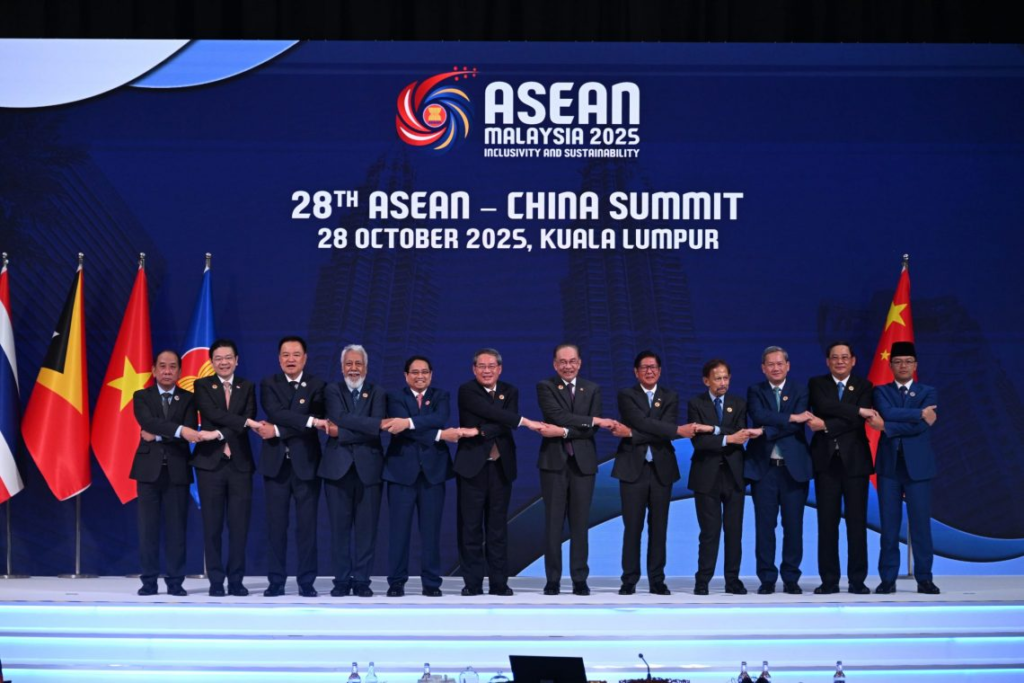
The 28th ASEAN-China Summit in Kuala Lumpur, Malaysia, in October 2025 (ASEAN Secretariat)
This year’s Balikatan iteration will have a profound impact on the wider Southeast Asian region. The location of the drill is mainly in the South China Sea, where disputes among other nations prevail. For decades, the default strategic stance of ASEAN member states has been a careful hedging, siding with both China for economic cooperation and the US over the defence sector. Balikatan 2026 presents a stark institutional test for the ASEAN consensus model. With no other ASEAN member states participating in the drills, the Philippines risks exacerbating a classic security dilemma.
Moreover, the Balikatan exercise risks the bloc’s positioning as a middle ground, creating friction with other ASEAN members that opt for non-confrontational and dialogue approaches, which is even more critical as Manila holds the ASEAN chair for 2026. The joint drill—which partly acts as a strategic signalling against China—risks complicating the diplomatic environment for the negotiation of the South China Sea Code of Conduct and collective maritime security.
In sum, Balikatan 2026 represents the culmination of the Philippines’ transition from internal volatility to projecting external archipelagic defence. By operationalising the CADC and aligning with a resilient network of Western and regional alliances, Manila is significantly reshaping the security architecture of Southeast Asia and the Indo-Pacific region. Ultimately, the current Philippine defence posture manifests the litmus test for its ability to harmonise security arrangements and economic resilience.
About The Author


3 thoughts on “From Hedging to Hard Balancing: Balikatan 2026 and the Philippine Defence Strategy”