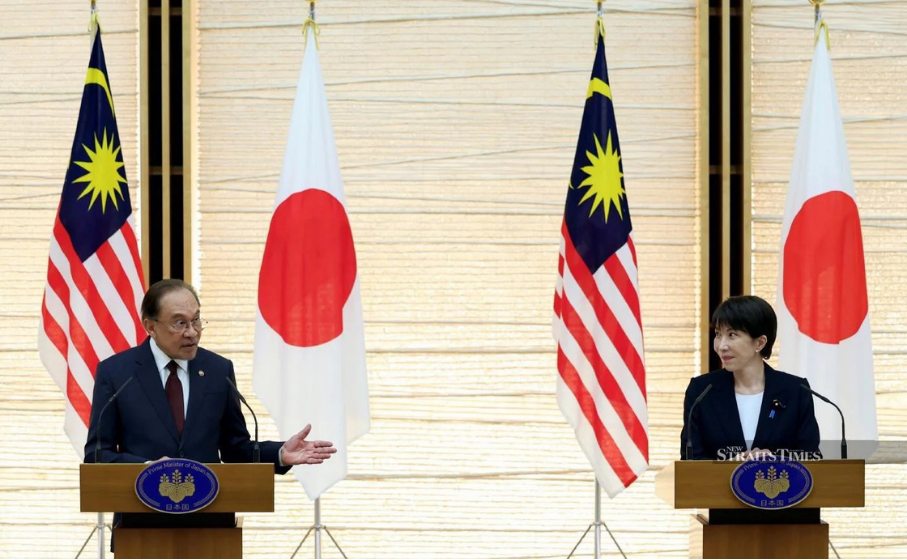
Malaysian Prime Minister Anwar Ibrahim speaking at a press conference on June 10 following an official welcoming ceremony for his working visit in Japan. (BERNAMA)
On June 10, Malaysia’s state-owned energy giant Petroliam Nasional (Petronas) signed a 20-year pact to supply 2 million metric tons of liquefied natural gas (LNG) annually starting 2028 to Japan’s largest power generator, JERA. The agreement was enacted during Malaysian Prime Minister Anwar Ibrahim’s working visit to Japan.
For context, this pact is a follow-up to the previously ratified memorandum of understanding signed by the two countries during last year’s Energy Asia forum in Kuala Lumpur.
Petronas subsidiary Petronas LNG explained in a statement that this accord reflects “a shift from traditional point-to-point LNG contracts toward more flexible supply arrangements”.
Reportedly, Petronas will deploy its new, eco-friendly 174,000-cubic-meter carries to transport the LNG. These advanced vessels are specifically engineered to meet stricter International Maritime Organisation (IMO) decarbonisation rules.
In response, JERA confirmed that Malaysia will be Japan’s primary source for LNG, noting that “as natural gas is increasingly being reassessed globally as an essential energy source for stable energy supply, securing reliable LNG has become even more important from an energy security perspective”.
Echoing the statement, Japanese Prime Minister Sanae Takaichi addressed the following press briefing that “cooperation with Malaysia, a stable supplier of LNG to Japan, is becoming increasingly important”.
What does this mean for business?
This multi-decade arrangement significantly alters the geopolitical leverage and trade scale between the two nations. As Japan’s second-largest LNG provider right behind Australia, this accord signals Kuala Lumpur’s successful attempt at capitalising on its bilateral position to lock in reliable, long-term economic revenue. To note the sheer scale of this expansion, JERA is drastically increasing its intake from a previous baseline of roughly 360,000 tonnes to a massive 2 million tonnes annually.
For commercial entities and industrial energy consumers, this long-term transaction provides a critical shield against global macroeconomic instability. This is particularly vital as Japan was one of the hardest-hit nations by the recent Hormuz energy corridor disruptions. Additionally, downstream businesses will benefit from enhanced supply chain decarbonisation, as the use of Petronas’ new eco-friendly carriers helps corporate players lower their Scope 3 upstream transport emissions.
Kala Advisory helps investors navigate openings like these as Southeast Asia reshapes its energy and supply-chain security. Visit kala-advisory.com.
About The Author