
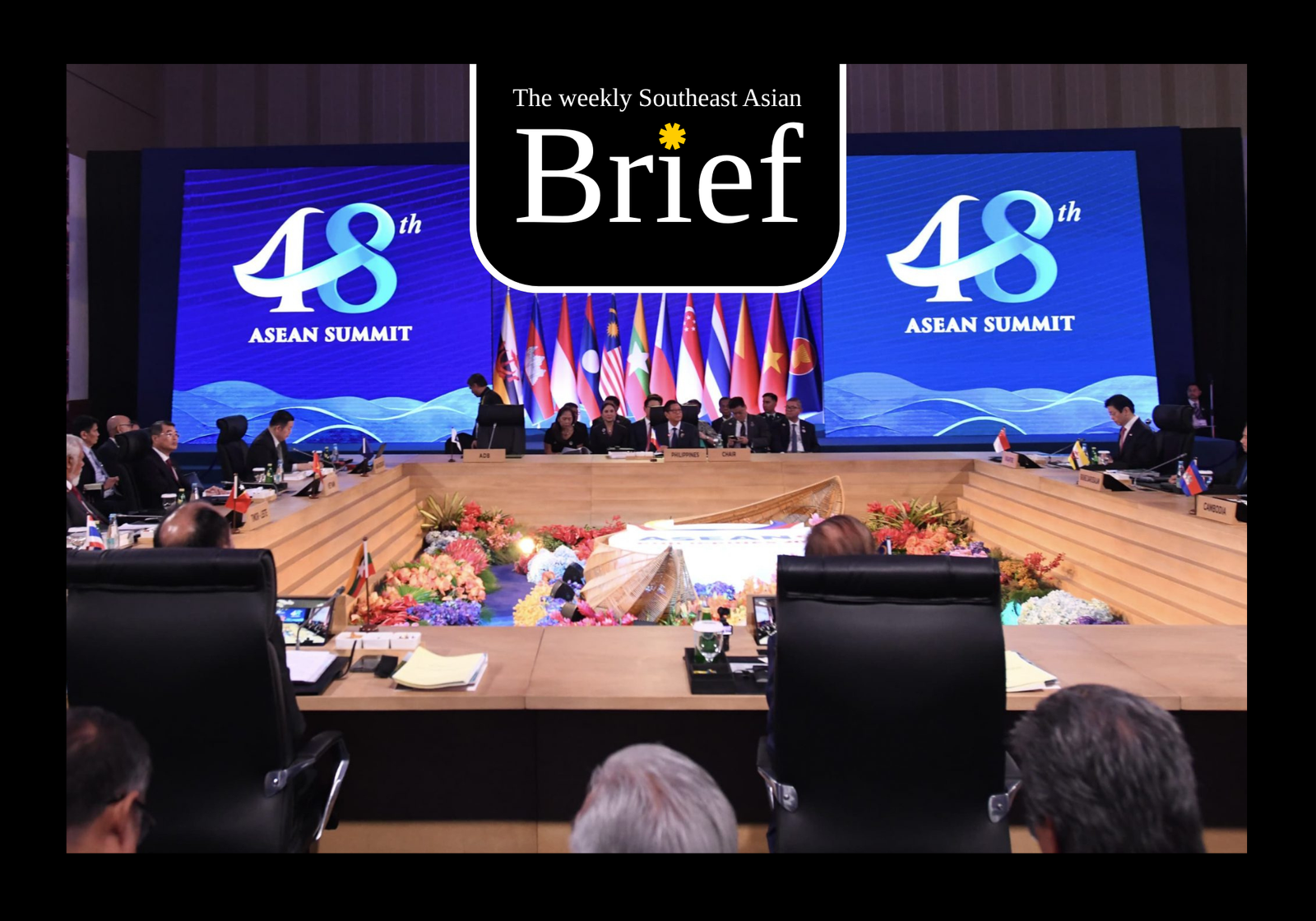
Plenary session of the 48th ASEAN Summit in Cebu, Philippines on May 8. (ASEAN Secretary)
The 48th ASEAN Summit in Cebu, Philippines, culminated on May 8 with member states’ leaders formally signing outcome declarations throughout the plenary and retreat sessions, concluded by a symbolic gala dinner. The summit produced three official documents: (1) the Chair’s Statement; (2) the ASEAN Leaders’ Declaration on Maritime Cooperation; and (3) the ASEAN Leaders’ Statement on the Response to the Middle East Crisis.
These documents were drafted during the preparatory phase led by the Philippines’ Department of Foreign Affairs (DFA) on May 6 and 7. On the two consecutive days, high-level delegations attended a series of technical meetings, including Senior Officials’ Meetings (SOM), Foreign Ministers’ Meeting (AMM), Joint Foreign and Economic Ministers’ Meeting as well as Coordinating Council (ACC) Meeting.
In line with the Philippines’ chairmanship theme of “Navigating our Future, Together,” Manila has placed a particular emphasis on regional maritime security. This priority was signalled from the outset through the chairmanship logo itself, which pays homage to the waters that connect ASEAN.
Against this backdrop, the signing of the Declaration on Maritime Cooperation carries considerable weight. The document is anchored in a collective adherence to and calls for the enforcement of the United Nations Convention on the Law of the Sea (UNCLOS) as the overarching framework governing maritime conduct in the region. This is a pointed signal given that the declaration comes amid the protracted ASEAN–China negotiations for a Code of Conduct (COC) in the South China Sea, which seeks to establish binding rules to prevent conflict and manage tensions in disputed waters.
Among the declaration’s key outcomes is the proposal to establish an ASEAN Maritime Centre, to be based in the Philippines. President Ferdinand Marcos Jr. confirmed at a press briefing on May 8 that ASEAN leaders had reached broad consensus in support of the initiative. He emphasised that the centre is not designed to confront any particular country, but rather to serve as a regional platform for coordination on maritime security, illegal fishing, smuggling, human trafficking and vessel traffic monitoring.
The declaration further underscores the need to protect Critical Underwater Infrastructure (CUI), including submarine cables and pipelines, against rising security and geopolitical threats. The urgency of this has been already shown and felt. President Marcos cited recent disruptions in the Strait of Hormuz as a live example of how conflicts affecting key maritime routes have seriously disrupted regional trade and supply chains.
This sense of urgency gave rise to the third outcome document. As a demonstration of a timely and coordinated regional contingency response, ASEAN leaders formulated the Statement on the Response to the Middle East Crisis. It addresses the region’s immediate vulnerabilities through several concrete measures, including fuel sharing through the implementation of the ASEAN Framework Agreement on Petroleum Security and a collective commitment to diversifying energy sources and accelerating the development of renewable energy.
Overall, this summit marks the halfway point of the Philippines’ chairmanship. With the foundational declarations now in place, the remaining months will be critical in determining whether the commitments made at Cebu translate into concrete, measurable progress.
The maritime domain as a focal point is a natural choice for the Philippines, the Southeast Asian nation most frequently embroiled in open maritime tensions in the South China Sea. In this sense, the chairmanship is not merely a diplomatic exercise but also a strategic opportunity, allowing Manila to leverage its position as ASEAN Chair to lend collective legitimacy to positions it has long held bilaterally.
Yet implementation remains the first and most pressing test. Key details underpinning the summit’s headline initiatives, including the operational framework, funding arrangements and mandate of the proposed ASEAN Maritime Centre, are still being worked out, with progress contingent on the political will and resource commitments of individual member states.
Geopolitical pressures will continue to complicate the picture. The Middle East crisis and South China Sea dynamics may yet compel ASEAN to revisit its consensus-based positions ahead of the year’s final summit. For many developing nations in the region, security is first and foremost an economic concern, and the more immediate pressures of stable food supply and affordable energy must be addressed before high-level declarations resonate at ground level.
Lastly, the Philippines’ artificial intelligence (AI) agenda remains one to watch. The ASEAN AI Summit, to be hosted by the Philippines in September 2026, will serve as a key litmus test for whether Manila’s ambitions on responsible AI adoption translate into a lasting institutional legacy beyond its chairmanship year.
About The Author



2 thoughts on “South China Sea and Strait of Hormuz dominate discussions at 48th ASEAN Summit”