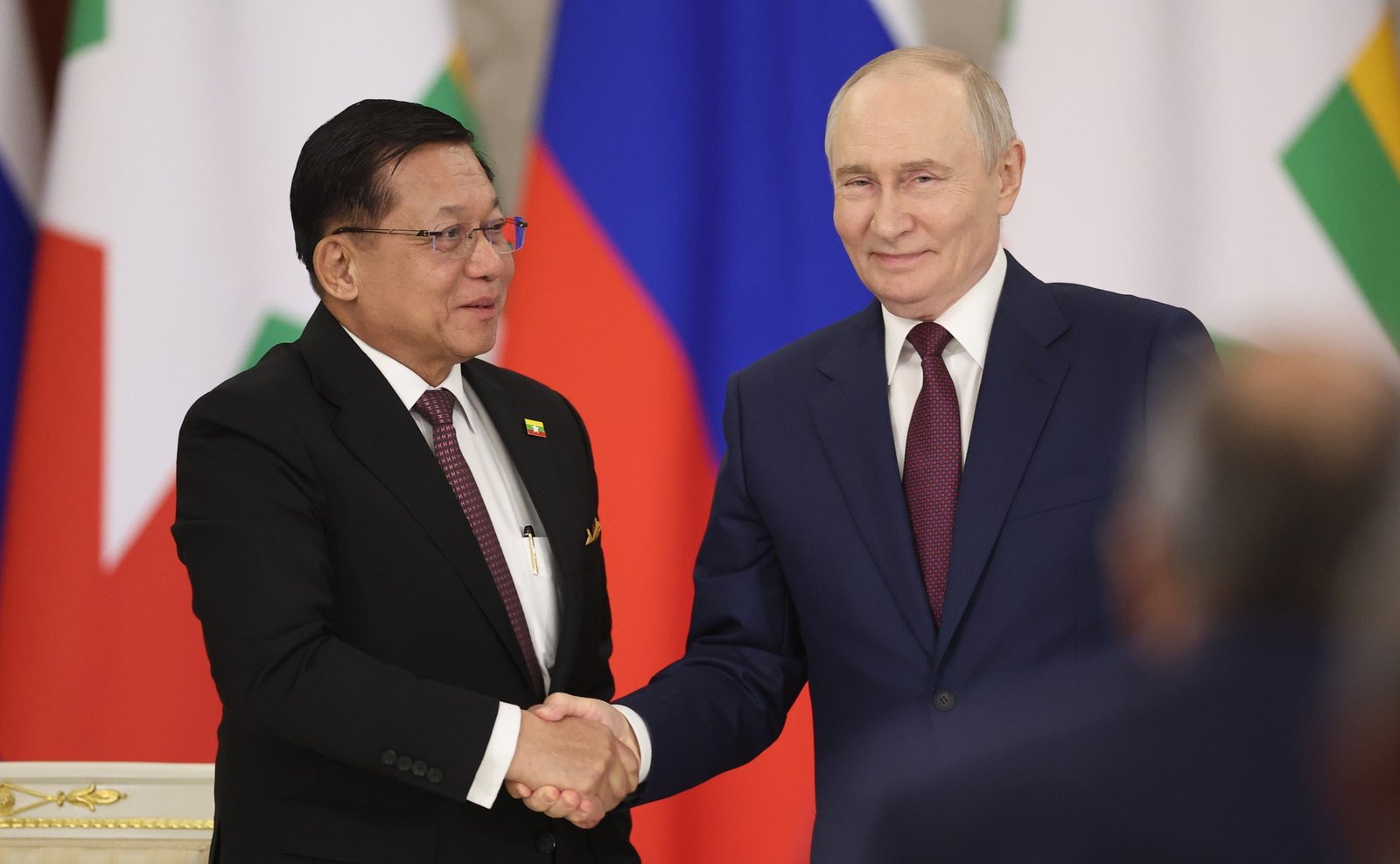
Russian President Vladimir Putin and Myanmar President Min Aung Hlaing attend a document exchange ceremony at the Kremlin in Moscow, Russia, on August 18. (Kremlin.ru)
On the following day, Junta leader Min and his counterpart President Vladimir Putin witnessed the signing of 12 Memorandum of Understanding (MoUs) during a meeting at the Grand Kremlin Palace in Moscow. The bilateral agreements span several critical technological and economic sectors, as President Putin put it, “we prioritise economic ties. Reliable financial settlement mechanisms have been established, with two-thirds of commercial transactions now conducted in Russian rubles”.
Energy and power took centre stage, with the joint construction of a power plant and an oil refinery in Myanmar currently under review. President Putin further noted that “there are good prospects for exporting liquefied natural gas to Myanmar,” pointing to a previously ratified, Russian-designed nuclear power plant project.
The discussions also encompassed high-tech development, with President Putin underscoring that “Russian companies are ready to introduce their unique cutting-edge digitalisation, cybersecurity and data storage technologies in Myanmar”. Additionally, a partnership in space and satellite systems is being built under the 2025 Intergovernmental Agreement on Cooperation in the Exploration and Use of Outer Space for Peaceful Purposes and Manned Spaceflight.
Reportedly, Myanmar’s junta leader will also attend a Myanmar-Russia Business Forum in the coming days.
The trip reaffirms a broader geopolitical strategy by Myanmar to pursue overseas diplomacy since the military-backed government was formalised under his presidency in April. Among his recent destinations are regional trade partners China and India, as well as ASEAN neighbours Laos and Thailand. The outings highlight Naypyidaw’s efforts to gain international legitimacy whilst securing a critical economic lifeline. Concurrently, Myanmar’s participation in the wider ASEAN agenda remains stalled and uncertain.
What does this mean for businesses?
Min Aung Hlaing will actively pitch for foreign investment in Myanmar, specifically targeting its crippled power grid. Without stable electricity, the country simply cannot accommodate large-scale manufacturing or industrial expansion. However, for ordinary citizens, daily life remains defined by systemic oppression, with the national economy still roughly 30% smaller than pre-2021 and COVID-19 levels. Ultimately, the junta’s current economic manoeuvres appear largely performative; for any genuine economic reform to take root, it must stem from sincere intent rather than political survival.
Kala Advisory helps investors turn geopolitical shifts and industrial openings like these into targeted, country-by-country market entry plans across Southeast Asia. Visit kala-advisory.com.
About The Author