
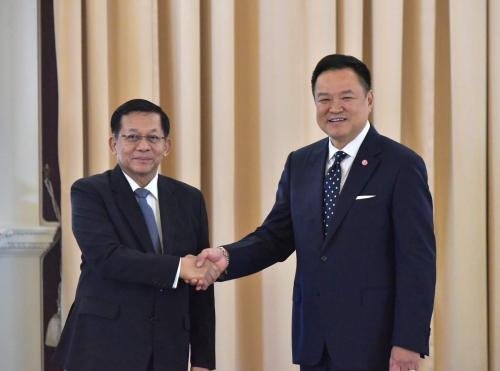
Thai Prime Minister Anutin Charnvirakul and Myanmar President Min Aung Hlaing during a plenary meeting at Government House in Bangkok, Thailand, on August 6. (Thailand Government Public Relations Department)
On August 6, Thai Prime Minister (PM) Anutin Charnvirakul rolled out the red carpet to welcome Myanmar’s military-backed President Min Aung Hlaing, officially commencing the first bilateral engagement between both nations since the 2021 coup.
The two-day visit was packed with high-level meetings, bilateral policy negotiations, as well as private-sector economic forums. The agenda included one-on-one talks between both leaders covering political reconciliation, economic ties and transboundary issues like scam networks.
“Myanmar has now reestablished itself on the path to democracy and is moving toward a better future,” the Burmese president stated, adding that his administration “has now begun working on national stability, peace and national reconciliation.”
Notably, the itinerary featured a Thailand-Myanmar business forum jointly organised by the Thai-Myanmar Association for Friendship, under the theme “A New Chapter in Thailand-Myanmar Business Partnership”. During the event, President Min Aung Hlaing pitched Myanmar to foreign investors despite ongoing domestic conflict and international isolation. Furthermore, a bilateral trade expansion target worth 12 billion US dollar was sealed, with PM Anutin pledging that Thailand would simplify trade regulations and remove bureaucratic barriers.
Additionally, both sides witnessed the official signing of a memorandum of understanding (MoU) regarding labor cooperation. This updated framework introduced several critical provisions, including mutual data exchange on labor market information, alongside enhanced worker rights and anti-trafficking guidelines. The MoU heavily emphasises a structured repatriation process, ensuring that workers return home safely at the end of their contracts.
The Thai PM concluded that Thailand and Myanmar are ready to “step into the new chapter of economic cooperation that is built upon mutual trust and benefit for the people of the two countries”.
The visit came at a time when the military regime is aggressively seeking international legitimacy to strengthen its polished “civilian” branding. Thailand is the second ASEAN member state the Burmese leader has visited, following his first official trip to Laos in July.
What does this mean for businesses?
Min Aung Hlaing’s rapid succession of state visits to China, India, Laos and now Thailand underscores an aggressive, calculated campaign to pitch Myanmar as an investable market. However, while these diplomatic ties slightly ease Naypyidaw’s regional isolation, businesses must approach this charm offensive with extreme caution. The regime’s narrative of stability lacks domestic reality; the junta has shown zero genuine political will to build peace, and the domestic landscape remains highly volatile. Corporate leaders should see through these superficial economic pitches. The escalating internal repression, coupled with the systemic growth of lawless online scam compounds, sends a clear warning signal: Myanmar’s current environment remains fundamentally unsustainable and hostile to secure international business operations.
Kala Advisory helps investors navigate volatile regional transitions and turn complex border policies into risk-mitigated, long-term entry plans across Southeast Asia. Visit kala-advisory.com.
About The Author

One thought on “Myanmar Junta Leader Seeks Economic Lifeline in Bangkok, $12bn Trade Deal Sealed”