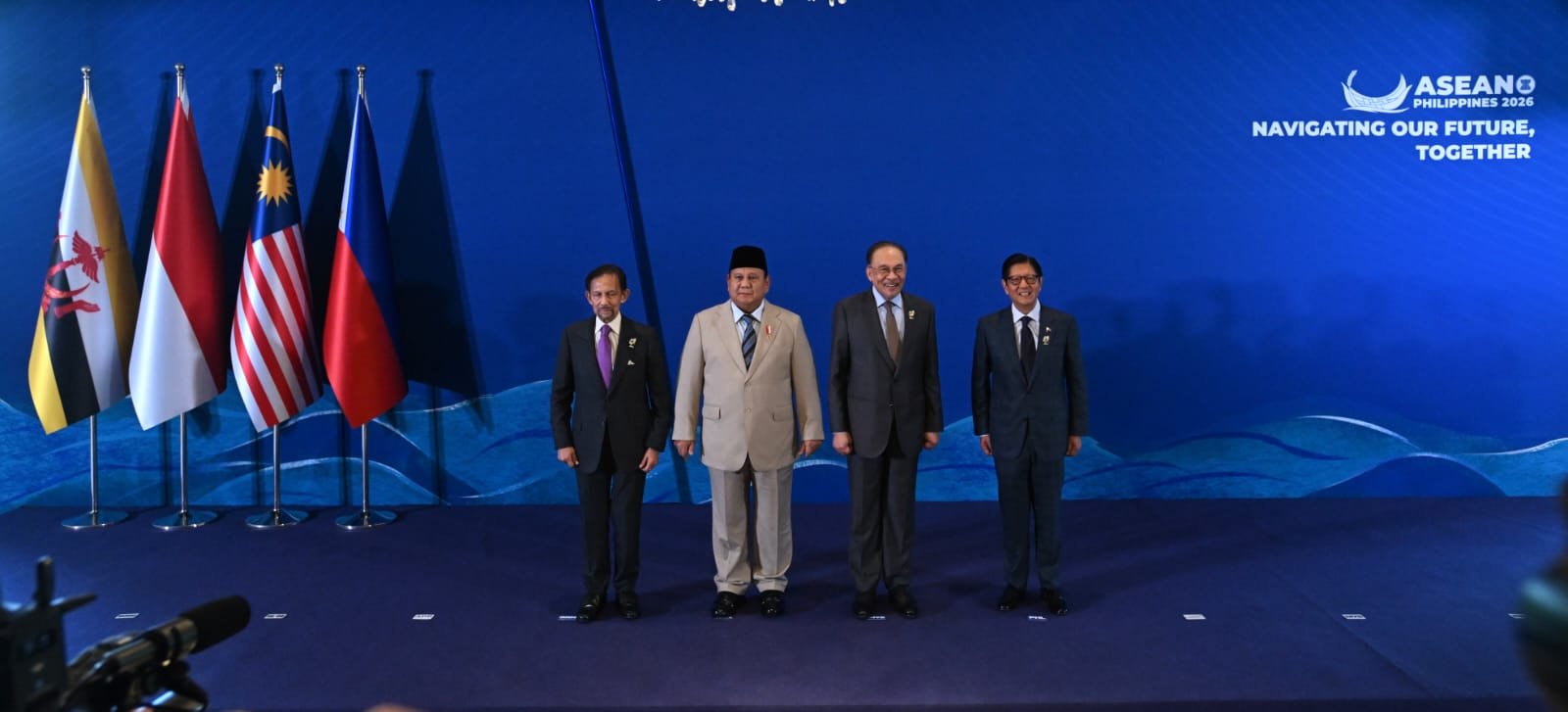
Brunei Darussalam Sultan Hassanal Bolkiah, Indonesian President Prabowo Subianto, Malaysian Prime Minister Anwar Ibrahim and Philippine President Ferdinand Marcos Jr. at the Special BIMP-EAGA Summit, May 7. (ASEAN Secretariat)
As part of the 48th ASEAN Summit, Special Brunei Darussalam-Indonesia-Malaysia-Philippines East ASEAN Growth Area (BIMP-EAGA) Summit took place on May 7 and yielded BIMP-EAGA Vision (BPEV) 2035—a strategic roadmap for the coming decade, envisioning a more resilient, inclusive, sustainable and economically competitive subregion.
Established in 1994, BIMP-EAGA is a sub-regional economic cooperation that aims to accelerate an inclusive economic and social development particularly in “underserved areas”. The initiative is designed to ensure that regions distant from their respective capitals—such as Mindanao in the Philippines, Sabah in Malaysia, North Kalimantan in Indonesia and Brunei—are not left behind.
Its 17th meeting—led by ASEAN Chair and Philippines’ President Ferdinand Marcos Jr.—brought together leaders of BIMP nations: Brunei Darussalam Sultan Hassanal Bolkiah, Indonesian President Prabowo Subianto and Malaysian Prime Minister Anwar Ibrahim, alongside ASEAN Secretary-General Kao Kim Hourn.
Aligning the special summit with the Philippines’ 2026 chairship theme, “Navigating Our Future, Together,” President Marcos engaged fellow subregional leaders to deepen connectivity in pursuit of shared, inclusive growth amid mounting uncertainties from the Middle East.
During the meeting, BIMP leaders acknowledged and assessed the escalating unrest to better shape future strategies for securing subregional stability—as Indonesia’s President Prabowo Subianto noted that the issue is “no longer a long-term problem but an urgent problem” to scrutinise.
Specifically, Marcos called on BIMP leaders to scale up public-private partnerships (PPP), drawing on the Philippines’ own experience in leveraging such arrangements to drive swift implementation of “high-impact priority projects” in Mindanao. “This vision is not merely a roadmap for economic integration, it is a promise to our people that development will be meaningful, sustainable and felt in their daily lives,” he affirmed.
What does this mean for business?
Whilst the 48th ASEAN Summit commanded the broader spotlight, the BIMP-EAGA special meeting carries distinct significance for the private sector. At its core, BPEV 2035 is a blueprint to bridge long-standing development gaps by transforming historically underserved border regions into viable economic hubs—areas rich in untapped natural resources and labour, yet chronically under-invested. The explicit push for PPP signals that governments intend to act as enablers rather than sole drivers of growth: setting the policy frameworks and infrastructure, whilst expecting the private sector to serve as the engine of delivery.
For businesses, this translates into early-mover opportunities—whether in infrastructure, logistics, agribusiness or energy—in markets that have long been overlooked because of their distance from capital cities.
About The Author