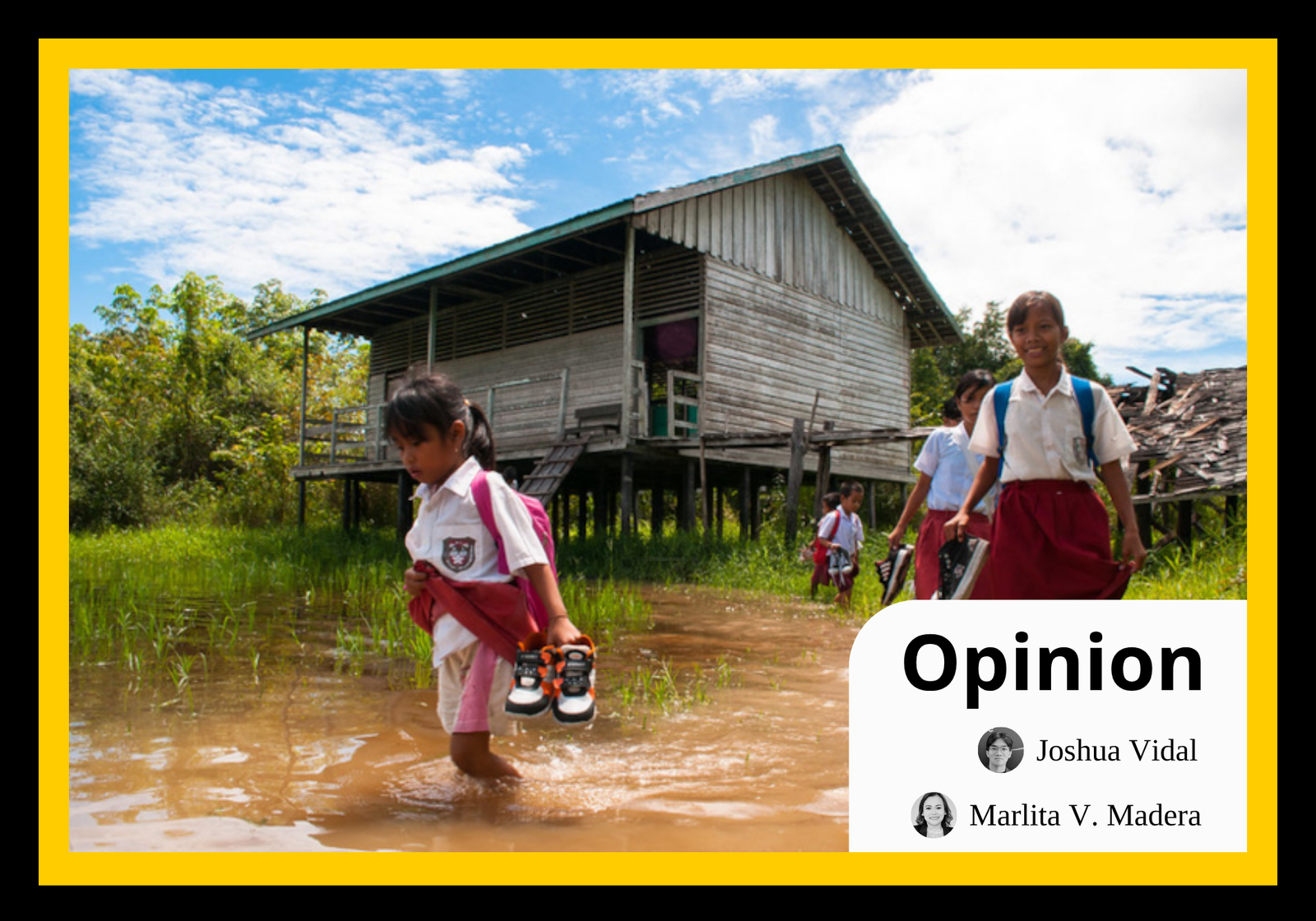
Children returning home from school during flooding in West Kalimantan, Indonesia. (CIFOR-ICRAF)
Joshua Vidal, MAEd is a Transdisciplinary Research Associate on Coastal Cities at Risk in the Philippines-Ateneo de Manila University, Editor-in-Chief for the Electronic Paper for Science and Technology Education-The Publication Office, and Founder of Schools Climate Action Projects.
Marlita V. Madera, PhD is a faculty member of De La Salle- College of St. Benilde, Manila
The views expressed are authors’ own and do not represent SEA Daily or that of another organisation.
If SDG 4 is to remain credible, the world must stop treating quality education as a promise to be repeated and start treating it as a system to be repaired.
The Sustainable Development Goals (SDG) are now approaching their 2030 deadline. Among them, SDG 4 carries one of the most powerful promises: to ensure inclusive and equitable quality education and promote lifelong learning opportunities for all. The promise remains morally powerful, but the evidence around global delivery is increasingly severe. The 2024 Sustainable Development Goals Report states that only 17% of SDG targets are on track, nearly half show minimal or moderate progress, and progress on more than one-third has stalled or regressed.
Yet the urgency of the deadline now forces a harder question. Is SDG 4 still feasible, or has it become a beautiful ambition suspended in thin air? The question is not cynical. It is necessary. The world that adopted the SDGs in 2015 is no longer the world trying to complete them. Since then, education systems have been shaken by the pandemic, widened inequalities, climate disruptions, political instability, teacher shortages, learning poverty and now technological turmoil brought by artificial intelligence (AI) and digital transformation.
When a deadline becomes a diagnosis
The 2030 deadline should not be treated merely as a calendar date. It is now a diagnosis of global education systems. In the past, SDG 4 represented optimism. It expanded the meaning of education beyond enrolment. It called not only for children to be inside classrooms, but for them to learn, complete school, develop skills, access technical and vocational pathways as well as participating in lifelong learning. This was its strength: it recognised that education is not only a school issue, but also a poverty issue, a labour issue, a technology issue, a climate issue and a democracy issue.
The present reveals the weakness of ambition without capacity. UNESCO estimates that 251 million children and youth were out of school in 2023. Although about 110 million more children, adolescents and youth have enrolled since 2015, the total out-of-school population declined by only 1% over the same period. That is the contradiction of SDG 4: the world has made movement, but not enough transformation.
The pandemic did not only interrupt schooling. It damaged the foundation of learning.
COVID-19 placed SDG 4 under severe stress. It closed schools, exposed the digital divide, weakened student engagement, increased dropout risks and forced teachers to carry systems that were not prepared for prolonged disruption. The deepest wound was not simply lost school days. It was lost learning.
A learning poverty update co-published by The World Bank, UNESCO, UNICEF, FCDO, USAID and the Bill & Melinda Gates Foundation, estimated that learning poverty in low- and middle-income countries rose to about 70%, meaning that seven in ten 10-year-olds could not read and understand a simple written text after pandemic disruptions.
This is not a temporary education problem. It is a generational risk because literacy is the foundation for science learning, digital literacy, civic participation, employability and lifelong learning. If students cannot read well, SDG 4 cannot succeed. If SDG 4 cannot succeed, the rest of the development agenda becomes weaker.
Technology has become both a tool and a new source of inequality
The present crisis of education is no longer only about classrooms, textbooks and teachers. It is also about technology. Digital tools can expand learning, support teachers, personalise instruction and connect students to knowledge beyond the classroom. But technology does not automatically create equity. In unequal systems, it can reproduce inequality at faster speed.
This is now especially visible in the rise of artificial intelligence. AI can help students draft, translate, explain, simulate and explore ideas. But it can also deepen dependence, weaken critical thinking, widen assessment problems and privilege students who already have better devices, stronger connectivity, educated adults at home and access to paid tools. UNESCO’s Guidance for generative AI in education and research and its AI competency frameworks for teachers and students both point to the need for human-centred governance, teacher capability, ethical use and digital literacy rather than technology adoption alone.
This is the new education divide. It is no longer only about who goes to school. It is about who has the conditions to learn meaningfully in a digital world. For SDG 4, this matters deeply. Quality education in 2026 must now include digital literacy, AI literacy, ethical reasoning, information evaluation and teacher capacity to guide students through machine-generated knowledge.
Climate shocks are also education shocks
SDG 4 is often discussed separately from climate change, but this separation is no longer realistic. UNICEF reported that at least 242 million students in 85 countries had their schooling disrupted by climate-related events in 2024, including heatwaves, tropical cyclones, storms, floods and droughts. The more detailed “learning interrupted” snapshot further identifies heatwaves as the most significant climate hazard for schooling disruption in 2024.
A classroom that repeatedly closes because of extreme heat or flooding cannot deliver quality education consistently. A student who misses school because of household displacement, illness, food insecurity or unsafe transport is not simply absent from class. That student is being pushed further away from the promise of SDG 4. Education resilience must now be part of education quality.
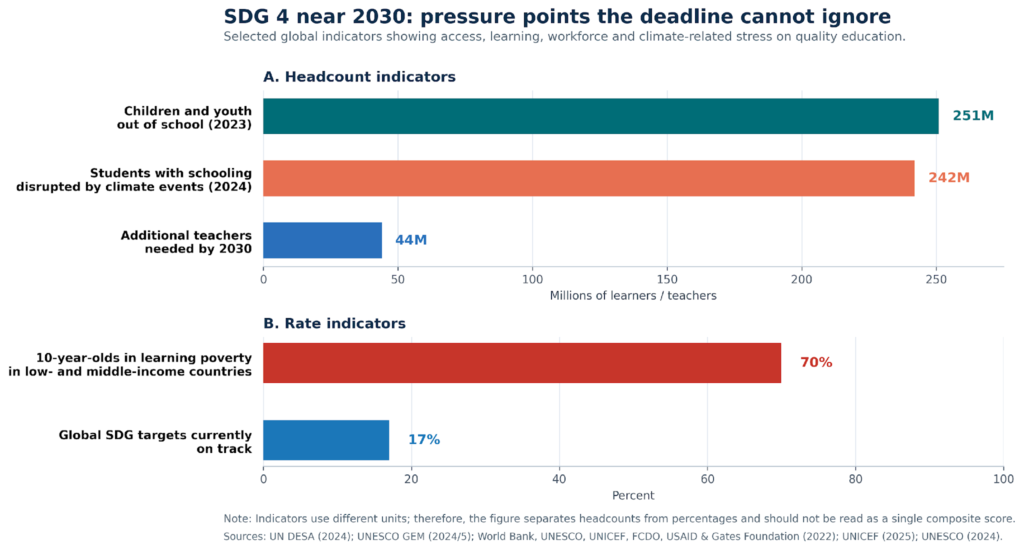
Figure 1. Evidence snapshot for SDG 4 near 2030. The visual separates headcount indicators from rate indicators to avoid misleading mixed-unit comparisons. Sources: UN DESA (2024); UNESCO GEM (2024/5); World Bank et al. (2022); UNICEF (2025); UNESCO Teachers (2024).
The SDG 4 question is no longer access alone
The world has often measured education progress by asking whether children are enrolled. That remains important, but it is no longer sufficient. A child can be enrolled and still not learning. A teacher can be employed and still unsupported. A school can have devices and still lack meaningful digital pedagogy. A curriculum can mention sustainability and still fail to prepare students for climate disruption. A country can report progress and still leave its poorest learners behind.
This is why SDG 4 must now be judged by a harder standard: not only whether education exists, but whether it works for the learners who need it most.
| Signal | Evidence with technical source | Implication for SDG 4 |
| Global SDG pressure | Only 17% of SDG targets are on track; more than one-third are stalled or regressing (UN DESA, 2024). | SDG 4 is operating inside a wider delivery crisis, not as an isolated education challenge. |
| Access gap | 251 million children and youth were out of school in 2023; the out-of-school population has fallen by only 1% since 2015 (UNESCO, 2024/5). | Universal access remains unfinished despite enrolment expansion. |
| Learning poverty | About 70% of 10-year-olds in low- and middle-income countries could not read and understand a simple text after pandemic disruptions (World Bank et al., 2022). | Quality education cannot be claimed when foundational literacy remains fragile. |
| Teacher shortage | 44 million additional teachers are needed globally to achieve universal primary and secondary education by 2030 (UNESCO, 2024). | Quality cannot be delivered without investing in the teaching workforce. |
| AI and digital disruption | UNESCO calls for human-centred policy, teacher capacity, ethics, and AI pedagogy (UNESCO, 2023; UNESCO, 2024). | Digital transformation must be governed as a learning-quality issue, not only a technology issue. |
| Climate disruption | At least 242 million students in 85 countries had schooling disrupted by climate events in 2024 (UNICEF, 2025). | Education resilience is now a core component of education quality. |
Table 1. Technical evidence matrix for SDG 4 feasibility near 2030. Figures are drawn from the cited institutional sources and should be interpreted as indicators of systemic pressure, not as interchangeable measures.
Is SDG 4 still feasible?
The honest answer is yes, but not under the current rhythm. SDG 4 is feasible only if the world stops treating education reform as a slow administrative exercise. The remaining years before 2030 require urgency, but not superficial urgency. More slogans, summits and declarations will not be enough. Education systems need financing, teacher development, learning recovery, digital inclusion, climate-resilient schools and stronger public accountability.
The danger is not only that SDG 4 will be missed. The greater danger is that it will be missed politely, through reports that describe partial progress while avoiding the deeper truth: quality education cannot be achieved through enrolment figures alone. If the world wants SDG 4 to survive beyond 2030 as more than a failed promise, it must be re-grounded in lived realities.
A child must be able to enter school, remain there, learn well, think critically, use technology responsibly, understand the changing planet and imagine a future beyond survival. That is the real test.
The future of SDG 4 is not hidden in 2030. It is being revealed now: in the classrooms still recovering from the pandemic, in the teachers asked to manage AI without enough support, in the students learning under heat and uncertainty and in the communities still waiting for education to become not only available, but truly transformative.
If SDG 4 becomes mist in thin air, it will not be because the promise was wrong. It will be because the world admired the promise more than it repaired the system.
About The Author