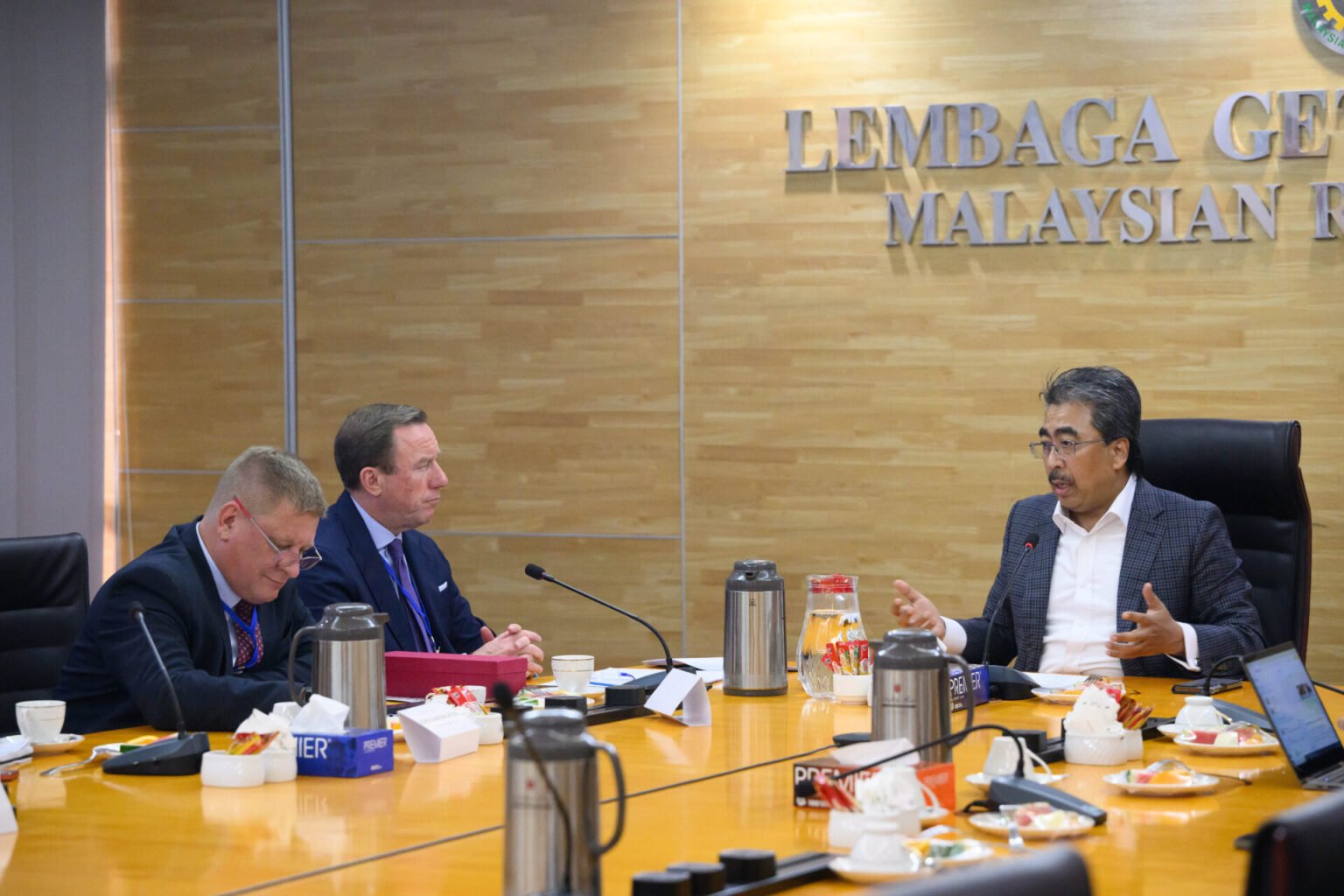
European business leaders meet Malaysian Investment, Trade and Industry Minister Johari Abdul Ghani. (EU-ASEAN Business Council)
Between August 4-6, the EU-ASEAN Business Council (EU-ABC) has led an engagement with Malaysian officials in regard to the Malaysia-European Union (EU) Free Trade Agreement (FTA). European business leaders were present, showing support towards a conclusion of negotiations by 2027.
The dialogue’s central focus include expanding trade and exploring investment feasibility across growth sectors, including artificial intelligence (AI) and the digital economy, as well as advanced manufacturing and green technology.
EU-ABC Executive Director Chris Humphrey highlighted that “European businesses strongly support the push to conclude the Malaysia-EU FTA negotiations in 2027,” adding that “the political will on both sides is clear, reflecting a mutual commitment to elevate bilateral relations and the broader ASEAN-EU relationship”.
Crucially, the executive director acknowledged Malaysia’s strategic foundation as a “regional investment hub,” but he strongly urged the country to strengthen its talent pipeline and skills development to ensure long-term economic competitiveness. He explained that European investors are “looking forward to a high-quality agreement that unlocks real benefits for both Malaysian and European businesses”.
“A high-quality FTA would ideally cover more than just tariff reductions. It should help reduce regulatory barriers, provide clearer rules, streamline customs procedures and strengthen investment conditions, resulting in a more transparent, predictable and investor-friendly trading environment,” he noted.
“The discussions so far have reinforced the considerable scope for deeper Malaysia–EU trade and investment ties. The priority now is to sustain momentum on the FTA and translate Malaysia’s policy ambitions into practical opportunities for investment and cooperation,” he concluded.
Convened over a decade ago in 2010, negotiations for an EU-Malaysia trade and investment expansion were put on hold in 2012 and only resumed in early 2025. Negotiations are targeted for conclusion in 2027, a goal set by the Malaysian government and the European Commission, a process that would be followed by a signing and ratification by both sides.
What does this mean for businesses?
This momentum serves as a greenlight, signalling European corporate confidence in Malaysia’s economic trajectory and solidifying its status as a premier Southeast Asian investment hub. For international businesses, a finalised deal should help reduce tariffs, regulatory red tape and create highly predictable trade corridors. Nevertheless, capturing this high-value foreign capital requires Kuala Lumpur to aggressively modernise its high-end manufacturing capabilities and rapidly scale up technical vocational (TVET) training to meet European standards. While current domestic political volatility introduces policy uncertainty, the commercial incentives of this economic integration will heavily pressure any future administration to maintain a pro-business, continuity-focused vision.
Kala Advisory helps investors transform structural shifts like the upcoming Malaysia-EU FTA negotiations into targeted, country-by-country market entry and regulatory navigation plans across Southeast Asia. Visit kala-advisory.com.
Editor’s note: This article was updated on August 7, 2026. An earlier version reported that the Malaysia-EU Free Trade Agreement was expected to be ratified in 2027 and that the EU-ASEAN Business Council delegation was in Kuala Lumpur to advance negotiations. The 2027 target, set by the Malaysian government and the European Commission, is for the conclusion of negotiations. Signing and then ratification would follow that process. The EU-ASEAN Business Council is not a party to the negotiations and its delegation met Malaysian officials to discuss the agreement and voice support for it. The headline, introduction and closing sections have been amended accordingly. SEA Daily thanks the EU-ASEAN Business Council for the clarification.
About The Author