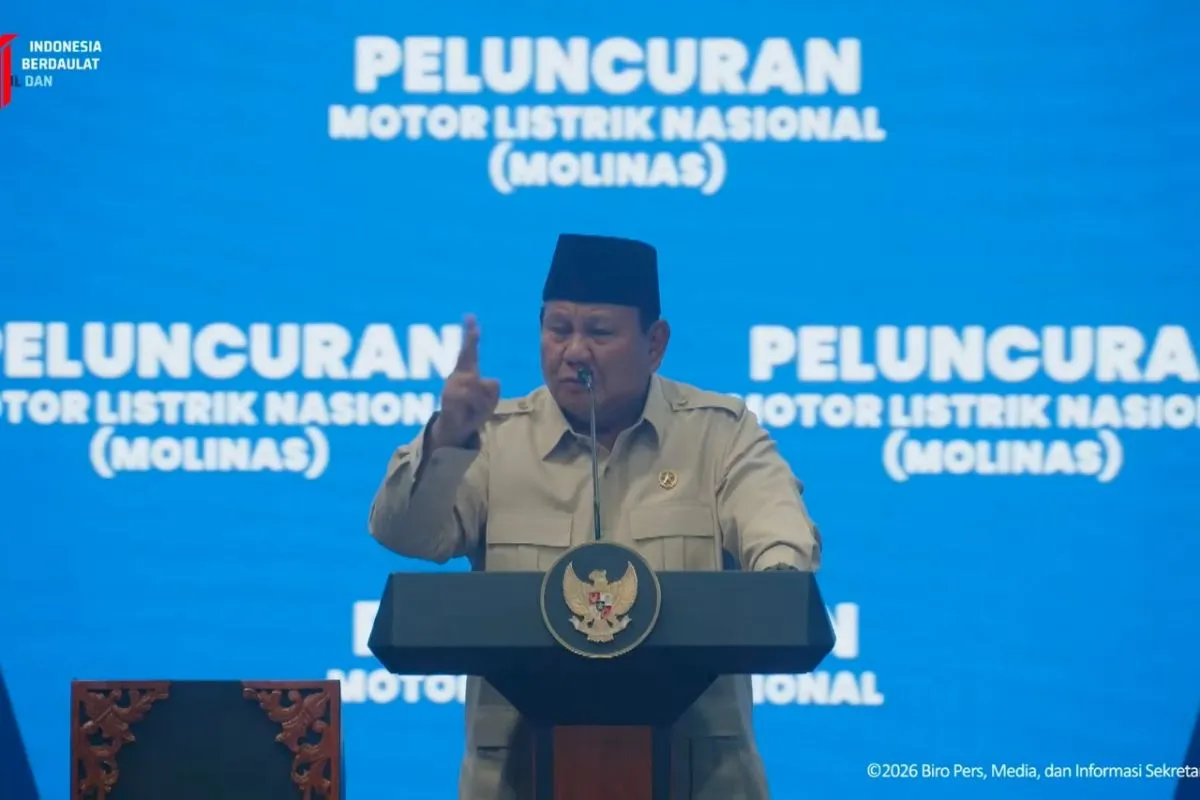
Indonesian President Prabowo Subianto speaks at the launch of the National Electric Motorcycle (Molinas) in Bekasi, West Java, on August 13. (ANTARA/YouTube Sekretariat Presiden)
President Prabowo Subianto said that Indonesia aims to kickstart the mass production of domestic electric vehicles (EVs) by no later than 2028. This ambition was announced during the inauguration of the National Electric Motorcycle (Molinas) in Bekasi, West Java province, on August 13. The president noted that “a large complex is being developed” across adjacent areas.
Southeast Asia’s largest economy is attempting to substantially curb its energy imports, whilst also advancing its technological development. The president explained that “the success of a nation in the modern era is defined by its level of mastery of science and technology and by its ability to leverage technology to sustain its life”.
President Prabowo expressed his appreciation for the Molinas initiative, highlighting the continuous effort to develop the national e-motorcycle industry despite “market pressures associated with established brands from Japan, South Korea and China”.
To support the initiative further, President Prabowo mentioned that his administration is working to foster wider usage of EVs, by assessing the feasibility of enabling citizens to exchange conventional vehicles for electric ones.
Additionally, President Prabowo underscored his administration’s commitment to facilitating a comprehensive EV ecosystem, thereby supporting a “safer and more prosperous” Indonesia.
What does this mean for businesses?
Indonesia’s ambitious target to achieve a two million unit national EV production volume signals a profound shift from a passive, resource-exporting consumer market into a self-sustaining industrial manufacturing hub. By abandoning business-as-usual practices in favour of deep structural transformation to secure national energy autonomy and reduce its heavy reliance on imported fossil fuels, the administration is opening immense corporate opportunities. If successfully realised, this transformative framework will unlock substantial state-backed infrastructure contracts, a surge in localized supply chain mandates, and extensive fiscal incentives for early adopters.
As Indonesia disrupts traditional automotive supply chains to forge its own EV future, Kala Advisory helps investors turn structural openings like these into targeted, country-by-country entry plans across Southeast Asia. Visit kala-advisory.com.
About The Author