

An aerial view of a China Coast Guard ship navigating near the disputed Scarborough Shoal, as Philippine Coast Guard aircraft carrying journalists patrols the area, days after two Chinese vessels collided in the area while allegedly trying to block a Philippine supply mission, in the South China Sea, August 13, 2025. Courtesy of Reuters
Tip of the Spear
On February 7, the China Southern Theater Command stated that the People’s Liberation Army Navy had conducted naval and air patrols in the South China Sea (SCS) between February 2 to 5 after “provocations from the Philippine side”. Earlier, following heated public exchanges between Chinese and Philippine officials over the South China Sea (SCS) territorial dispute, the Philippine Department of Foreign Affairs stated on January 26 that it has “made firm representations to the Chinese ambassador and the Chinese Embassy covering serious concerns with the escalation of public exchanges.” The incident follows a long series of maritime tensions in the region. On December 12 and 14, 2025, three Chinese vessels intercepted a Philippine Coast Guard ship distributing supplies to fishermen within the Philippines’ exclusive economic zone (EEZ) near Sabina Shoal. The Chinese ships used water cannons, injuring three fishermen and damaging two Philippine boats.
Earlier incidents include a collision between coast guard vessels of both countries on October 12, 2025, followed by mutual accusations, and in September, a China Coast Guard water cannon attack that injured a Philippine crew member near Scarborough Shoal. These standoffs trace back to at least 2012, when the Philippine Navy personnel boarded Chinese fishing vessels, prompting Chinese vessels to maneuver aggressively to prevent their detention.
Increased Chinese maritime activity has raised concerns among Southeast Asian (SEA) nations, many of whose waters fall within Beijing’s internationally unrecognised claims in the SCS. In the 2025 State of Southeast Asia Survey, 51.6% of SEA respondents expressed concern over “aggressive behaviours in the SCS,” up from 39.9% in 2024. Sharing maritime borders with China and with around 2.26 million km² of its EEZ under Chinese claim—the highest among SEA countries—The Philippines is on the frontline of this pressure.
Consequently, Malacañang has adopted an increasingly hawkish posture vis-à-vis Beijing. Over 80% of Filipinos surveyed worry about China’s growing influence. This also explains Manila’s push for the ratification of a legally binding Code of Conduct (COC) for the SCS, immediately after it assumed ASEAN Chairmanship in 2026. The COC seeks to align maritime claims with the 1982 United Nations Convention on the Law of the Sea (UNCLOS) and constrain Beijing’s expansive claims.
Caught in the Crossfire
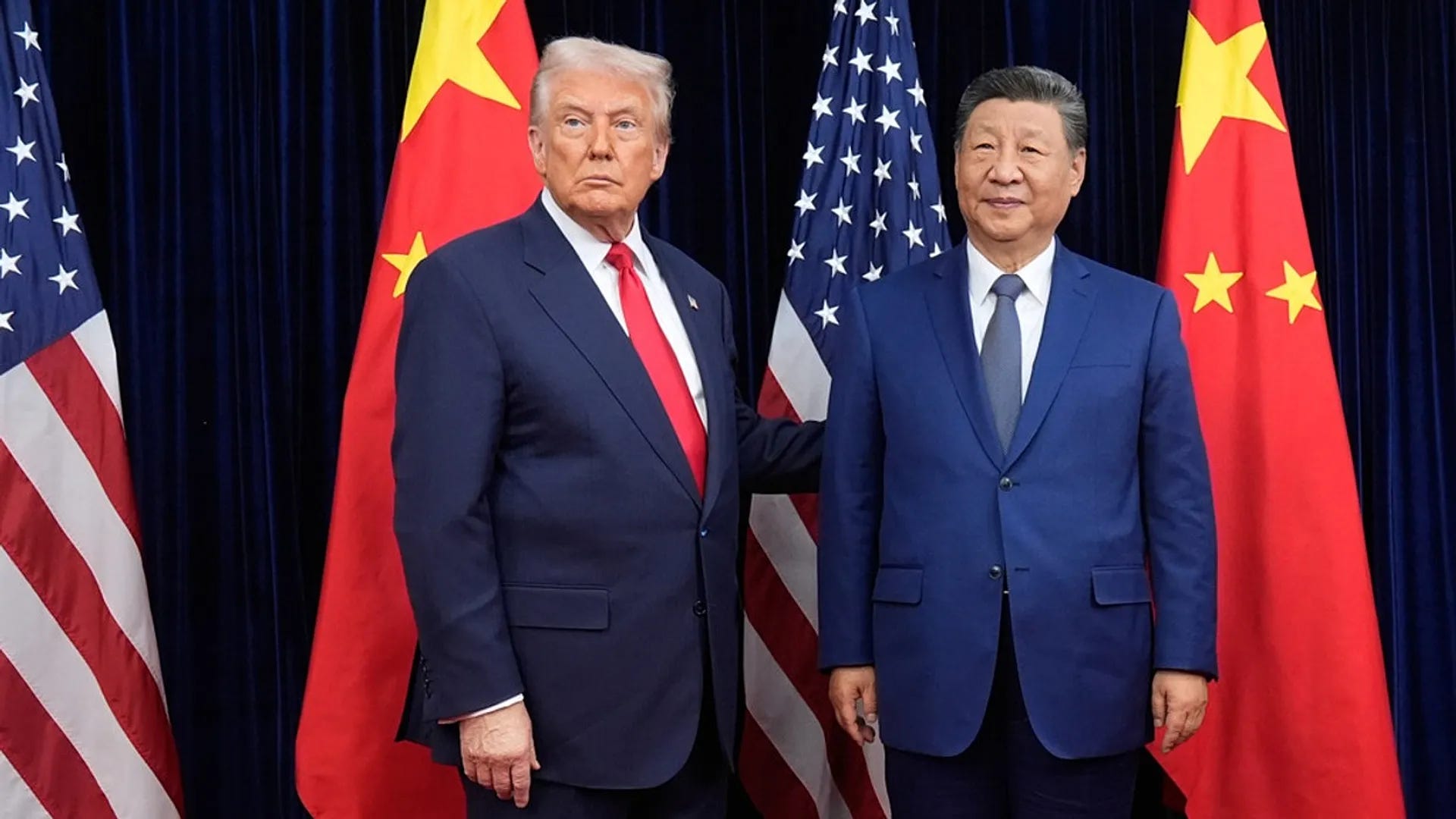
US President Donald Trump and Chinese President Xi Jinping pose ahead of their summit talk at Gimhae International Airport in Busan, South Korea, Oct. 30, 2025. Courtesy of AP
Against this backdrop, the Philippines naturally grows closer to China’s great power rival, the United States (US). Current President Ferdinand Marcos Jr. has met the sitting US Presidents three times since taking office in 2022, producing various deals, including an agreement in August 2025 when both countries pledged to conduct 500 joint military exercises across 2026. Furthermore, in December, the US Congress approved US$2.5 billion in security assistance to the Philippines from 2026 to 2030.
However, this trend does not hold across all SEA countries. While 86.4% of Filipinos in the same ISEAS survey stated that they will side with the US if forced to choose between the two major powers, almost half of the respondents would turn to Beijing’s camp. Indonesians are among the most supportive, with 72.2% indicating alignment with China. Geographically located between the two powers and being the most divided region in the matters, SEA has thus emerged as a particularly fertile arena for influence operations by both Beijing and Washington.
For China, the SCS has long held strategic importance, dating back to the Ming Dynasty (1368–1644), when vast fleets under admirals such as Zheng He operated across Southeast Asia and the Indian Ocean. This maritime tradition later declined due to domestic policy shifts and foreign interventions, severely constraining China’s power-projection capabilities. The SCS re-emerged as a core sovereignty concern only in the late 20th century, formalised in the 1997 People’s Liberation Army Military Terminology, which defined China’s “near seas” as the Bohai, Yellow, East, and South seas. This doctrinal shift coincided with rapid economic growth and expanding defence expenditure, enabling renewed regional power projection. Beijing’s first formal international assertion over SCS came in 2009, when it submitted to the United Nations a map featuring the nine-dash line. Subsequent land reclamation and militarisation efforts are framed as non-negotiable expressions of historical sovereignty, leading it to reject external challenges, including the 2016 international ruling invalidating the nine-dash-line claim.
For the US, the strategic importance of the SCS derives from a Cold War containment strategy in the Asia-Pacific, specifically the island chain strategy aimed at constraining the Soviet Union and China. This doctrine underpinned US military and political interventions along the region’s periphery and led to the establishment of the US Pacific Fleet, the Navy’s largest. Although the Soviet Union collapsed in 1991, the strategy endures, now oriented toward China. Reflecting this continuity, the 2026 US National Defence Strategy states that Washington “will erect a strong denial defence along the First Island Chain.” Consequently, the SCS remains central to US efforts to limit Chinese influence and prevent its displacement from the Indo-Pacific.
As these competing Chinese and US strategies collide, the SCS has become a focal point of great-power rivalry. This escalating militarisation leaves limited room for smaller claimant states to defend their interests, placing the Philippines in an increasingly vulnerable position.
A Herculean Task
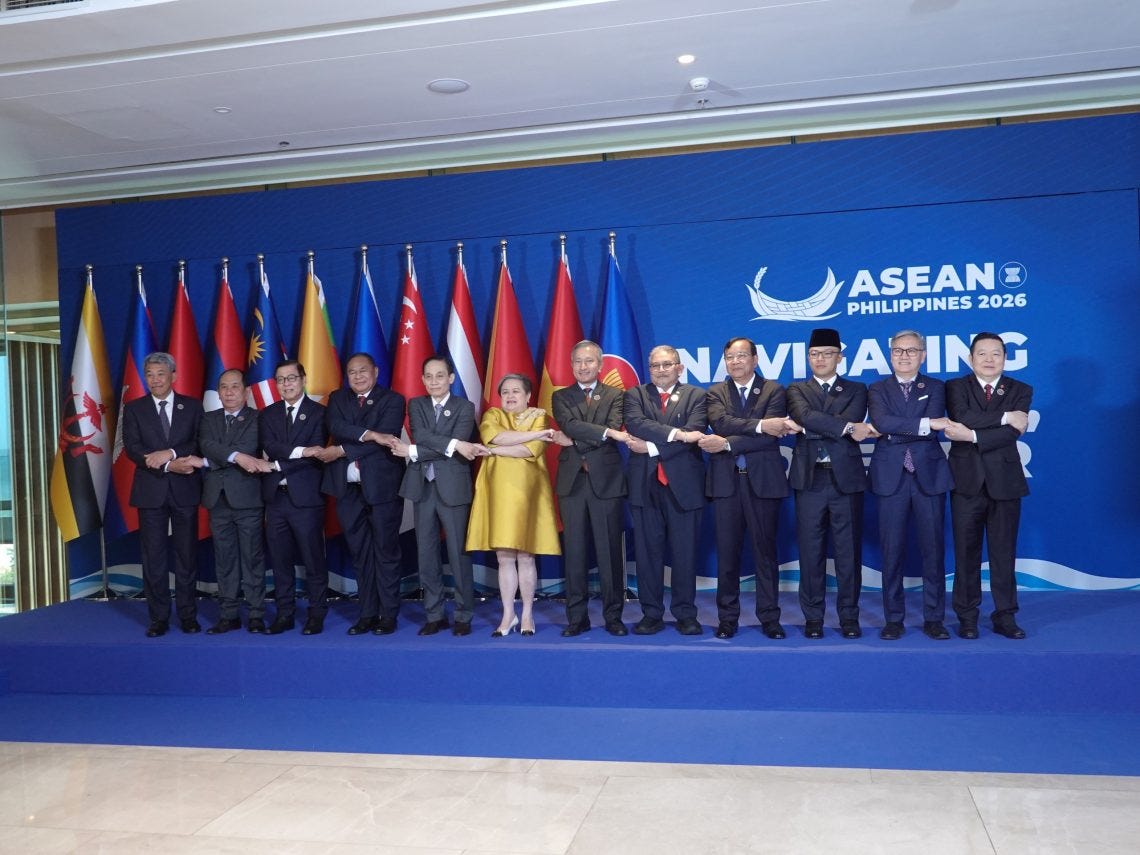
The Philippine Secretary of Foreign Affairs and Chair of ASEAN Foreign Ministers’ Meeting Retreat (AMM Retreat), Ma. Theresa P. Lazaro, led the AMM Retreat in Cebu City, Philippines, January 29, 2026. Courtesy of ASEAN
The Philippines thus finds itself at a critical juncture, as evolving power dynamics in the SCS increasingly shape its sovereignty and security outlook. Without decisive policy shifts and sustained capability enhancements, current trends indicate that Beijing will continue to expand its influence and operational presence, further marginalising Manila. Between 2019 and 2024, Chinese mobilisation in the SCS expanded significantly, from relatively limited naval capabilities to an estimated 400 maritime militia vessels, an average of 232 patrol ships, and 27 militarily active outposts. By contrast, the Philippine Navy fields just over 100 vessels, of which only four frigates constitute its principal surface combat capability.
Although frequently advanced as an alternative strategy, a de-escalatory stance has delivered limited strategic returns and at times has instead emboldened China’s military activities in SCS. Under President Rodrigo Duterte (2016–2022), Malacañang pursued a conciliatory approach toward Beijing despite opposition from within his own cabinet. This policy shift was symbolised by Duterte’s 2016 announcement of a “separation from the US” during a visit to Beijing and his public dismissal of the 2016 arbitral ruling invalidating China’s nine-dash-line claim. Although this approach coincided with a sharp increase in Chinese investment—from only US$10.8 million in 2016 to US$1.75 billion in 2019—it came at the cost of a significant escalation in Chinese maritime activities in the SCS, suggesting that accommodation failed to moderate Beijing’s behaviour.
China’s approach to the SCS is rooted in an inflexible sovereignty claim reflected through a preference of coercive signalling, leaving limited avenues for diplomatic compromise. This dynamic was evident between 2023 and 2024, when Manila adopted a firmer stance in resupplying the BRP Sierra Madre, a central feature of its claim in the Spratly Islands. Despite repeated interference through water cannons and blocking manoeuvres, Philippine naval and coast guard forces persisted. These episodes suggest that sustained resistance, rather than de-escalation, has been more effective in preserving Philippine claims in SCS. In this context, Malacañang’s recent military deals—and posture adjustments represent a necessary response.
Nevertheless, the Philippines lacks the capacity to deter China independently. This explains its deepening security alignment with the US, which has provided substantial military assistance and expanded defence cooperation. Yet Washington’s reliability has become less predictable, particularly under the Trump administration, where alliance commitments have increasingly become transactional. This exposes Manila to strategic vulnerability in case US priorities shift. Sustaining deterrence therefore requires the Philippines not only to demonstrate tangible alignment value to Washington but also to seek complementary sources of external support.
Manila’s most viable alternative therefore lies with other Southeast Asian states as they are immediately affected by China’s unilateral claims in the SCS. However, the region remains deeply fragmented, with ASEAN struggling to articulate a coherent collective approach toward China. Vietnam, despite being among the most exposed claimants and expanding its security engagement with the US, remains constrained by deep economic interdependence with Beijing. Indonesia, the region’s largest actor, likewise prioritises stable economic relations while avoiding direct confrontation over the SCS. Consequently, prospects for a unified regional response to Chinese assertiveness remain limited.
Against this backdrop, the Philippines’ assumption of the ASEAN chairmanship in 2026 constitutes a narrow but essential window of opportunity. Malacañang has already moved to accelerate negotiations on an ASEAN-China SCS COC. Nevertheless, to generate meaningful leverage, the Philippines would need to regionalise the costs of Chinese incursions, promote alternative economic partnerships to reduce regional dependence on China, and invite regional powers to contribute to a more credible deterrence posture at the regional level.
This window is both rare and time-bound. The Philippines will not chair ASEAN again for another 12 years, and domestic political uncertainty further complicates the strategic outlook. Vice President Sara Duterte, widely regarded as a leading contender in the 2028 presidential election, is expected to pursue a more accommodating approach toward China, echoing her father’s foreign policy stance.
In sum, given the non-negotiable nature of China’s sovereignty claims in the SCS, military deterrence remains the Philippines’ most viable instrument for preserving control over its exclusive economic zone. However, in an increasingly fragmented and volatile strategic environment, Manila cannot rely solely on US support. Its most credible way forward lies in leveraging its ASEAN chairmanship to consolidate regional resistance to coercive behaviour while incrementally strengthening its own defence capabilities. While the challenges are substantial, success would significantly enhance the Philippines’ strategic position and bargaining power.
About The Author




4 thoughts on “A Frontline Nation: The Philippines and the Rising South China Sea Tensions”