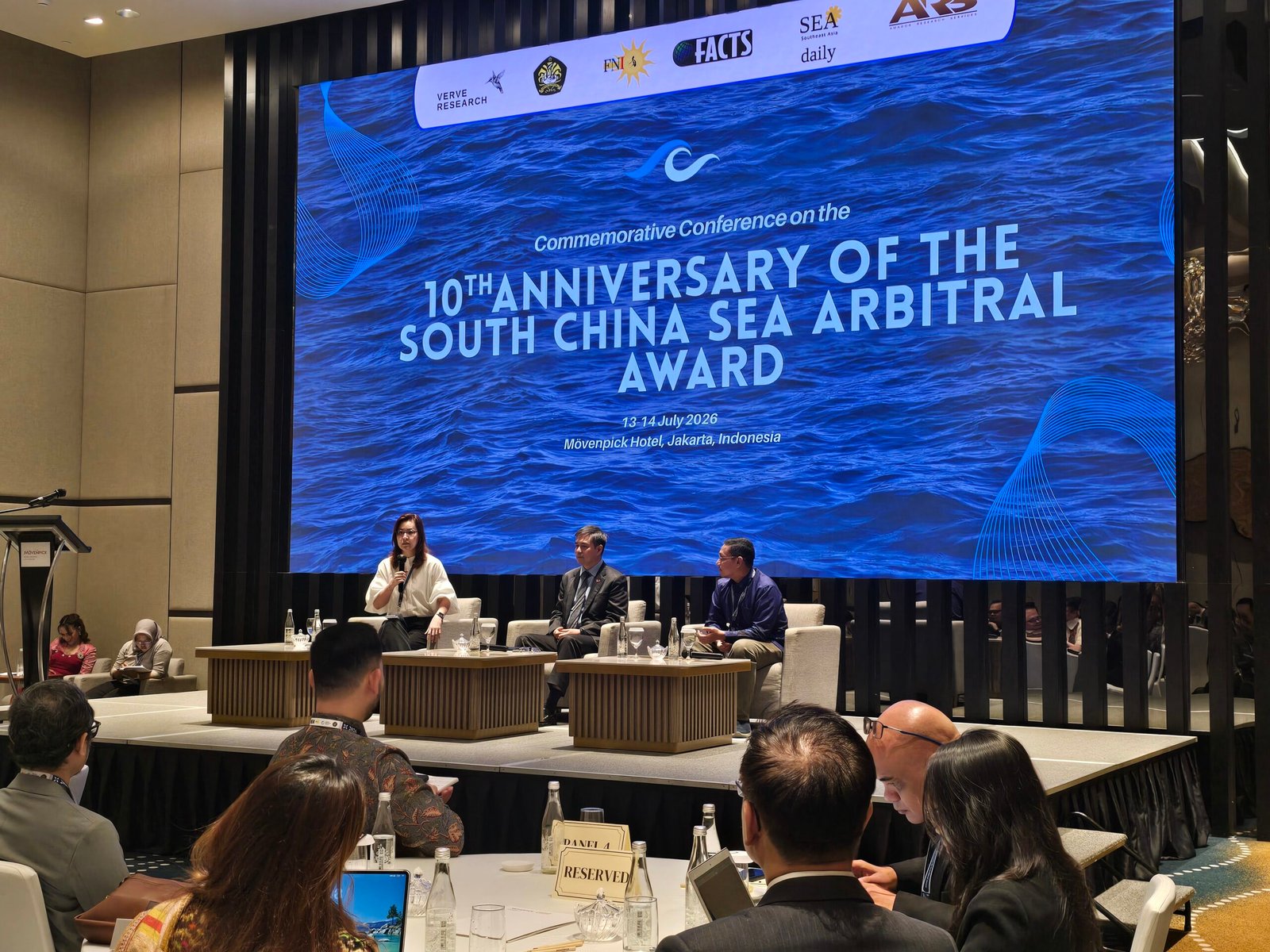
The kick-off panel, “ASEAN Views on the Arbitral Award,” features (from left to right) moderator Irene Chan of the Asia Pacific Foundation of Canada, alongside speakers Rogelio Villanueva Jr., Deputy Assistant Secretary of the Philippines’ Department of Foreign Affairs and Prof. Hazmi Rusli of Universiti Sains Islam Malaysia. (SEA Daily/Elisabeth Xaviera)
July 12 of this year marks a decade of the Arbitral Award, where the Permanent Court of Arbitration (PCA) in The Hague found no legal basis for China’s nine-dash line claim, a statement it handed down under the UN Convention on the Law of the Sea (UNCLOS) on 2016. Beijing rejected it then and ignores it now, leaving Southeast Asia to manage a verdict that is binding in law but unbacked by any mechanism to compel compliance.
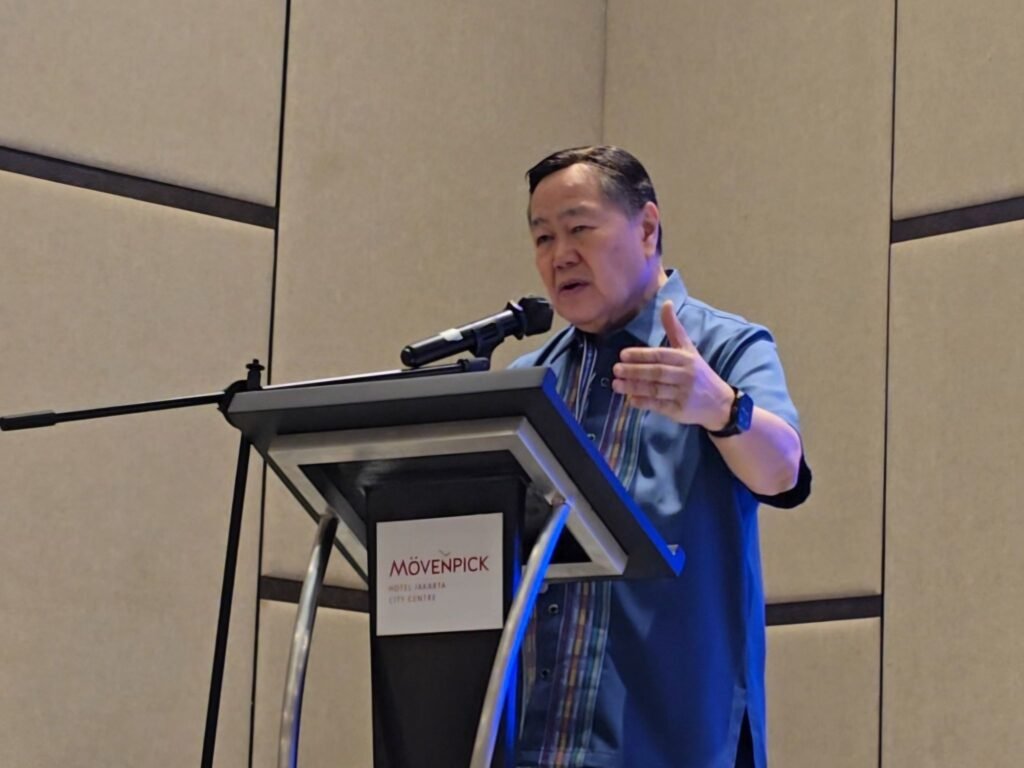
Retired Senior Associate Justice Antonio Carpio of the Philippine Supreme Court delivers a keynote speech for the Commemorative Conference on the 10th Anniversary of the SCS Arbitral Award on July 13 in Jakarta. (SEA Daily/Elisabeth Xaviera)
That continuing tension framed the Commemorative Conference on the 10th Anniversary of the SCS Arbitral Award, a two-day gathering of officials, diplomats and legal scholars convened in the ASEAN capital of Jakarta by FACTS Asia around the anniversary. Delivering the keynote, Justice Antonio Carpio (Ret.), former Associate Justice of the Philippine Supreme Court, made the case for the award’s residual value. While it cannot settle the dispute, it “prevents disputes from escalating into a crisis”. There is “nothing to lose in protesting a unilateral claim”, warning that without a collective response the region concedes ground by default.
The award’s next real test is the Code of Conduct (CoC), which ASEAN and China have pledged to conclude in 2026 under a deadline set in 2023. The Philippines, this year’s ASEAN chair, has pushed monthly negotiations, but optimism has faded through the year amid renewed friction around Scarborough Shoal. Analysts now warn the text could be diluted to the point of omitting any reference to the 2016 ruling, an outcome Beijing would welcome. Manila itself has signalled that a weak code may be worse than none.
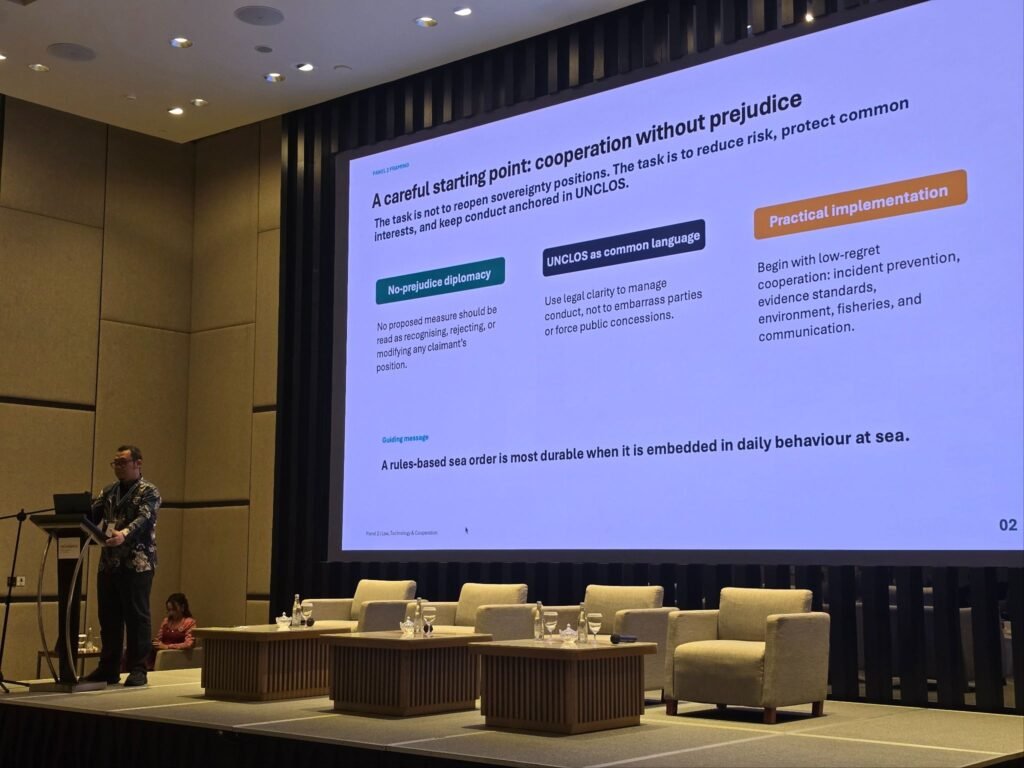
Prof. Arie Afriansyah of the University of Indonesia speaks on regional collaboration for managing the SCS dispute during Panel 2, “Enforcing the Arbitral Award: Law, Technology and Cooperation”. (SEA Daily/Elisabeth Xaviera)
Prof. Arie Afriansyah of the University of Indonesia, who served as both panellist and moderator told SEA Daily his take, saying he is “pessimistic” that negotiators can meet this year’s deadline on the CoC because “there are critical matters that are hard to agree upon”. A concluded code, he added, would nonetheless “demonstrate to stakeholders the region’s capability in managing this conflict without any escalation”.
As an Indonesian scholar, Prof. Arie underlined that although Jakarta is not a claimant and formally non-aligned, it has “legitimate interests” in the waters off the Natuna Islands and a long record of backing both UNCLOS and the award. Legal clarity, he said, is what allows Indonesia to be a “good neighbour”, making the resolution of maritime delimitation “our responsibility” to pursue.
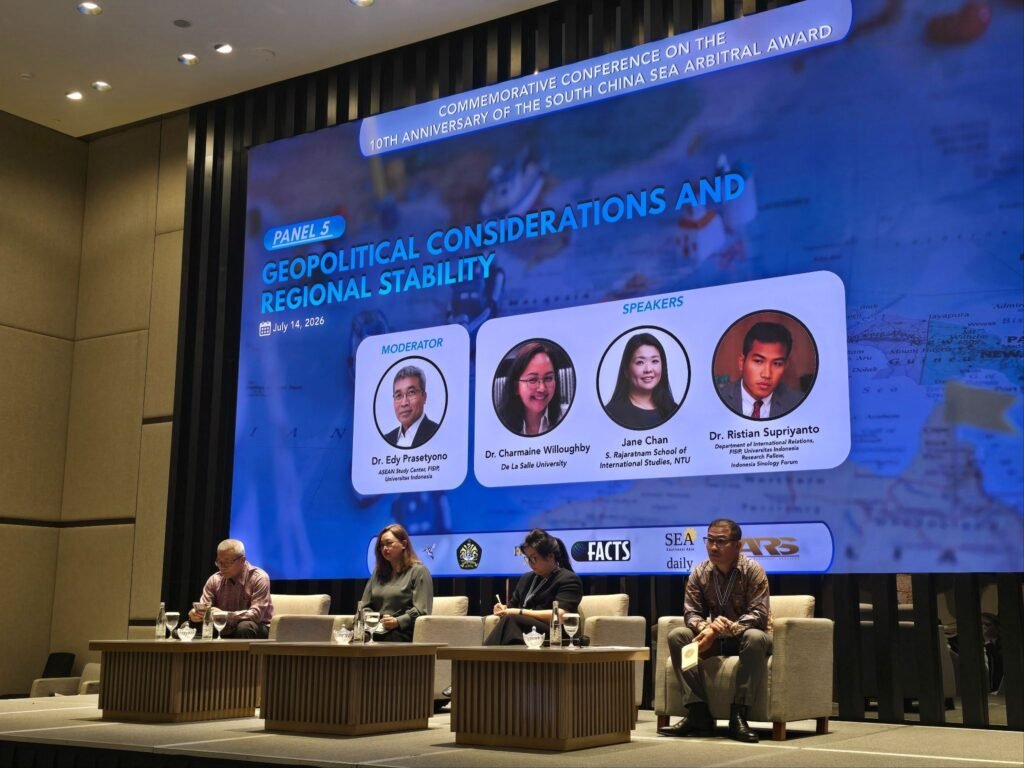
Q&A session of Panel 5, “Geopolitical Considerations and Regional Stability”. (SEA Daily/Elisabeth Xaviera)
On a regional level, maintaining a collective front remains a challenge. Jane Chan of the S. Rajaratnam School of International Studies (RSIS) pointed out that a rising China appeals to Southeast Asian states that stayed non-aligned and “never ended up with the US”. This is thus a hurdle for the implementation of the Arbitral Award: a bloc that cannot enforce it, decides by consensus and counts members with little interest to antagonise Beijing. A decade after the ruling, it still defines the dispute in law. Whether that counts for much in the CoC now under negotiation is the question the anniversary left open.
About The Author