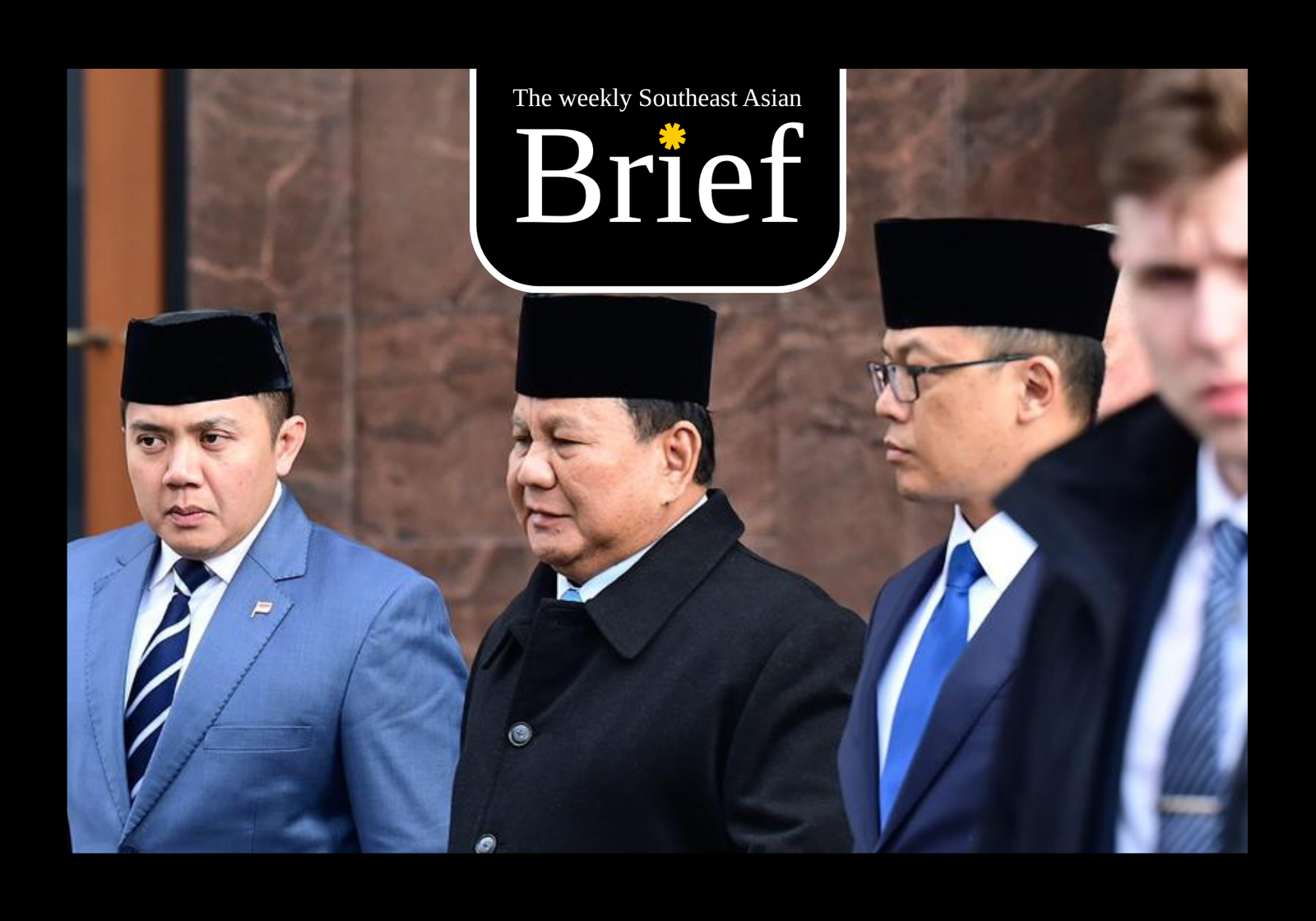
Cabinet Secretary, Teddy Indra Wijaya, accompanies President Prabowo Subianto during his state visit to Moscow on April 13, 2026. (Indonesian Presidential Secretariat)
In mid-April 2026, Indonesian President Prabowo Subianto embarked on a wave of state visits which represents Jakarta’s attempt to navigate an increasingly uncertain global condition. Within 48 hours, he moved between two important capitals, namely Moscow and Paris, while his defence minister, Sjafrie Sjamsoeddin, signed a major defence pact in Washington almost simultaneously.
On April 13, Prabowo met Russian President Vladimir Putin at the Kremlin for an unusually long five-hour discussion, consisting of a two-hour bilateral session followed by a three-hour tête-à-tête. The meeting focused on expanding strategic cooperation between Indonesia and Russia, particularly in energy, mineral resources, research, agriculture and industrial development. Indonesian officials also highlighted Russia’s significant role in global politics, as a permanent veto holder in the United Nations Security Council (UNSC) and a founding member of BRICS+. This marked Prabowo’s third visit to Russia in less than a year and his second meeting with Putin in under six months, signaling a deliberate intensification of bilateral ties. Prabowo framed the trip as a “consultation” on rapidly shifting geopolitics, thanking Putin for Moscow’s support of Indonesia’s accelerated BRICS accession.
A day later, Prabowo was formally received by French President Emmanuel Macron at the Élysée Palace with a guard of honour. The two leaders held a tête-à-tête of more than two hours to discuss bilateral cooperation across priority sectors, such as defence procurement, the energy transition and renewables, infrastructure and transportation, education and the creative economy. Officials in Jakarta emphasised that both Russia and France are UNSCU veto holders, highlighting a deliberate charm offensive to great-power interlocutors from across the geopolitical spectrum within a single trip.
Meanwhile, prior to the European tour, a leaked defence document revealed that Jakarta and Washington were negotiating a proposal granting American military aircraft “blanket” overflight access to Indonesian airspace for contingency operations, crisis response and joint exercises, replacing the long-standing case-by-case approval regime. The proposal reportedly emerged from Prabowo’s meeting with President Donald Trump in February, and was expected to be signed during Defence Minister Sjafrie’s April 13 visit to the Pentagon, which is the very same day Prabowo was at the Kremlin. Although the Pentagon’s subsequent statement on the new Major Defense Cooperation Partnership made no public reference to overflights, a US official acknowledged that this did not mean the matter had not been discussed privately and Indonesia’s defence ministry has confirmed that a draft “letter of intent” remains under review.
The plan has drawn criticisms. Indonesia’s own foreign ministry sent an “urgent and confidential” letter to the defence ministry warning that blanket overflight rights could entangle Jakarta in South China Sea (SCS) conflicts and create “the impression that Indonesia is involved in an alliance” that would increase national security risks by making it a potential target in a regional conflict. The letter noted that US military aircraft had already carried out 18 surveillance operations in the SCS between January 2024 and April 2025 in violation of Indonesian waters and airspace, with protests going unanswered.
Taken together, these moves suggest that President Prabowo is attempting to build geopolitical “safety nets” by engaging with several major powers at once. Yet the simultaneity could itself be a problem. Courting Putin in the morning and deepening defence ties with Washington the same evening, then professing strategic partnership with Paris the following day, risks appearing less as a revival of Indonesia’s traditional non-alignment policy than as a cautious accommodation of every major power without clearly defining Jakarta’s long-term direction. Analysts warn that blanket US airspace access, in particular, would mark a quiet but decisive pivot away from a balancing position. This would represent a shift China will surely take note of along the Strait of Malacca, where Indonesia’s Natuna-facing geography makes it a natural pressure point.
While these efforts may seemingly “elevate” Indonesia’s international profile, domestic concerns over economic stability, a weakening Indonesian rupiah and political uncertainty remain largely unaddressed. As a result, questions are mounting over whether Prabowo’s hyperactive hedging is producing genuine strategic autonomy or merely deferring the hard choices that each of these relationships will eventually demand.
About The Author