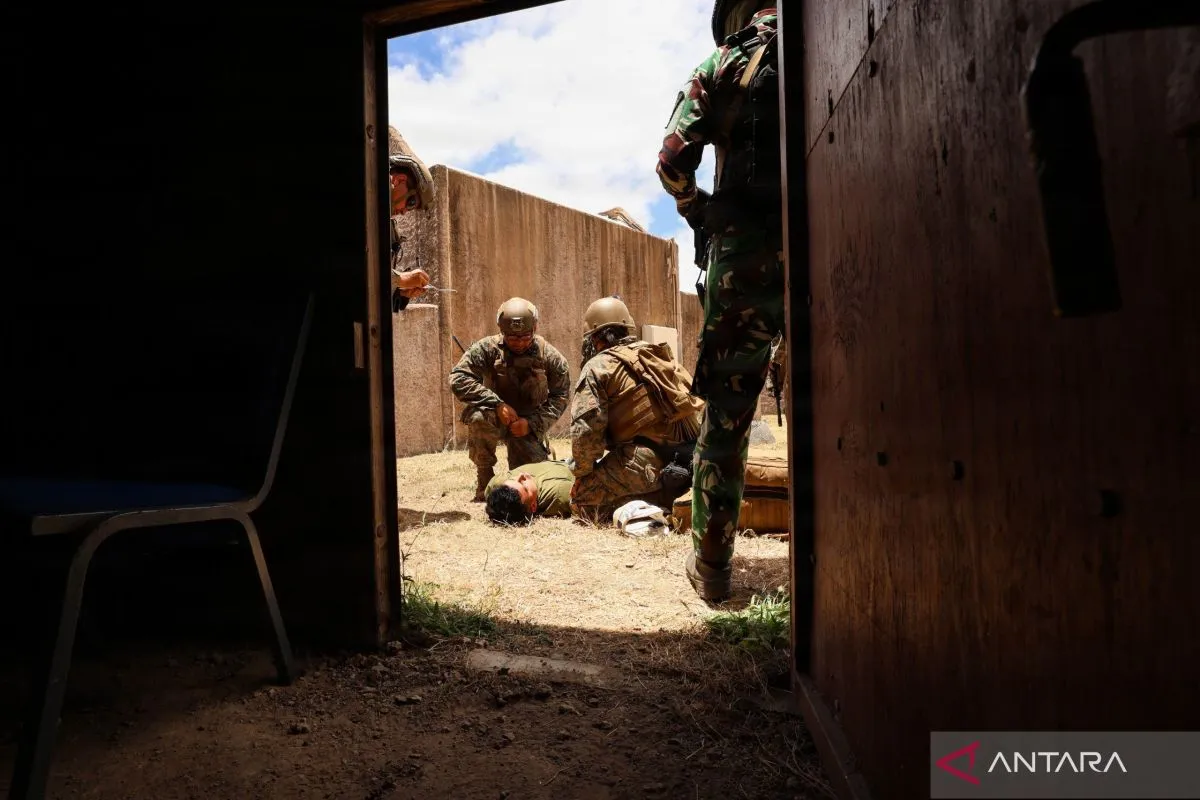
US Marines and Indonesian Navy perform tactical combat casualty care during a joint military exercise. (ANTARA/HO-TNI AL)
On July 26, Indonesian Navy (TNI AL) Marines and the US Marine Corps (USMC) conducted a joint Mass Casualty Training (MASCAL) exercise in Hawaii as part of the Rim of the Pacific (RIMPAC) 2026 exercise, enhancing their ability to respond to large-scale military and humanitarian emergencies.
The training simulated mass casualty scenarios designed to improve the speed, precision and coordination of personnel managing complex emergency situations. Head of the Indonesian Navy Information Service Rear Admiral Tunggul said the activity provided an opportunity for both forces to exchange operational knowledge and practical techniques in casualty management.
“This exercise also serves as a vital platform for exchanging knowledge, tactical experience and techniques to manage casualties effectively during both military operations and humanitarian missions,” he said.
The scenarios were developed to replicate real operational conditions, while safety measures ensured the training was conducted successfully without incident. The activity formed part of Indonesia’s wider participation in RIMPAC 2026, a multinational maritime exercise conducted in and around the Hawaiian Islands from June 24 to July 31. Led by the US Indo-Pacific Command, the exercise brings together 30 countries, more than 30,000 personnel, 30 ships, five submarines, over 190 aircraft and 15 land force contingents to strengthen cooperation and interoperability among participating militaries.
As part of its participation, an Indonesian Navy delegation led by Commander of the 2nd Marine Force Major General Oni Junianto and Vice Assistant for Operations to the Chief of the Indonesian Navy First Admiral Mochammad Riza attended operational briefings, observed training activities and engaged in discussions with senior military officials from participating countries.
The inclusion of mass casualty training highlights how multinational military exercises are increasingly focused not only on conventional combat readiness but also on humanitarian assistance and disaster response. In the Indo-Pacific, where countries frequently face natural disasters alongside evolving security challenges, medical coordination and rapid response capabilities have become important areas of defence cooperation.
For Indonesia, participation in RIMPAC provides an opportunity to develop operational capabilities while reinforcing partnerships with international counterparts. The engagement reflects Jakarta’s broader defence diplomacy approach, which seeks to balance military preparedness with cooperation and regional stability.
About The Author