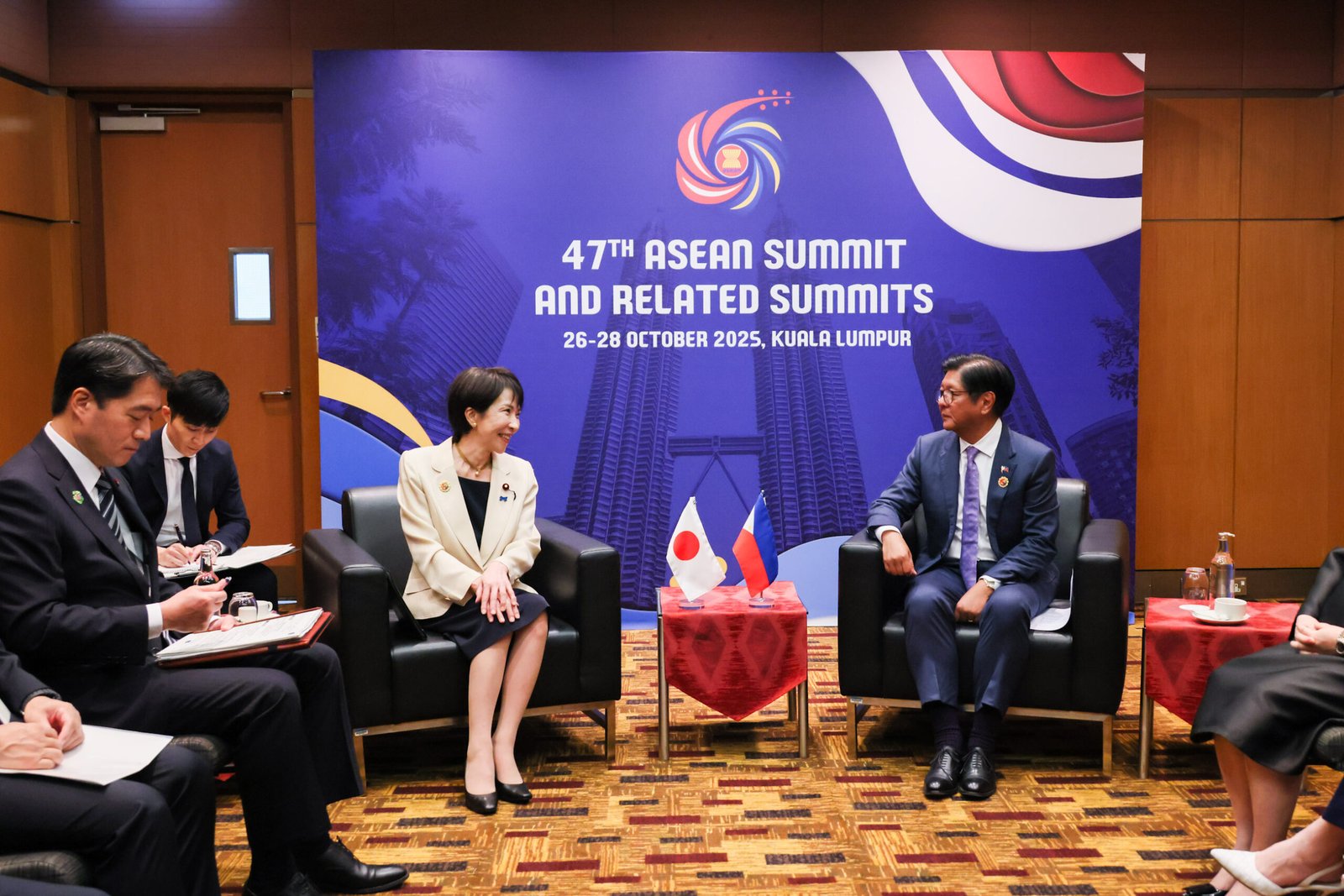
PM Takaichi visits Kuala Lumpur for ASEAN summits, meets U.S. President Trump and Philippine President Marcos, and lays wreaths at memorial sites, Oct. 25–26, 2025. (Prime Minister’s Office of Japan)
President Ferdinand Marcos Jr. and Japanese Prime Minister Takaichi Sanae formally elevated their countries’ bilateral relations to a Comprehensive Strategic Partnership (CSP) during a state visit on May 28, marking a step forward in bilateral ties amid geopolitical and economic challenges. The announcement, made at a joint press conference following their summit at the Akasaka State Guest House, coincided with the 70th anniversary of the normalisation of diplomatic ties, first established on July 23, 1956.
“As we commemorate the 70th anniversary of the normalisation of diplomatic relations between our countries, I am pleased to announce that we have elevated our relations from a Strengthened Strategic Partnership to a Comprehensive Strategic Partnership,” President Marcos declared. Both leaders described the relations as being “closest like-minded countries,” underlining cooperation across a wide range of fields in pursuit of an updated Free and Open Indo-Pacific.
The summit covered a wide range of strategic sectors, with an emphasis on economic, security and maritime cooperation.
In the security and defence realm, both countries agreed to foster the Official Security Assistance (OSA), a framework to assist and supply “armed forces and related organisations of like-minded countries” and to launch the ‘2+2’ meeting between foreign and defence Ministers. They also agreed to facilitate the transfer of defence equipment, including Abukuma-class destroyers and TC-90 aircraft. Both sides further expressed readiness to open a negotiation on the General Security of Military Information Agreement (GSOMIA), underscoring their intent to expand intelligence and defence collaboration.
Within the maritime security sphere, both countries reiterated their adherence to international law to establish “maritime boundaries” aligning with “the United Nations Convention on the Law of the Sea (UNCLOS) and guided by relevant international jurisprudence”. They jointly rejected unilateral attempts to alter the status quo in the East and South China Seas, stressing the importance of the 2016 South China Sea Arbitral Award as a guiding principle.
On the economic front, the summit advanced the Japan–Philippines Economic Partnership Agreement (JPEPA) and the ASEAN–Japan Comprehensive Economic Partnership (AJCEP) to foster trade growth.
Furthermore, the two leaders also agreed to develop the Luzon Economic Corridor (LEC), a trade hub designed to facilitate global supply chains and mutual benefits. This corridor will link Subic-Clark-Manila-Batangas. Tokyo also pledged continued Official Development Assistance (ODA) to fund “high-quality infrastructure development”, while Manila welcomed Japan’s Partnership on Wide Energy and Resources Resilience (POWERR) Asia initiative to bolster regional energy resilience.
Beyond bilateral relations, both Japan and the Philippines addressed pressing regional and global issues, including the situation in Myanmar, the ongoing conflict in the Middle East and Pyongyang’s nuclear deterrence. Both sides also discussed the convergence between Tokyo’s Free and Open Indo-Pacific (FOIP) and the ASEAN Outlook on the Indo-Pacific (AOIP), signalling a shared vision for regional stability.
About The Author