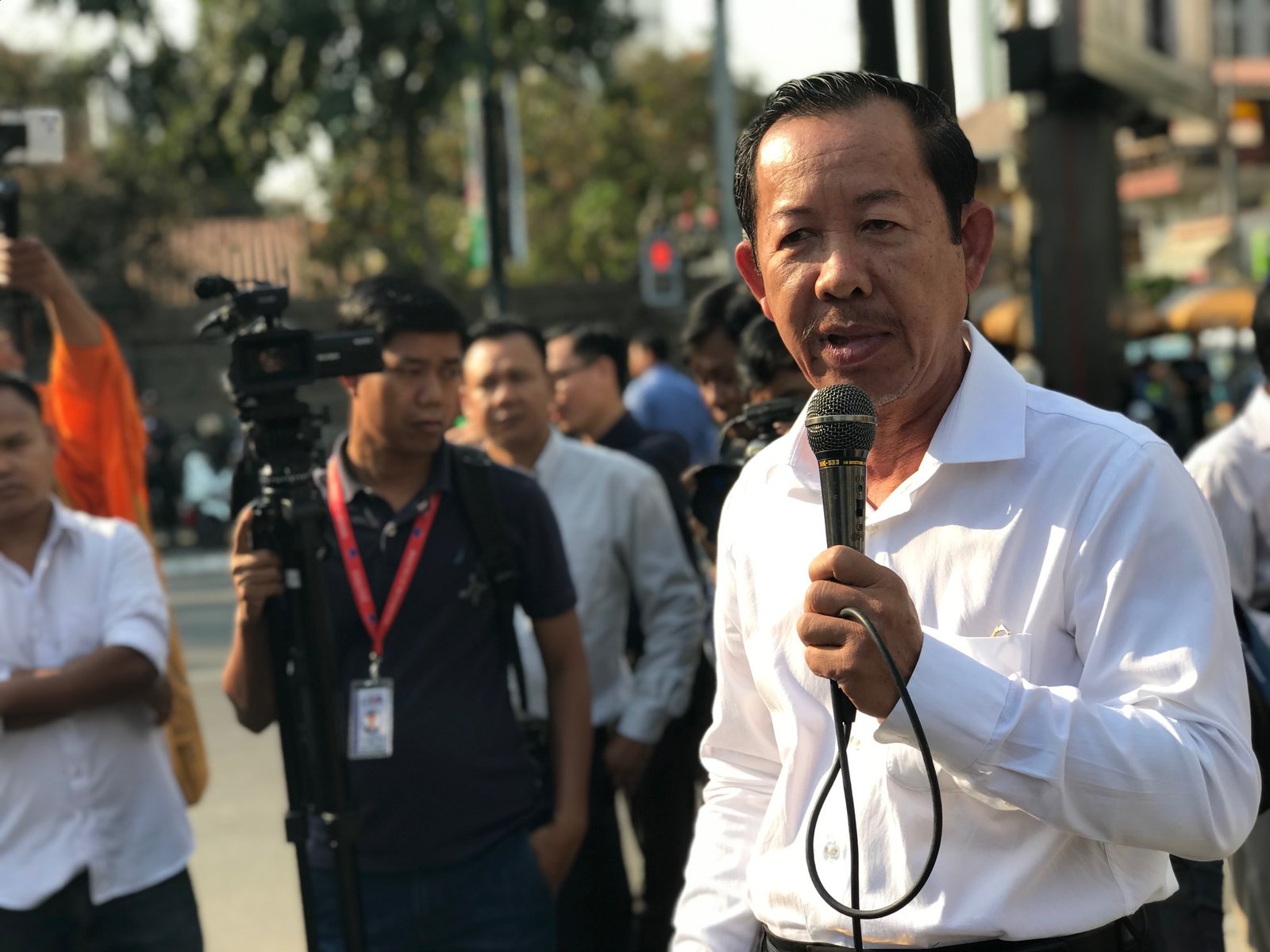
Rong Chhun, president of the Cambodian Confederation of Unions, recalls Chea Vichea’s union activism during the 16th‑anniversary commemoration of Vichea’s murder in Phnom Penh, January 22, 2020. (Hul Reaksmey/VOA Khmer)
The Cambodian Supreme Court upheld the verdict against prominent opposition Rong Chhun on June 19, suspending his four-year sentence to three years of probation, whilst effectively stripping him of his political rights. Chhun, who served as an adviser to the opposition Nation Power Party, was banned from joining the race, voting and travelling abroad.
Delivering the ruling, Judge Chaing Sinath said, “Therefore, the judges’ council of the Supreme Court has decided to uphold the judgment dated March 31, 2026, but his sentence shall be temporarily suspended on probation, with a probation period of three years.”
Chun was charged with an “incitement to disturb social security” based on Articles 88, 494 and 495 of the Cambodian Criminal Code, arising from his public comments in Radio Free Asia and direct advocacy on behalf of those who are largely affected by government major projects. The Phnom Penh Municipal Court had originally sentenced Chhun last year to four years in prison and fined him 4 million Cambodian riel (1,000 US dollar).
In 2020, Chhun faced a similar charge of “incitement to disturb social security” under Articles 494 and 495 following his public statements he made about demarcated border posts between Cambodia and Vietnam, in which he claimed that they violated local community rights. He was sentenced to two years of imprisonment and ordered to pay 400 million riel.
Cambodian oppositional figures and parties are oftentimes targeted by the ruling coalition. Khoeun Virath, regional head of the Nation Power Party (NPP) in Prey Veng province, was also sentenced to two years following his remarks on Facebook. He was charged with Articles 494, 495 and 502 under the Cambodian Criminal Code, for “incitement and insulting a public official”.
These cases highlight Cambodia’s hostility towards political opposition. Phnom Penh routinely targets figures with significant appeal in its society, such as Kem Sokha’s case—who was sentenced to 27 years of imprisonment on charges of colluding with foreign powers. In the broader context, human rights groups and United Nations bodies view the case as politically motivated to silence opposition through legal authoritarianism, aimed at hollowing out Cambodia’s opposition before it can take root.
About The Author