
Timor-Leste has recently been on a flurry of high-level engagements. On May 21, Dili elevated its relationship with Canada into a special strategic partnership, with President José Ramos-Horta receiving a high-level Canadian commercial delegation that included the National Bank of Canada, BlackBerry and the Canada-ASEAN Business Council, with Ottawa pledging 15 million US dollars towards a solar project. Only a day prior, the President, alongside Prime Minister Kay Rala Xanana Gusmão hosted Australia’s Deputy Prime Minister Richard Marles for the commemoration of its 24th anniversary of independence with talks ensuing on defence, energy and development sectors.
The engagements run in both directions. In May, Dili’s leaders also took the charm offensive abroad. Prime Minister Gusmão addressed the plenary of the 48th ASEAN Summit in the Philippines, where he set out three regional priorities, energy security, food security and strategic stability, and used the sidelines to meet Vietnamese Prime Minister Lê Minh Hưng on trade, investment, education and fisheries cooperation. He stayed on for early talks on tourism and agricultural cooperation with host city Cebu. Days later, Ramos-Horta made a first-ever state visit to Papua New Guinea, agreeing to open reciprocal embassies and forging a “Blue Economy” partnership between the two oil-and-gas producers.
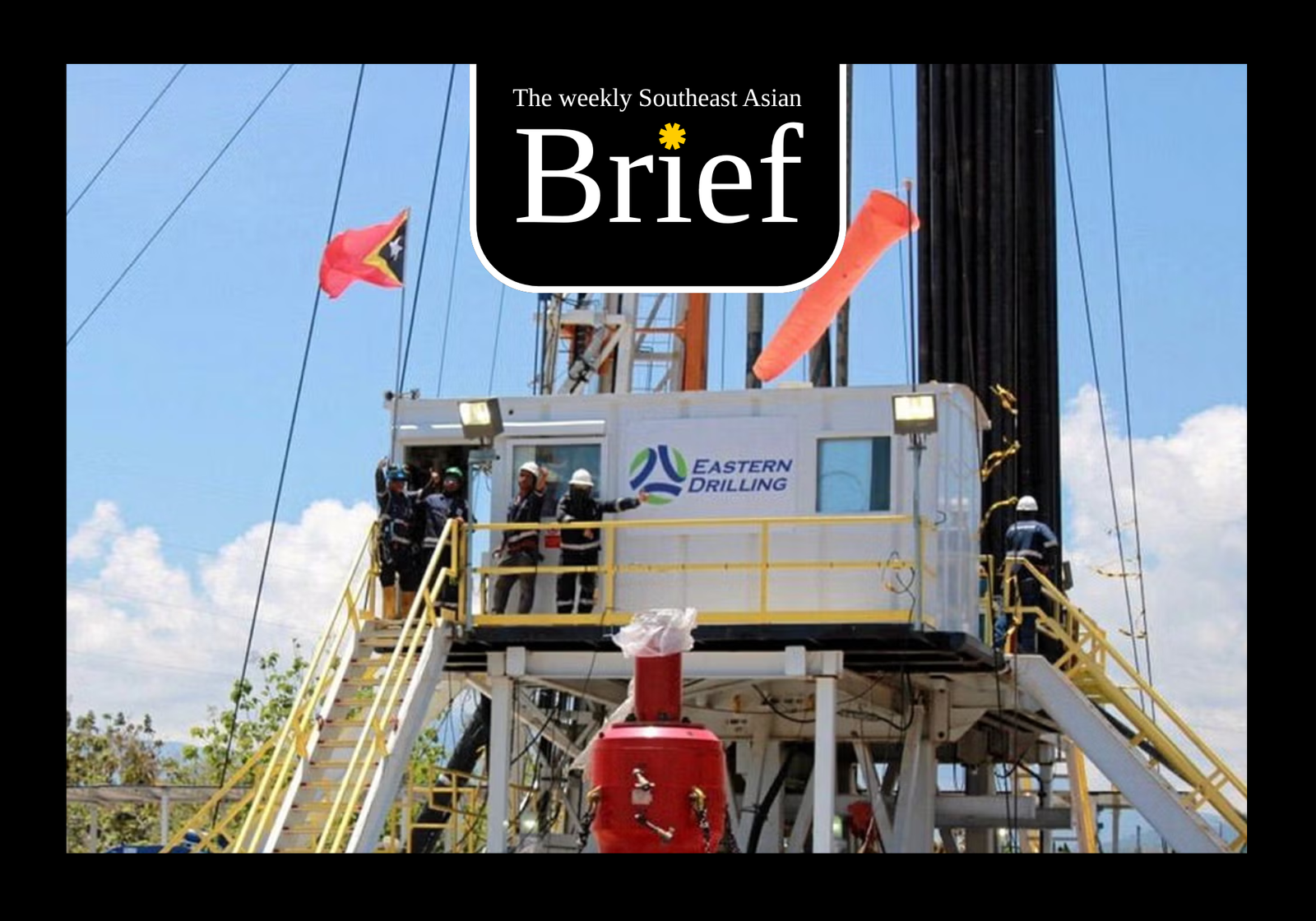
These deals mask a more pressing looming economic crisis. Timor-Leste is one of the most petroleum-dependent states on earth, with hydrocarbons historically accounting for more than 90% of exports and over 80% of government revenue. However, the wells are starting to run dry. Bayu-Undan, the field that anchored state finances for two decades, peaked at 114,000 barrels per day in 2019 and permanently ceased production in June 2025. For the first time, the country now lives almost entirely on investment income from its 18.95 billion US dollar Petroleum Fund, drawn down at a rate that puts it on course for depletion within a decade.
ASEAN is central to Timor-Leste’s race against time. Accession was finalised in October 2025, and Dili’s own 2026 Economic Report frames membership as a strategic driver of competitiveness, investment and institutional reform, with the 2029 ASEAN Chairship as the deadline by which it hopes to showcase progress. Membership to the bloc also grants access to integrated regional markets that widen the country’s investment appeal, which it has pitched during its foreign engagements.
The diversification bets are focused on four sectors the government repeatedly singled out. The first commodity is still gas. Greater Sunrise, holding roughly five trillion cubic feet of gas and over 225 million barrels of condensate, remains Dili’s foremost economic priority. Timor-Leste’s national oil company Timor GAP holds a 56.56% majority stake in the bloc, alongside Australia’s Woodside Energy and Japan’s Osaka Gas, and the government insists on onshore processing to capture jobs and value at home.
The second is agriculture, where premium coffee, vanilla and coconut products are promoted as the country’s most credible non-oil exports. The third is tourism, a growing sector that is set to benefit from ASEAN’s intra-regional market of 48.5 million visitors, supported by the Dili airport expansion and new direct routes from Malaysia and China. The fourth includes renewables and the blue economy—the sustainable use of ocean, sea and coastal resources to support economic growth. Dili has adopted a national Blue Economy Policy, marketed during the Melanesian Oceans Summit in Port Moresby. Timor-Leste sits at the meeting point of the Coral Triangle and the Pacific, home to 76% of known coral species and over 2,200 reef fish species, assets Dili wants to convert into sustainable fisheries, marine tourism and ocean-conservation finance. The country has ratified agreements protecting biodiversity beyond national jurisdictions and backed the global 30×30 conservation goal, which targets the designation of 30% of the earth’s surface as protected areas by 2030.
For investors, ASEAN’s newest member acts as a compelling but unfinished case. The diplomatic momentum is real, and so is the early commercial interest, with delegations naming oil and gas, tourism and agriculture as the sectors of greatest potential. The Asian Development Bank (ADB) projects steady annual growth of 4% for both 2026 and 2027, and the Petroleum Fund still offers a financial runway that few frontier economies enjoy.
But the structural risks are precisely what the charm offensive seeks to overcome. An economy that draws on its sovereign wealth fund to cover the majority of public spending is not sustainable and any delay on diversification is risky. Greater Sunrise, the single largest prize, has stalled for years over processing and cost disputes, and the Pacific agreements so far amount to diplomatic architecture rather than committed capital. For foreign capital to translate into leverage, Dili must convert diplomatic relations into concrete projects.
The diplomatic courting is thus expected to intensify through 2029, when Dili is set to hold the ASEAN chair. Timor-Leste’s strategy is to use accession to attract the investment that builds a post-oil economy, and use the chairship to prove it can. The execution is the hard part. The country must convert engagement into non-oil revenue before its oil-backed fund runs out. The 2026 engagements have bought Timor-Leste attention and goodwill, but whether it has bought enough time remains unclear.
About The Author

4 thoughts on “Timor-Leste races to build a post-oil economy before the fund runs dry”