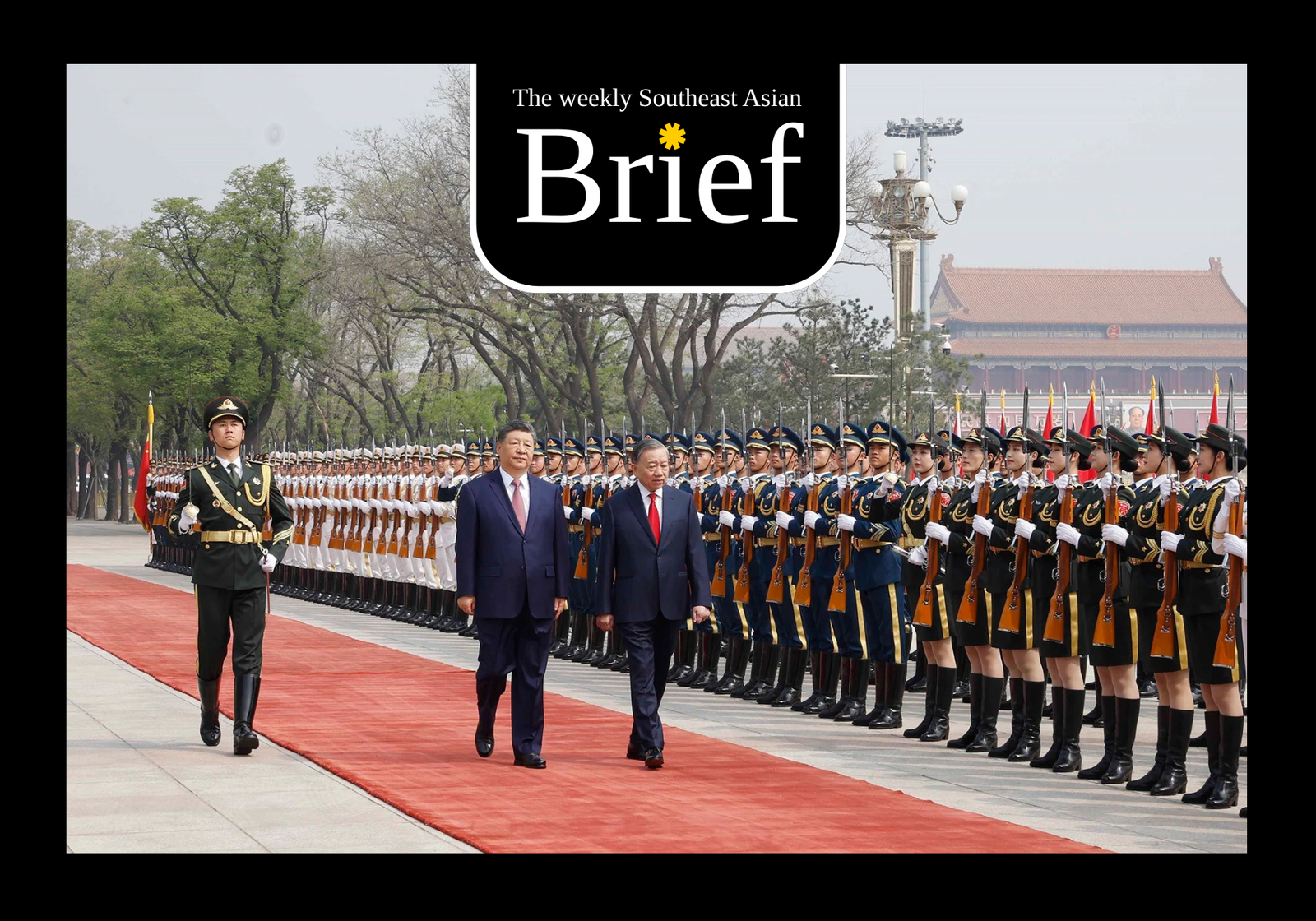
Vietnamese President and Communist Party General Secretary Tô Lâm, alongside Chinese President Xi Jinping, reviews the People’s Liberation Army honor guard. (VNA)
On April 17, Vietnam’s newly-elected President and General Secretary of the Communist Party of Vietnam (CPV), Tô Lâm, concluded his four-day visit to China with substantial outcomes, advancing the bilateral ties between the two countries.
The visit marked the president’s first overseas trip since taking office on April 7, signaling Hanoi’s resolve in positioning Beijing as its top foreign policy priority. In the joint statement, the two communist nations agreed to establish a “Vietnam–China community with a shared future at a higher level.”
Two notable ‘firsts’ further showcased Beijing’s arduousness toward his “comrade plus brother”: (1) Tô Lâm became the first foreign head of state to set foot in the Xiong’an New Area; and (2) traversed over 2,500 km of Chinese territory aboard a high-speed train in a single 10-hour journey.
In practice, the talks resulted in 32 cooperation agreements on strategic sectors with the aim of “maintaining peace, cooperation and development; opposing unilateralism and trade protectionism,” as addressed by Chinese Ambassador to Vietnam He Wei in a press briefing at the end of the visit.
On the infrastructure front, both nations agreed to fast-track high-speed rail projects, identifying connectivity as a “new highlight” of the partnership. Economically, the two sides committed to maintaining free and open trade and investment, building stable and resilient production and supply chains—including the establishment of a dedicated working group—while encouraging reputable enterprises from both countries to invest in each other’s markets. On security, both parties reaffirmed their commitment to preserving a stable and peaceful external environment as a foundation for domestic development.
The visit also yielded agreements in emerging sectors—notably artificial intelligence (AI), semiconductors and digital infrastructure such as 5G and big data. On the green economy front, both sides signaled a push toward renewable energy and clean technologies, with Vietnam looking to draw on China’s experience in electric vehicles and clean energy transition.
Indeed, the two nations share one of the longest-standing kinships in the world, and such cooperation may appear to be little more than routine relationship maintenance between a big brother and a little brother. Yet it is precisely this familiarity that warrants closer scrutiny.
On the surface, the cooperation stands to benefit Vietnam—ranked among the fastest-growing economies in Southeast Asia, with GDP growth projected at around 6–7% for 2025–2026—as it continues to apply a manufacturing-led development model similar to the one China previously pursued; much like a younger sibling following in an older one’s footsteps.
However, the negotiation outcomes point to Vietnam’s deepening dependence on China, which gives pause for concern. Analysts warn that Hanoi is growing too comfortable with Beijing, to the point where China appears to be an exception in Vietnam’s foreign affairs calculus.
To gain genuine leverage, Hanoi must be more firm in its posture. Vietnam’s international relations are guided by its “Bamboo Diplomacy” strategy—characteris ed by “strong roots, sturdy trunks, and flexible branches”—which idealis es the balance between firm independence and national interest on one hand and pragmatic flexibility in navigating geopolitical tensions on the other. Crucially, this demands that Hanoi be able to maneuver as a middle power between competing great power rivals and extract meaningful leverage from that position.
Vietnam’s recent rapprochement with the US, culminating in a Comprehensive Strategic Partnership, offers a vivid demonstration of this potential. Yet the concessions Hanoi has been willing to extend to Washington remain markedly limited compared to what it readily yields to Beijing, revealing an imbalance that potentially undermines its claim to true strategic autonomy.
Viewed through a realist lens, Tô Lâm’s visit to Beijing is best understood not in isolation, but as one move in a much larger geopolitical chess game. Amid growing global uncertainty, the US and China are locked in an intensifying race to secure and control global supply chains—and Vietnam sits squarely in the middle. Under China’s Tianxia strategic culture, Beijing’s influence across the Indo-Pacific is both deep and deliberate. Its planned diplomatic visits to Thailand, Cambodia and Myanmar signal a continued push to consolidate that influence—moves that deserve close attention. The rapid pace of Chinese diplomacy in the region, in this reading, is less about goodwill and more about urgency: a calculated response to Washington’s own efforts to build a counterbalancing coalition and, in Beijing’s view, “encircle” China. For Hanoi, navigating this rivalry with genuine autonomy—rather than quietly drifting into one orbit—remains the defining foreign policy challenge of this moment.
About The Author