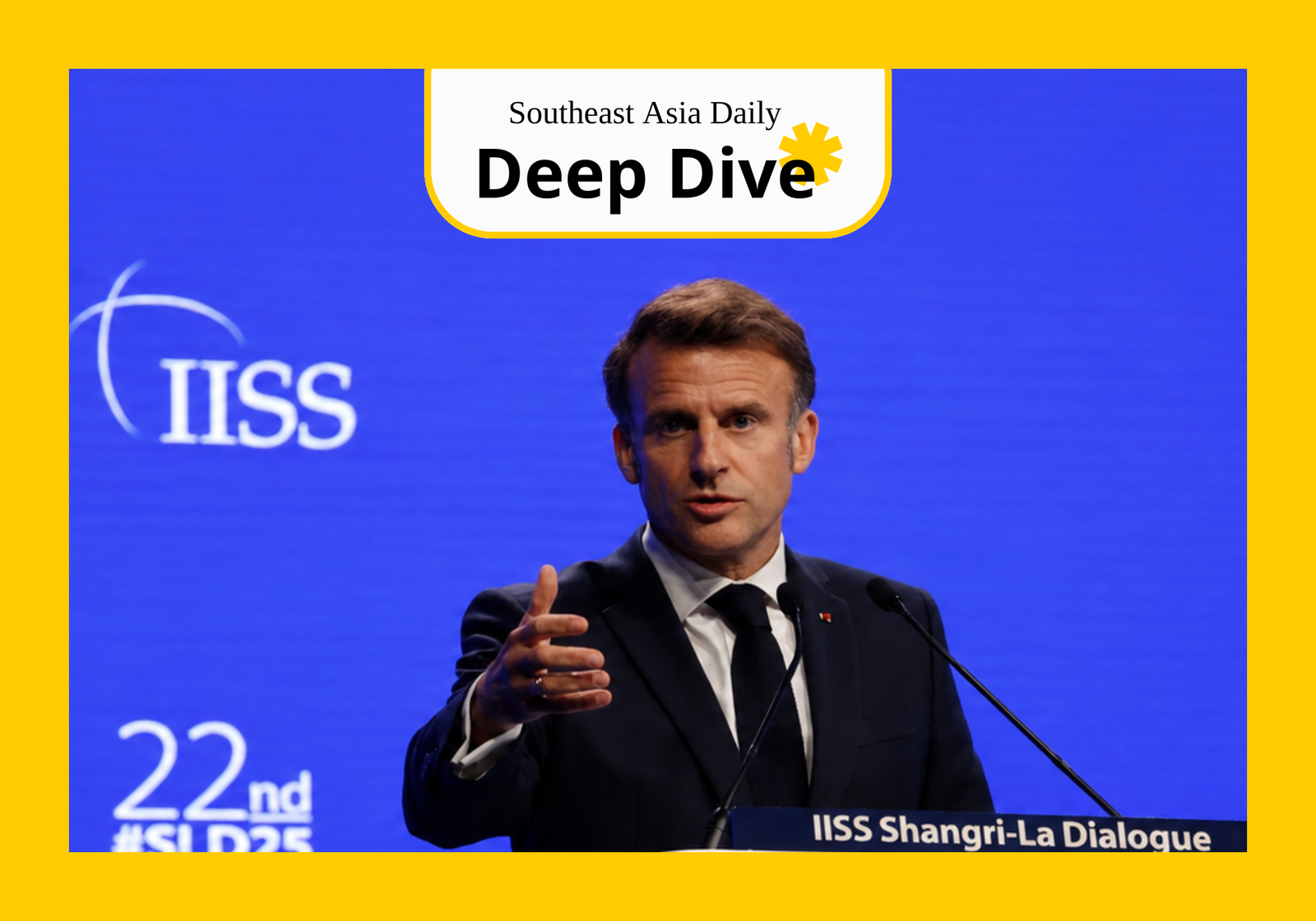
French President Emmanuel Macron at the 2025 Shangri-La dialogue in Singapore (AFP)
Paris Looks Southeast
On April 8, 2026, following the One Health Summit, French President Emmanuel Macron welcomed Cambodia’s Prime Minister Hun Manet at the Elysée palace for a private meeting. Both leaders expressed their ambition to deepen bilateral relations and to elevate the relationship to a strategic partnership this year. After the meeting, Macron also announced his intent to visit Cambodia in autumn 2026. A week later, on April 14, Macron received Indonesian President Prabowo Subianto in their second meeting in the last two months. They discussed the strengthening of bilateral strategic partnership, with mention of cooperation in the energy sector. A source close to the Presidential aide revealed to SEA Daily that President Prabowo is set to return to Paris in May, with defence equipment as the main point of discussions. It is noteworthy that Indonesia recently bought 42 Rafale jets and 2 Scorpène with cooperation in the energy sector was also mentioned.
These visits from two Southeast Asian leaders reflect the fruition of Paris’ continuing engagement with the region while illustrating France’s ambition to develop and strengthen partnerships with the region in a strategy of diversification in its partners. In 2025, during the CLEMENCEAU Mission, Paris deployed the French carrier strike group with the flagship Charles de Gaulle aircraft. The strike group’ maiden voyage to the Pacific and its port calls in Indonesia, the Philippines, Vietnam, Singapore and Malaysia signals France’s willingness to be a prominent actor in Southeast Asia. This naval mission was followed, few months later, by Macron’s visit to the region, making stops in Vietnam, Indonesia and Singapore. The Vietnam visit marked the first visit of a sitting French president in at least a decade. Meanwhile, in Indonesia, Macron and Prabowo agreed on an action plan to strengthen the bilateral strategic partnership by 2050 to commemorate the 100th anniversary of bilateral relations. In Singapore, Macron delivered the keynote address at the Shangri-La Dialogue, the most important inter-governmental security conference in Southeast Asia. There, he called for a new partnership between Europe and Southeast Asia with “mutual benefits”, expressing the necessity to foster strategic autonomy in an uncertain world where multilateralism and international order are contested by dominant powers. He did not miss the opportunity to promote France’s stance as the “third way” and “balancing power” amidst continuing US-China tension.
The “Third Way”

French aircraft carrier Charles de Gaulle in West Nusa Tenggara, Indonesia during the Clemenceau Mission in the first half of 2025. (ANTARA)
Macron’s charm offensive in Southeast Asia illustrates France’s diplomatic approach driven by the concept of “strategic autonomy”. With this strategy, Paris continuously seeks to maintain control over strategic sectors such as defence, energy or supply chains, avoiding overreliance on the US or the North Atlantic Treaty Organisation (NATO). Since 2016, the European Union (EU) has adopted a similarly self-reliant stance, reflected by the European Union Global Strategy. The serious undermining of the transatlantic relationship under the second administration of US President Donald Trump has demonstrated the importance of this approach.
Therefore, France’s foreign policy must be understood in a European context. As China and the US seem to be locked in a Thucydides’ Trap, France advocates for a “third way” approach, positioning the EU and France as reliable partners, engaged in protecting a rule-based international order, economic liberalism, multilateralism and freedom of navigation. This approach, defended by Emmanuel Macron during his address at the Shangri-La Dialogue, is well received in Southeast Asia, which is the cradle of the non-aligned movement and the 1955 Bandung conference, as well as the frontline of US-China influence operations. Taking advantage of this arrangenment, bilateral free-trade agreements have been signed or are under negotiations between the EU as a whole and ASEAN countries: Singapore (signed in 2014), Vietnam (signed in 2016), Indonesia (negotiations started in 2016), Thailand (negotiations started in 2023), the Philippines (negotiations started in 2024) and Malaysia (negotiations started in 2025). Discussions for an EU-ASEAN free-trade agreement have also resumed since 2022, after a brief period of stall. Through these agreements, the EU and France aim to limit their dependency to the US or China in their strategic supply chains, highlighting the European Commission’s shift toward the “de-risking” strategy.
Apart from acting on behalf of the EU, France also seeks to protect its own national interests through its continued regional engagement. France was notably the first European country to adopt an Indo-Pacific strategy in 2019, which was updated in 2025. This strategy underlines the importance of this area, which covers Africa’s east coast all the way to insular Oceanian countries. France attaches a particular attention to this region as it considers itself as an Indo-Pacific resident power, especially given its sovereignty over overseas territories in the Indian Ocean (La Réunion, Mayotte, TAAF) and in the Pacific (French Polynesia, New Caledonia, Wallis-and-Futuna, La Passion-Clipperton) with 1.8 million French nationals and 90 % of France exclusive economic zone (EEZ). While France doesn’t have territories in Southeast Asia proper, military deployment in the region such as PEGASE, CLEMENCEAU or JEANNE D’ARC missions help to secure key support points, a necessity to reach French overseas territories in Oceania, and to strengthen cooperation with local armed forces. Apart from security interest, France also looks to boost exports through various initiatives in Southeast Asia, as one of the world’s fastest growing markets. This is seen as a necessary step as Paris faces a longstanding trade deficit, standing at 81 billion euros in 2024 (6,4 billion euros with ASEAN). Aeronautics, with the success of Airbus’ A320 exports in Southeast Asia, and electronics and informatics are the two most important growing sectors of French exportations in the region, representing 13% each, while luxury, a historic pillar of French exports is facing difficulties with a contraction of 33% for leather goods or 18,6% for perfumes in the first trimester of 2025.
Limited Means and Competing Priorities

French Prime Minister Sebastien Lecornu speaking at the National Assembly in Paris, France (Reuters)
Nevertheless, France’s ambitious vision in the region covers the harsh reality of limited resources to achieve those goals. For instance, France is facing financial difficulties with an annual deficit around 5% of its gross domestic product (GDP) and a global debt reaching 117.4% of its GDP. Furthermore, while France operates an embassy in every ASEAN member state, except Timor Leste, its diplomatic network is limited compared to the likes of the US and China. To make matters worse, France’s Ministry of Foreign Affairs continues to receive lower state funding. Furthermore, France’s increasing military cooperation with Southeast Asian nations translates to a frequent deployment of military assets to the region; a costly operation France cannot maintain permanently. While deployments from permanent forces based in New Caledonia or French Polynesia are more affordable, they consist only of limited forces without first rank vessels or fighter jets. Moreover, France’s domestic political instability limits the government’s capacity to manoeuvre, while uncertainty around the 2027 presidential elections undermines the credibility of France’s position on the international scene.
Lastly, while France’s intention to deepen its relations with Southeast Asia is genuine, this region remains overshadowed by more pressing priorities, namely the Russo-Ukrainian war, the war in the Middle East and the deepening of European construction. Consequently, since the beginning of the war in Iran, most of the French navy first rank vessels are deployed in the Mediterranean Sea, the Red Sea and the Arabic Sea, leaving no option for a major deployment in the Indo Pacific region, with even a planned fleet review commemorating the French Navy’s 400-year anniversary cancelled. Likewise, the 2025 PEGASE mission, an annual deployment of the Air Force in the Pacific, was redirected to northern Europe to reassure partners in the region against Russian and American threats. Economic, human and cultural exchanges between France and the region also remain limited. ASEAN represents only 3% of France’s annual imports and 2.4% of its exports, ranking 6th commercial partner behind the European Union, the US, China, the United Kingdom and Switzerland.
In sum, France’s intention to strengthen its relationship with ASEAN countries is sincere, primarily to secure Paris’ and the EU’s strategic autonomy. However, despite reciprocation from Southeast Asian governments, the ties are challenged by the distance between the two regions, the uncertainty of global context and the instability of France domestic politics. Agreements and state visits have set the stage, but France’s strategic relevance in Southeast Asia will ultimately rely on its ability to turn declarations into sustained presence, which is a process made harder by fiscal strain, competing theatres and domestic political uncertainty.
About The Author