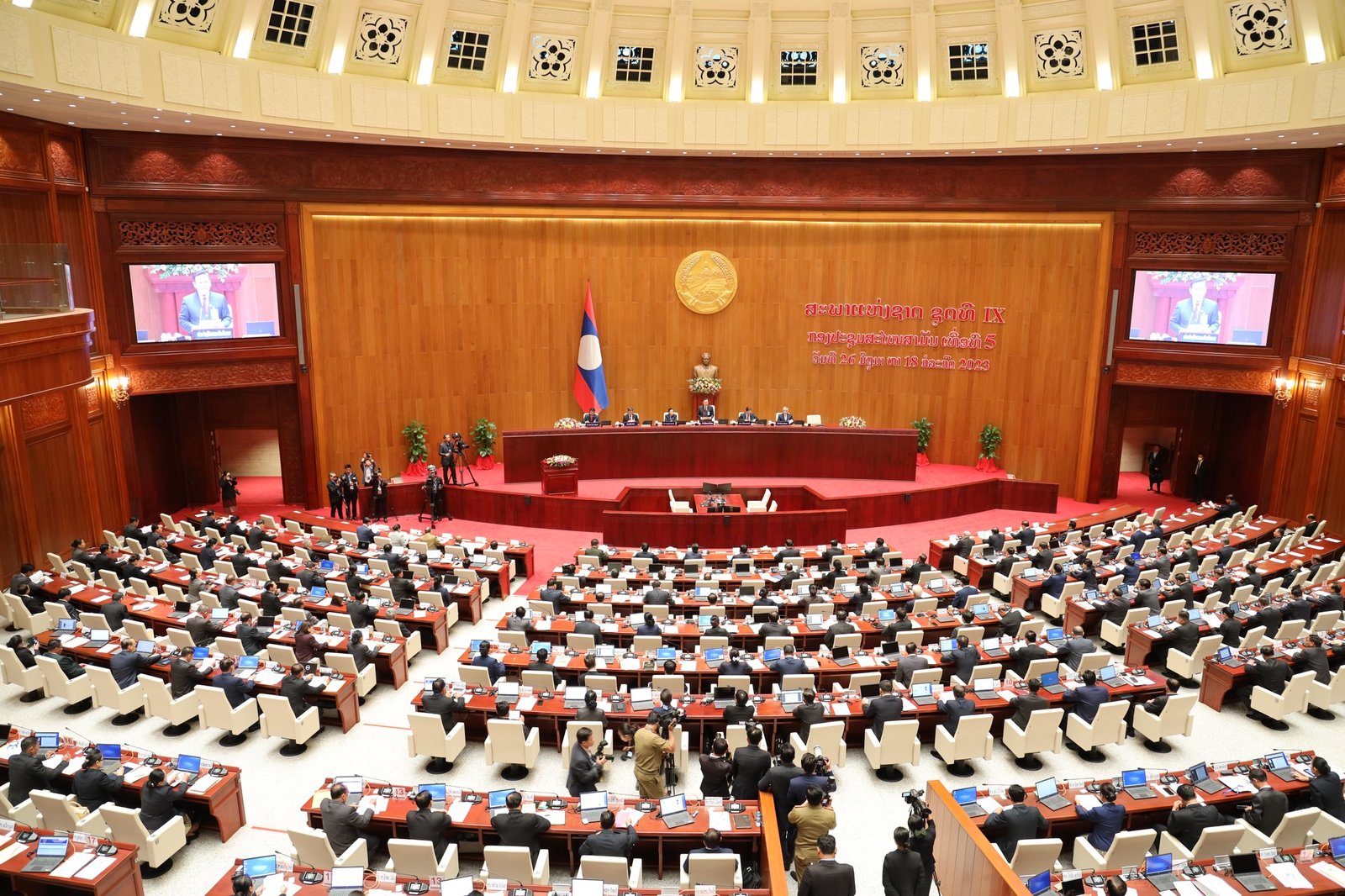
Thai Prime Minister Anutin Charnvirakul and new cabinet ministers take an oath in front of King Maha Vajiralongkorn at Dusit Palace in Bangkok, Thailand, April 6, 2026 (Bureau of the Royal Household).
Continuity Over Change
On April 9, Thai Prime Minister Anutin Charnvirakul delivered his government’s policy statement to parliament. His ambition can be summed up in a single sentence: “to build a stronger Thailand”. This roadmap is hardly surprising coming from a politician from the conservative camp. It has, however, been undergoing a major strategic transformation for some time now, and Anutin is one of the leading figures in this shift.
A month ago, following the dissolution of the Thai National Assembly last December—a decision taken by the conservative Prime Minister Anutin Charnvirakul—early elections were held. Many commentators had expected a victory for the progressive and reformist People’s Party. However, it was Anutin’s Bhumjaithai Party that emerged victorious and strengthened, securing 193 of the 500 seats in the lower house, House of Representatives (up from just 71 previously). The early elections had, however, been a demand of the opposition People’s Party, which had hoped to replicate its performance in the 2023 elections, where it had defied polls and came out on top. Back then, representatives of conservative circles had succeeded in having that victory overturned and in having several members of the People’s Party declared ineligible. Nevertheless, after further twists and turns—a hallmark of political life in Southeast Asia—the People’s Party finally agreed to support the ruling Anutin’s coalition on the condition that it call for early elections and for a referendum about constitutional reform. When the result of the vote was announced, the disappointment must therefore have been bitter for the People’s Party. It is nevertheless important not to stop at this observation and to attempt to identify the various factors that led to the conservative camp’s victory.
Various commentaries on the Conservative Bhumjaithai Party’s landslide victory, which enabled outgoing Prime Minister Anutin to extend his term at the head of the government, have paid relatively little attention to the two other elections held on that day. It is true that the Bhumjaithai Party’s victory in one of the votes was decisive in both the legislative and executive spheres. With a single-member majority voter system, it involved electing constituency representatives to the Parliament. The second election, which allocated only 100 of the 500 seats in the House of Representatives, was a proportional representation system. For this second ballot, voters were not required to choose between local candidates but to select a list proposed by the political parties. It was therefore possible to vote for a party’s local candidate and, for the other ballot, to choose a list from a different party. The focus was on representativeness in the first case and on support for ideas in the second. Finally, moving even further away from forms of representativeness, a referendum was also held on whether or not the constitution should be revised.
The Bhumjaithai Party, with 9,993,777 votes—or 29.92% of the votes cast—came out well ahead in the first ballot, which gave it a large number of elected representatives (174 seats) and thus the opportunity to form a coalition government with other parties. However, it was beaten by the progressive People’s Party (9,802,658 votes, 29.70%) in the second ballot, which yielded fewer seats (only 31 seats won by the People’s Party).
In the first ballot, the disparity between the number of votes received by each party and the number of seats won was not proportional. The People’s Party received 7,864,475 votes and won 87 seats, whereas the Bhumjaitahi Party, with just 9,993,777 votes, won twice as many seats—174. The latter won a very large number of constituencies with few voters, whereas the People’s Party won in constituencies with a large number of voters (over 800,000 in Bangkok, for example) but which yielded few seats (only 33 for Bangkok). As is the case worldwide, the progressive People’s Party won in densely populated urban areas, but performed much less well in the vast majority of constituencies, which are less populated and operate on forms of legitimacy and competence that differ from those of cities. Electoral geography matters in Thailand, as it does elsewhere.
The overwhelming ‘yes’ vote (58.64%) in the referendum is largely down to the People’s Party, as this was one of its long-standing demands.
Pragmatic Conservatism and the Politics of Influence
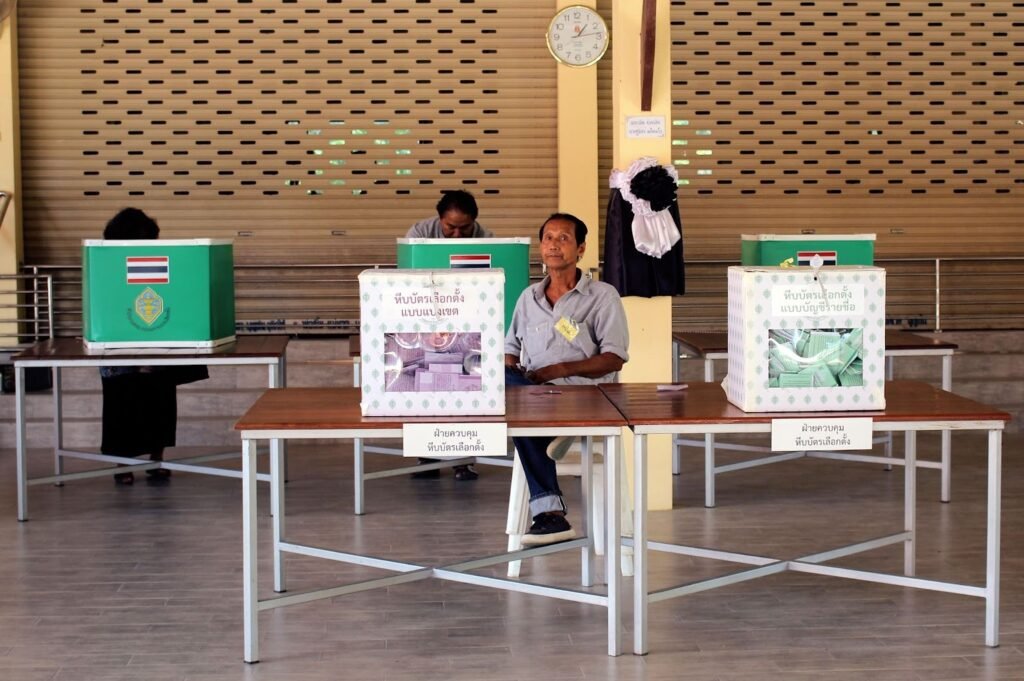
Ballot boxes during the 2023 general election in Thailand (Wikimedia)
This focus on the arithmetic of votes minimises the People’s Party’s defeat, puts into relativity what some have called the ‘blue wave’ or the ‘conservative turn’, and draws attention to the nature of voters’ preferences. A hasty assessment might conclude that Thai voters are contradictory, as many voted for one party in one ballot and for its rival in the other. In reality, they reacted to the way in which the electoral options were presented to them. Voters can be conservative in certain areas—such as the way of ‘running the affairs’—and progressive in others when seeking remedies for the imperfections of public life or rejecting injustices. In another way, Thais may have considered that the Bhumjaithai Party and People’s Party were not on entirely opposing sides, that their positions could be compatible, or even complementary. Ultimately, in their minds, these two parties were less opposed to one another than they were simply talking about different things, on different scales.
Bhumjaithai’s central role has been established locally, within constituencies (such as in Buriram), but also nationally through a unified network system. A web of connections where mutual interests converge and where a focus on the “running of affairs” through the exercise of influence predominates. “Running of affairs” encompasses both what is defined as administrative concern—presented as rigorous and efficient—and an informal way of handling local affairs, resolving conflicts, and establishing a “clientelistic” relationship. In both cases, influence is gained when the position and role held are central to the local ecosystem. The advantage often goes to incumbents who benefit from reputation, patronage opportunities, local influence and name recognition. From this perspective, Anutin has very effectively positioned himself in a way that keeps his competitors at a distance from the spheres of influence most widely recognised as decisive for the daily lives of Thais.
To make the leap from the local to the national politics, he had to consolidate his forces. Anutin forged coalitions and maintained his leadership, while attracting key figures from civil society and technocrats, as well as potential rivals who rallied to his side. He has long possessed this expertise. The Prime Minister has, in fact, been involved in “every major coup” that has allowed him to position himself at the heart of Thai power, whether it was dominated by the populist Shinawatra clan and the Pheu Thai Party, or—following the latter’s decline—by General Prayut’s junta. He perfectly embodies the lability of Southeast Asian politicians.
Anutin supports meteoric rises, forms alliances with former rivals, expands his ministerial portfolios, and builds networks. What matters most to billionaire Anutin is staying in the spotlight by giving the impression that he is the only one capable of defusing tensions and resolving conflicting positions. Pragmatically, as prime minister, Anutin carried out reshuffles within the Ministry of the Interior, appointing senior officials who were favourable to him. In doing so, he increased Bhumjaithai’s influence and power in key areas for the upcoming election. This network was possible because he possessed leverage through his position within the executive branch—a managerial role that People’s Party representatives had not attained. This strategic positioning not only garnered voter support but also, in the run-up to the elections, secured the backing of prominent figures within Thai society, including technocrate Commerce Minister Supajee Suthamphun. The prospect of his re-election became synonymous with keeping these figures in power. This move to bolster credibility also led to no fewer than sixty members of parliament switching parties. For this new election, they left their parties to join the Bhumjaithai Party.
Anutin and Bhumjaithai’s proactive strategy consisted of a highly cunning control of the legislative and executive spheres in the run-up to the elections. The terms to best explain this tactic are ‘centrality’ and ‘position of influence’, both of which explicitly refer to the conservative imaginary. At various levels of the Thai public sphere, Anutin and his party have managed to occupy a central position synonymous with influence. The benefit of this positioning is that it relegates competitors to the periphery, without any real influence. Influence is a key factor in understanding the Thai people’s choice.
Nationalist conservatism has long been embodied in Thailand by a large number of small parties with strong ties to the military, which formed coalitions as circumstances dictated, particularly to prevent their opponents from coming to power. It has often appeared to be a reactive force. In recent years, the conservative camp has not hesitated to intervene in the public sphere with the aim of controlling or undermining the democratic process in the name of safeguarding higher principles (such as those of the monarchy) which, in their view, ensure the country’s unity and stability. In the conservative national imagination, these principles are unique and intangible. Protecting them is a ‘sacred’ mission often undertaken by the military. The unity of royal, military and religious functions is supposed to be the most effective formula for resolving all the nation’s problems. Therefore, preserving it therefore appears to be a more important duty than that of social justice, for the latter, in conservative thinking, flows from the former. Social justice is an emanation of the unity of the monarchy and the state. Order creates justice. The proliferation of coups, the annulment of elections and the dissolution of parties is an expression of this dynamic, which could be described as authoritarianism presented as benevolent and protective.
The achievement of Anutin and the Bhumjaithai Party is maintaining this paternalistic political narrative whilst toning down the most overt (and therefore most likely to be contested) forms of authoritarianism. This tactic allows conservatism to achieve the electoral support it used to lack.
This situation stems from a shift within conservatism, moving away from direct interventionism to defend interests towards a search for a political centre that is less polarising. This transformation, which is more strategic than ideological, has enabled it to remain in power through democratic means. In the context of Thailand’s history, it represents a remarkable achievement for the conservative camp.
Anutin’s conservatism therefore swaps an uncompromising and unyielding approach for a semblance of pragmatic consensus that eliminates the possibility of more radical change. The martial, nationalist rhetoric remains, but it is directed towards the external enemy, which in the case of the February elections was Cambodia, with whom a border conflict has broken out. This tactic appeals to voters, who see in it strength and stability. It also appeals to the oligarchs (businessmen, the military, monarchists) because it allows them to preserve their privileged positions without having to resort to anti-democratic ‘coups’ that provide ammunition for the progressive opposition.
Lessons in Continuity and Control
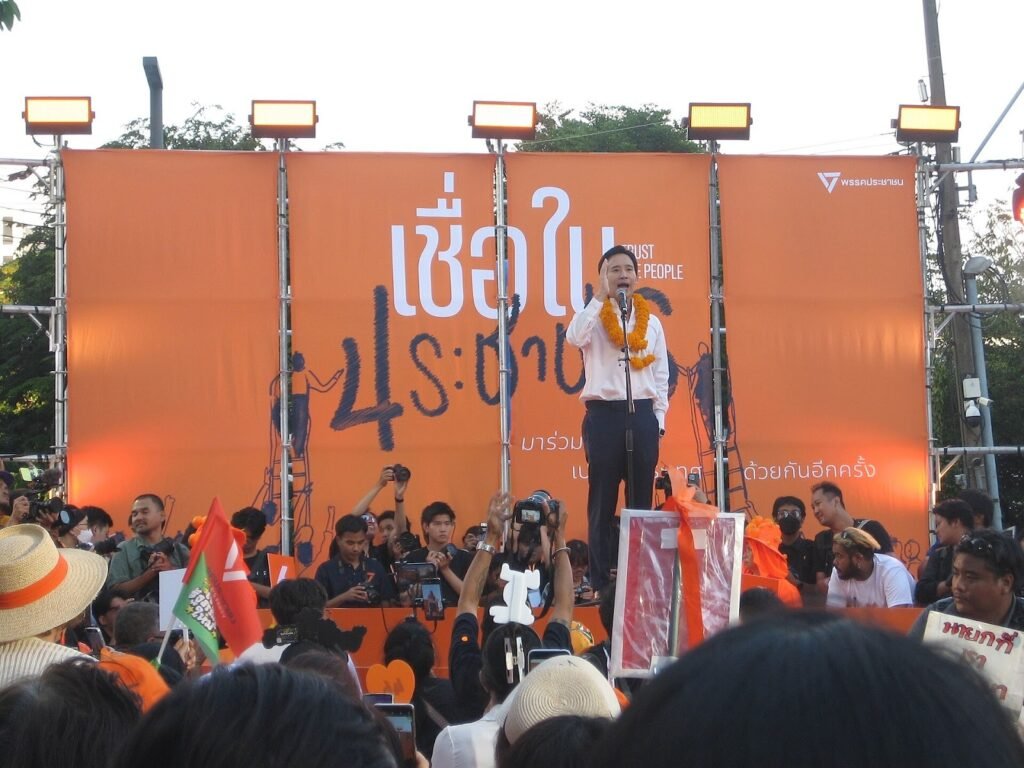
A major rally and campaign march by the People’s Party, under the campaign “Believe in the People,” moved from Siam Square toward Samyan Mitrtown in preparation for Thailand’s general election of members of the House of Representatives in 2024 (Wikimedia)
The February election was marked above all by a lack of turnover among political figures. Of the constituencies where the winning party changed between 2023 and 2026, 39% were not actually won by newcomers, but by incumbents who switched parties.
In constituencies where the same party held the seat across two elections, 93% of the winners were incumbents. Approximately 20% of constituencies where the winning party changed were also held by candidates from political families, indicative of voting patterns centered on candidates rather than parties.
This point demonstrates the enduring power of the Thai oligarchy. Typically wary of democratic movements, it appears that from now on, the group comprising entrepreneurs and military figures with conservative and nationalist values not only tolerates this type of citizen participation but even sees a benefit in taking part in it. The immediate, common-sense explanation for this phenomenon is that the oligarchy’s shift toward respecting the ballot box stems from the fact that the election outcome is now favorable to them. It allows the oligarchy to avoid having to override the election results, to avoid having them invalidated after the fact, and thus, in a certain sense, to find legitimacy in this process.
Polls will never fully capture the trends and dynamics within political parties. Thus, it seemed clear that the Bhumjaithai Party was gaining momentum in consolidating and expanding its base and support, while the People’s Party was, conversely, losing influence. Thus, the decision by People’s Party leaders to support Anutin’s government may have created confusion and bewilderment among supporters of a party that was ideologically built to oppose the fickleness of politicians, in order to maintain a solid ideological foundation centered on the principle of clarity and the avoidance of confusion regarding political allegiances. It would thus be interesting to see the electoral consequences of the People’s Party leadership’s tactical choice and the risk taken by blurring the lines of reference for their traditional voters. The pre-election rallying behind Anutin’s government was, at the same time, an implicit acknowledgment not so much of a partnership between the People’s Party and the Bhumjaitahai Party, but of the latter’s central position. The People’s Party leaders, for their part, believed that by supporting the Anutin government, they would secure a guarantee of early elections in the support agreement. In short, the People’s Party remained on the sidelines, biding its time, while Bhumjaithai garnered importance and legitimacy.
About The Author