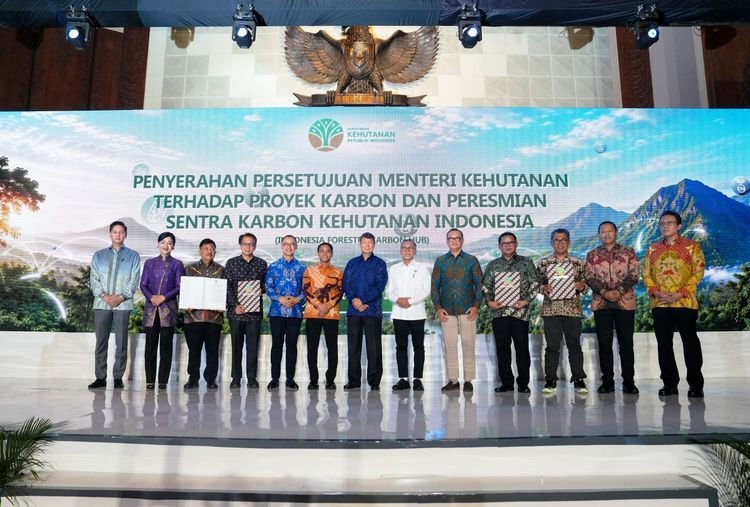
The launch of the Indonesia Forestry Carbon Hub in Jakarta, Indonesia, on July 6, 2026. (Indonesian Ministry of Forestry)
In his remarks, Special Envoy for Climate and Energy, Hashim Djojohadikusumo, stated that the ultimate goal of the hub is to help attract international buyers to finance the restoration of 12.7 million hectares of degraded Indonesian land.
Speaking at a subsequent press briefing, Forestry Minister Raja Juli Antoni explained that the government has issued carbon asset approvals to four pilot projects spanning roughly 225,000 hectares. These include three private forest concessions (PT Global Alam Lestari, PT Rimba Makmur Utama and PT Mohairson Pawan Khatulistiwa) alongside one pioneering community project in Jambi province, Sumatra.
He further emphasised that this setup is projected to generate up to 30 million tonnes of CO2 equivalent in cuts, converting into 5 trillion Indonesian rupiah (279 million US dollar) in transactions and another 500 billion (27.9 million US dollar) in non-tax state revenue. He affirmed that such vast potential can only be maximised if managed properly and accountably.
“In such governance, Indonesia’s forests can become greener while serving as a new source of economic growth. The green economy is one of the new engines of growth expected to support the 8% national economic growth target,” he added.
To achieve this, the minister elaborated that this coming July 9, the government is preparing to launch the Carbon Unit Registry System (SRUK). This will enable an Automated Data Flow (API) to connect data from the Verra Registry (the world’s largest tracking system for voluntary carbon credits), SRUK and the Indonesia Stock Exchange (IDX) using blockchain technology. Such a system guarantees absolute transparency and end-to-end traceability.
What does this mean for businesses?
This launch provides immediate regulatory certainty for project developers, enabling them to convert forestry and land concessions into monetisable, blockchain-verified environmental assets. By integrating with the global Verra Registry and IDXCarbon, this framework allows international buyers to securely acquire high-integrity credits while eliminating double-counting risks.
For domestic industries such as energy and mining, this rollout establishes necessary infrastructure for imminent compliance. Businesses must now integrate carbon accounting to prepare for mandatory emissions caps and taxation, moving from voluntary initiatives to legal compliance on the Indonesia Carbon Exchange.
Kala Advisory helps investors move on openings like these as Southeast Asia builds out carbon markets and green-asset infrastructure. Visit kala-advisory.com.
About The Author