
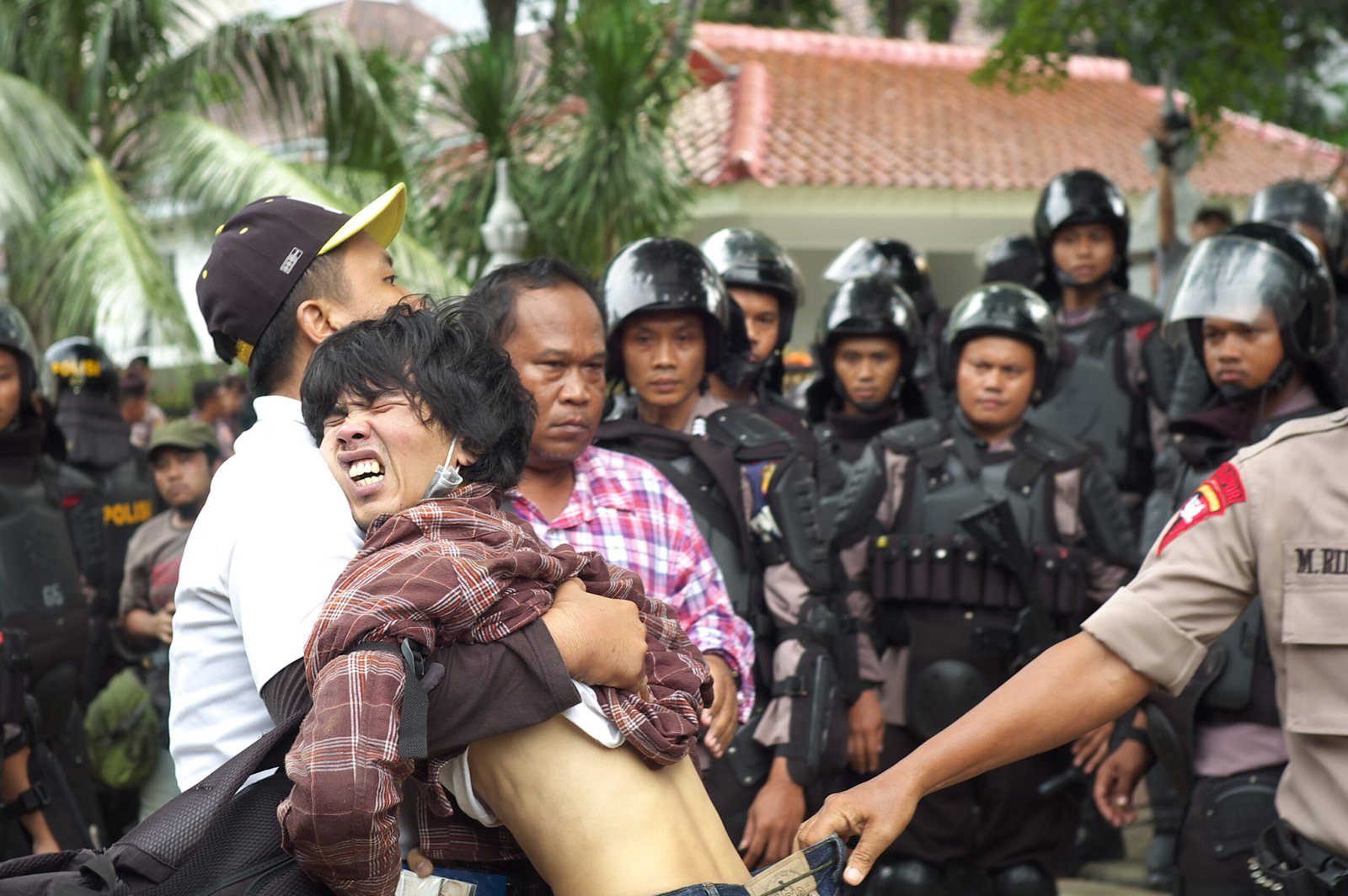
A suspected provocateur is dragged from the crowd after tensions flare between police and the KASBI Labour Union, with bottles thrown but no injuries as both sides quickly de‑escalate. (Wikimedia)
The Indonesian House of Representatives passed a revised version of the Indonesian National Police (Polri) Law during a plenary session on June 9. Facing no objection in the parliament, the law was unanimously adopted, amending the previous regulation, Undang-Undang Nomor 2 Tahun 2002. This law aims to strengthen professionalism in policing and reinforce the principle of a civilian police force.
He added that the bill is expected to meet national legal needs and accelerate National Police’s transformation into a professional, accountable and trusted institution. He also underlined that the “drafting [process of] the National Police Bill has absorbed broad public input and participation (meaningful participation) from its drafting to its deliberations”,
The revision expands Polri’s authority in the cyber domain, granting powers over security, supervision and regulation of cyberspace (including the ability to block or cut access to safeguard domestic security).
The new law also permits high‑ranking officials to enter civilian institutions without retiring, a regulation that has sparked significant debate over meritocracy and the encroachment of security actors into civilian matters. Another major change concerns age limits: “60 years for members of the National Police, and 65 years for functional officials, in accordance with statutory provisions for those positions.”
Some non-governmental organisations (NGOs) criticised the mechanisms, arguing the ratification was considered too hasty, bypassing the formal processes. Moreover, analysts warn that Polri couldl become a superbody institution possessing an immense exercise of power, under the new law.
This ratification contradicts a Constitutional Court ruling in November 2025 that annulled the phrase “or not based on an assignment from the Chief of Police”. To date, 4,300 active personnel outside the policing function. This new law gives tremendous space for high-ranking officers to occupy positions across ministries or governing bodies at the same time.
The reform agenda for Polri remains contested. As the National Human Rights Commission (Komnas HAM) noted, Polri is the institution most frequently complained about, with 1,201 cases due to procedural errors, and 167 cases of violence or torture. This ratification presents both challenges and opportunities. While the law gives extra education for police cadets an exposure to democratic and human rights curriculum, it also poses significant concerns over the reinforcement of aggressive policing and the undermining of democratic consolidation.
About The Author




One thought on “Indonesian Parliament passes new Police Law, expanding cyber powers and civilian roles”