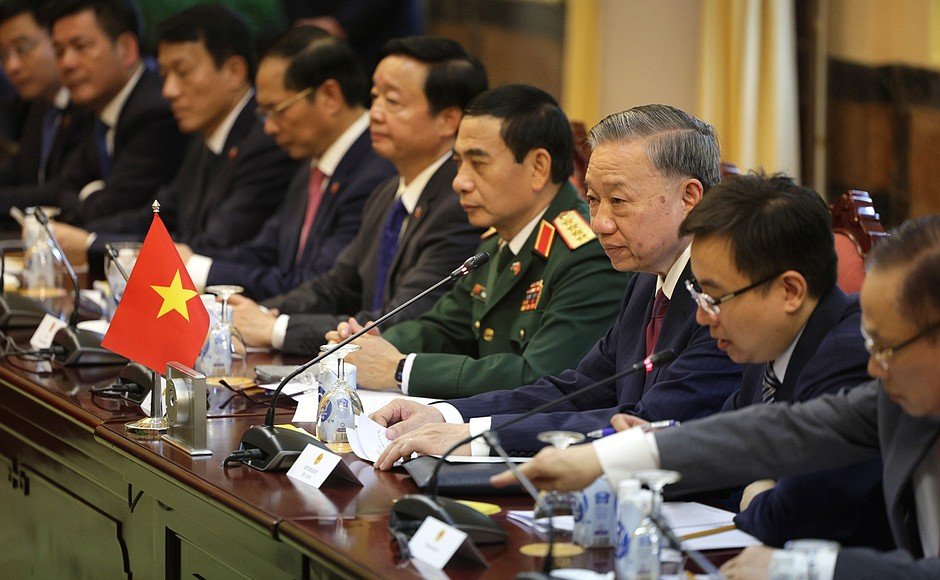
Vietnamese President and Party General Secretary Tô Lâm meets Russian President Vladimir Putin during Russia–Vietnam talks as part of Putin’s state visit to Hanoi. (Office of the President of the Russian Federation)
Vietnamese President and Communist Party of Vietnam (CPV) Secretary General, Tô Lâm, announced a new set of development and foreign policy priorities on June 11, signalling a strategic shift aimed at boosting domestic potential while playing an active role in regional and world affairs.
Domestically, the government pledged to focus on the “crucial and ongoing” role of foreign affairs, putting it on par with national defence and security. Sourcing from Vietnam’s Politburo Resolution No. 06-NQ/TW, President Tô Lâm emphasised “new phase to shift from a diplomacy protecting development space to a diplomacy building national development capacity,” underscoring the administration’s commitment to equity and growth.
On the foreign policy front, Vietnam outlined plans to realise its character, identity and stature globally. Officials confirmed that new intersections between strategic sectors in the country will be strengthened in order to build resilience for its position at both the regional and global level.
The speech also highlighted the upholding of the “security-development belt”, positioning Hanoi as maintaining a cordial relationship with its neighbouring countries. By building political trust and strategic connectivity in key sectors like infrastructure and technology, Hanoi intends to work closely together to secure borders, handle water and space challenges and peacefully resolve all disputes. Moreover, the resolution implementation underlines the commitment to rule-based orders, particularly adherence to the existing constitution of the oceans, the United Nations Convention on the Law of the Sea (UNCLOS).
Analysts noted that the convergence of domestic development goals with foreign policy ambitions reflects sustainable development and green growth, underscoring how Vietnam is seeking to attract foreign direct investment (FDI) while gaining access to international climate finance.
This came to the fore, bearing in mind the Resolution No. 24-NQ/TW which was established on June 3, 2013 by the 11th Party Central Committee of the CPV. As a national strategy for a proactive model centred on environmental governance, this framework is used to balance the economic trajectory and emission reductions.
Taken together, the implementation of directives suggests that Vietnam is entering a new phase where national development priorities are carefully aligned with foreign relations. This signals Hanoi’s aim to reach strategic autonomy and self-reliance while maintaining a cautious positioning through its “Four Noes”, namely preventing Hanoi from making military alliances, aligning with one country against another, hosting foreign military bases on its territory and using coercion.
About The Author