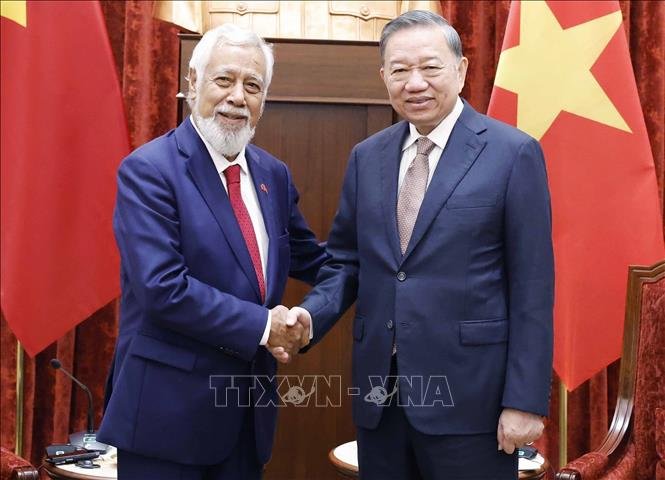
Party General Secretary and State President Tô Lâm hosts a reception in Hanoi on June 10 for Timor‑Leste Prime Minister Kay Rala Xanana Gusmão, who is on an official visit to Vietnam and attending the third ASEAN Future Forum (AFF) 2026. (VNA/Thống Nhất)
Timor Leste’s Prime Minister, Xanana Gusmão conducted a formal visit to Hanoi from June 7 to 10, meeting his counterpart Prime Minister Lê Minh Hưng. The visit aimed to explore new strategic sectors and advance bilateral relations, marking a significant step forward in a relationship that stretches back to the establishment of diplomatic ties in 2002.
Both governments announced that Timor-Leste and Vietnam will formally elevate their bilateral relations next year, coinciding with the upcoming 25th anniversary of their diplomatic ties.
During a talk with Vietnamese President Tô Lâm, Hanoi pledged to strengthen bilateral ties, promising deeper cooperation in trade, investment, education and defence. The leaders also discussed Timor‑Leste’s ASEAN accession, with Vietnam affirming its support for the country’s development trajectories, including the Congress for Timorese Reconstruction (CNRT).
On the economic front, the summit advanced talks on a Bilateral Trade Agreement. The two sides committed to advancing bilateral trade and leveraging mutual strengths, with both agreeing to expand joint efforts in agricultural goods, manufacturing, telecommunications, digital transformation and infrastructure projects.
Moreover, the Vietnam–Timor-Leste Joint Committee, to be overseen by the two foreign ministers, will be established to address matters of mutual interest. Prime Minister Xanana also proposed establishing a Vietnam–Timor-Leste Industrial Park (V-TIP) in Dili, envisioned as a hub and joint venture to attract manufacturers and boost industrial growth.
Beyond economics, both sides agreed to deepen cooperation in development, health, education, people-to-people ties, climate, digital economy, maritime cooperation and natural resources and mining. Agreements included a visa exemption arrangement and a memorandum of understanding on higher education cooperation.
Beyond the bilateral agenda, both leaders addressed adherence to institutional arrangements and frameworks, specifically pledging support for the United Nations, ASEAN and other international forums. They also discussed regional volatility, pledging to secure stability, cooperation and development. Parliamentary cooperation also featured in the talks, signalling a shared vision for strengthening government-to-government ties while also building each countries’ legislative capacity.
This visit reflects Hanoi’s preference and high-priority of its special relationships with its Southeast Asian counterparts. With the deepening of bilateral relations with one of Southeast Asia’s newest and smallest nations, Hanoi signals its vision for inclusive regional connectivity.
About The Author