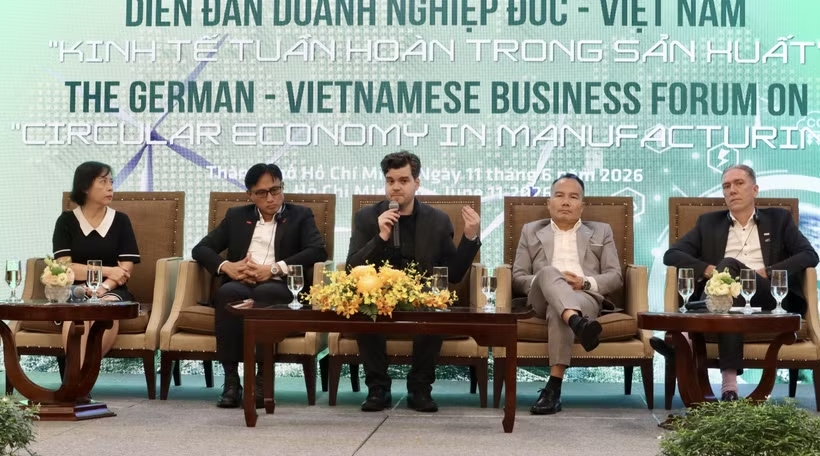
Representatives from Vietnam and Germany during the 2026 Germany-Vietnam Business Forum in Ho Chi Minh City, on June 11. (Vietnam News Agency)
The 2026 Germany-Vietnam Business Forum commenced on June 11 in Ho Chi Minh City, Vietnam. Co-organised by the Ho Chi Minh City Investment and Trade Promotion Centre (ITPC) and the German Business Association (GBA), the bilateral meeting focused extensively on the theme “Circular Economy in Manufacturing”.
German Consul General in Ho Chi Minh City, Andrea Suhl, noted in her opening remarks that Vietnam is entering “a promising new phase of economic growth and modernisation,” pointing to the country’s ambition to reach a high-income status by 2045. To achieve this, she emphasised, Hanoi cannot solely rely on investment; it must undergo a “fundamental shift” towards resource efficiency and circular economic models”.
She further explained that the circular economy is now a vital instrument to safeguard production and bolster economic resilience amid supply chain disruptions and growing uncertainties. The diplomat affirmed that Germany remains ready to support Vietnam’s long-term growth.
In response, Deputy Director of ITPC, Cao Thị Phi Vân, steressed Hanoi’s strong commitment to this transformation, noting that German technological expertise is an exemplary fit with Vietnam’s manufacturing capabilities. She asserted that such collaboration will create job opportunities in green technology and eco-industrial park development.
Crucially, Chairman of the GBA in Vietnam, Alexander Ziehe, underscored that Vietnam, in particular Ho Chi Minh City, is “well positioned” to integrate circular economy solutions. By doing so, he added, Vietnam is set to enter the next stage of industrial development.
Echoing these executive perspectives, business leaders concurred that a shift towards sustainable manufacturing is non-negotiable. They noted it is no longer merely an environmental issue, but a structural necessity to cope with digitalisation and supply chain optimisation.
What does this mean for business?
In the first five months of 2026, Vietnam experienced a remarkable surge of over 30% in total registered foreign investment. While this influx is a highly positive indicator, strategically managing and absorbing this capital will ultimately determine whether Hanoi can successfully realise its ambition of becoming a high-income nation by 2045. To effectively digest these investments, both policymakers and enterprises must prioritise substantial funding for human resource development and the rapid deployment of circular economy solutions.
Adopting these sustainable models will not only enhance Vietnam’s domestic economic resilience and generate widespread green employment opportunities, but it will also significantly upgrade the country’s position within global value chains. This structural transition has become an operational mandate, particularly as major investor regions like Germany and the wider European Union enforce increasingly strict Environmental, Social and Governance (ESG) compliance standards. Consequently, Vietnamese suppliers must seamlessly integrate digitalisation and sustainable manufacturing practices to secure their roles in modern international trade networks.
Kala Advisory helps investors move on openings like these as Southeast Asia shifts toward green, ESG-aligned manufacturing. Visit kala-advisory.com.
About The Author